 Add to Chrome
 Add to Firefox
 Add to Edge
MDTransformer: A Hardware-Software Co-Design of Mode-Division Photonic Transformer Accelerator with Inverse-Designed Coherent Crossbar
Jul 28, 2026
Recently, photonic transformer accelerators (PTAs) have successfully achieved significant speedup and energy efficiency improvements over electronic accelerators for expediting Transformer inference. However, state-of-the-art rely on expensive multi-wavelength light generation and large dot-product units due to active phase-shifter components, thus making their approach inefficient and impractical. To address this, we propose MDTransformer, a novel hardware-software co-design of PTA based on mode-division optical dataflow and operations. Specifically, MDTransformer performs complex matrix operations using spatial-mode interference, that leverages the inverse-designed multi-mode couplers, crossings, and Mach-Zehnder IQ modulators into a compact mode-division photonic tensor core (MPTC), capable of executing matrix multiplications in the optical domain. Its each guided mode (i.e., TE0-TE3) acts as an independent computational lane, enabling four-fold parallelism-per-waveguide without spectral filtering or free-spectral-range limitations. Moreover, its coherent detection and IQ modulation jointly encode amplitude and phase, realizing complex-valued arithmetic for full-range operations in transformers. MDTransformer offers analog multiplication with sub-4-bit effective precision and inter-modal crosstalk below -30 dB. Its inverse-designed approach also offers scalable and full compatibility with single-laser continuous-wave operation at 1550 nm. Experimental results show that MDTransformer achieves 40.4% area reduction, 63.6% power saving, 40.6% energy saving, and comparable latency over the state-of-the-art PTA across different workloads (i.e., DeiT-Tiny/Small/Base and BERT-Base/Large). These results show that MDTransformer offers a practical solution for high-performance and energy-efficient transformer-based systems.

Arabian Horse Identification Benchmark Dataset
Jun 15, 2017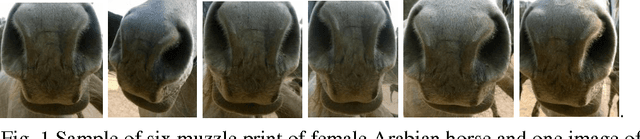

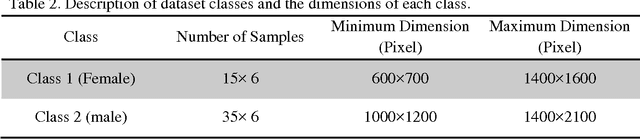
The lack of a standard muzzle print database is a challenge for conducting researches in Arabian horse identification systems. Therefore, collecting a muzzle print images database is a crucial decision. The dataset presented in this paper is an option for the studies that need a dataset for testing and comparing the algorithms under development for Arabian horse identification. Our collected dataset consists of 300 color images that were collected from 50 Arabian horse muzzle species. This dataset has been collected from 50 Arabian horses with 6 muzzle print images each. A special care has been given to the quality of the collected images. The collected images cover different quality levels and degradation factors such as image rotation and image partiality for simulating real time identification operations. This dataset can be used to test the identification of Arabian horse system including the extracted features and the selected classifier.