 Add to Chrome
 Add to Firefox
 Add to Edge
A Critical Look at the Current Usage of Foundation Model for Dense Recognition Task
Aug 01, 2023
In recent years large model trained on huge amount of cross-modality data, which is usually be termed as foundation model, achieves conspicuous accomplishment in many fields, such as image recognition and generation. Though achieving great success in their original application case, it is still unclear whether those foundation models can be applied to other different downstream tasks. In this paper, we conduct a short survey on the current methods for discriminative dense recognition tasks, which are built on the pretrained foundation model. And we also provide some preliminary experimental analysis of an existing open-vocabulary segmentation method based on Stable Diffusion, which indicates the current way of deploying diffusion model for segmentation is not optimal. This aims to provide insights for future research on adopting foundation model for downstream task.

Noisy Universal Domain Adaptation via Divergence Optimization for Visual Recognition
Apr 20, 2023To transfer the knowledge learned from a labeled source domain to an unlabeled target domain, many studies have worked on universal domain adaptation (UniDA), where there is no constraint on the label sets of the source domain and target domain. However, the existing UniDA methods rely on source samples with correct annotations. Due to the limited resources in the real world, it is difficult to obtain a large amount of perfectly clean labeled data in a source domain in some applications. As a result, we propose a novel realistic scenario named Noisy UniDA, in which classifiers are trained using noisy labeled data from the source domain as well as unlabeled domain data from the target domain that has an uncertain class distribution. A multi-head convolutional neural network framework is proposed in this paper to address all of the challenges faced in the Noisy UniDA at once. Our network comprises a single common feature generator and multiple classifiers with various decision bounds. We can detect noisy samples in the source domain, identify unknown classes in the target domain, and align the distribution of the source and target domains by optimizing the divergence between the outputs of the various classifiers. The proposed method outperformed the existing methods in most of the settings after a thorough analysis of the various domain adaption scenarios. The source code is available at \url{https://github.com/YU1ut/Divergence-Optimization}.
Recipe Generation from Unsegmented Cooking Videos
Sep 21, 2022
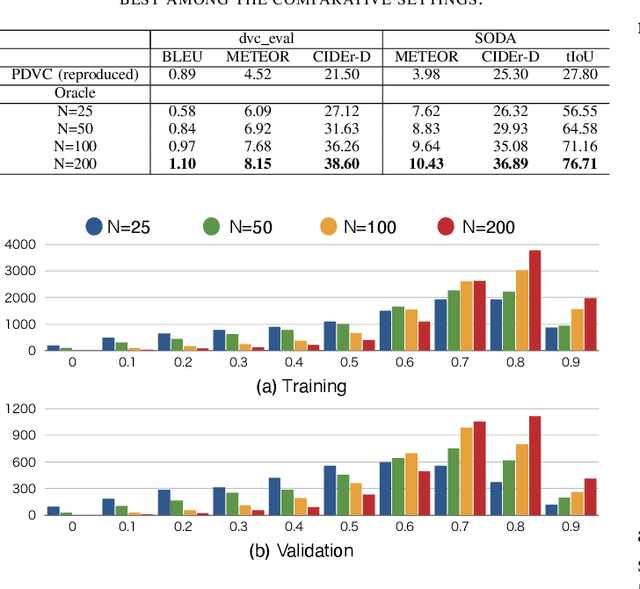

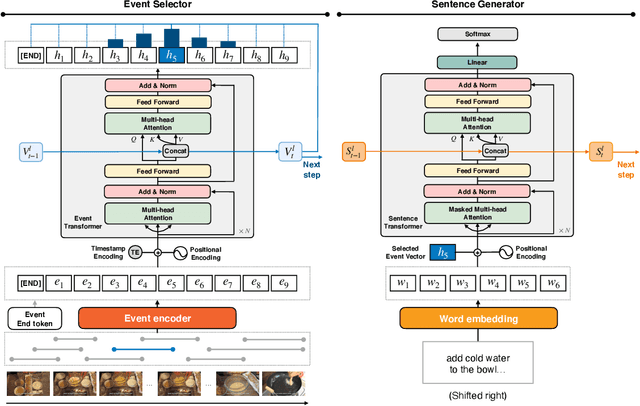
This paper tackles recipe generation from unsegmented cooking videos, a task that requires agents to (1) extract key events in completing the dish and (2) generate sentences for the extracted events. Our task is similar to dense video captioning (DVC), which aims at detecting events thoroughly and generating sentences for them. However, unlike DVC, in recipe generation, recipe story awareness is crucial, and a model should output an appropriate number of key events in the correct order. We analyze the output of the DVC model and observe that although (1) several events are adoptable as a recipe story, (2) the generated sentences for such events are not grounded in the visual content. Based on this, we hypothesize that we can obtain correct recipes by selecting oracle events from the output events of the DVC model and re-generating sentences for them. To achieve this, we propose a novel transformer-based joint approach of training event selector and sentence generator for selecting oracle events from the outputs of the DVC model and generating grounded sentences for the events, respectively. In addition, we extend the model by including ingredients to generate more accurate recipes. The experimental results show that the proposed method outperforms state-of-the-art DVC models. We also confirm that, by modeling the recipe in a story-aware manner, the proposed model output the appropriate number of events in the correct order.
Visual Recipe Flow: A Dataset for Learning Visual State Changes of Objects with Recipe Flows
Sep 13, 2022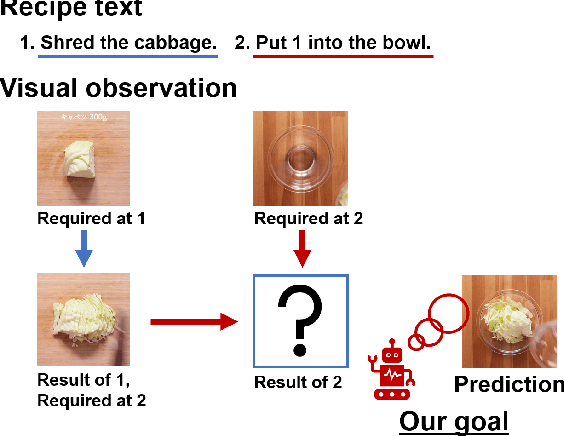
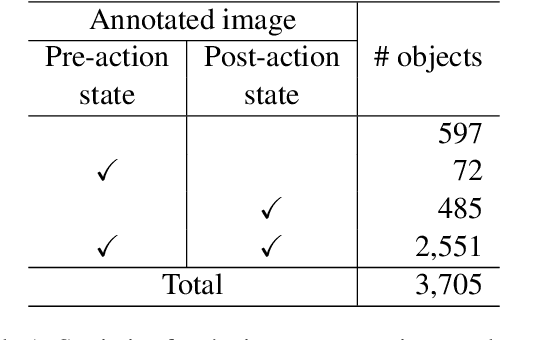
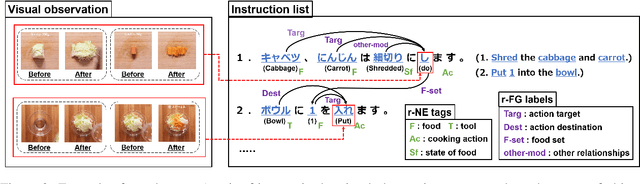
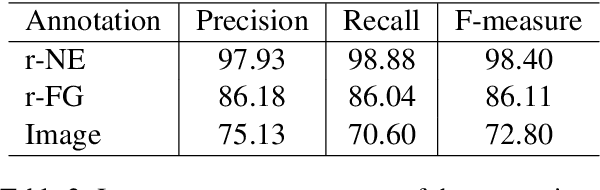
We present a new multimodal dataset called Visual Recipe Flow, which enables us to learn each cooking action result in a recipe text. The dataset consists of object state changes and the workflow of the recipe text. The state change is represented as an image pair, while the workflow is represented as a recipe flow graph (r-FG). The image pairs are grounded in the r-FG, which provides the cross-modal relation. With our dataset, one can try a range of applications, from multimodal commonsense reasoning and procedural text generation.
Edge-Selective Feature Weaving for Point Cloud Matching
Feb 08, 2022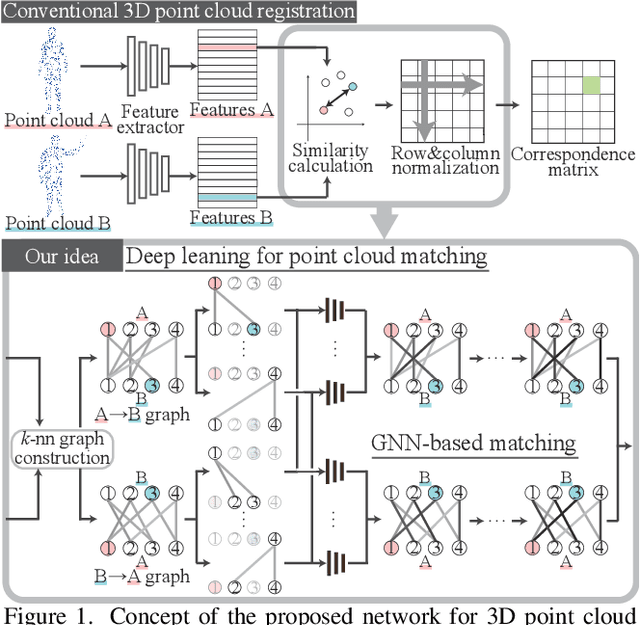
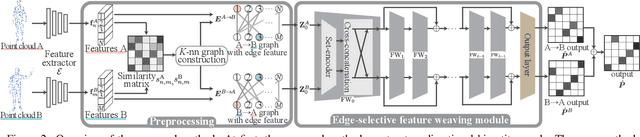
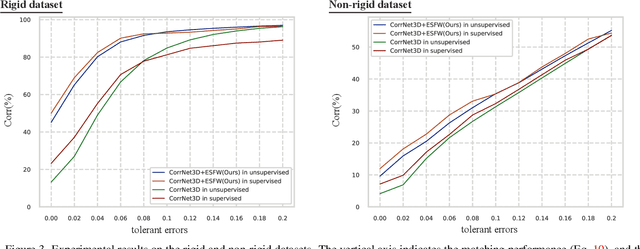
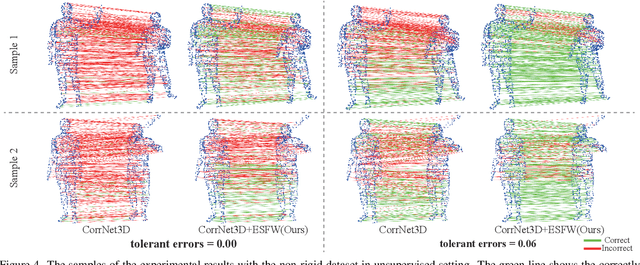
This paper tackles the problem of accurately matching the points of two 3D point clouds. Most conventional methods improve their performance by extracting representative features from each point via deep-learning-based algorithms. On the other hand, the correspondence calculation between the extracted features has not been examined in depth, and non-trainable algorithms (e.g. the Sinkhorn algorithm) are frequently applied. As a result, the extracted features may be forcibly fitted to a non-trainable algorithm. Furthermore, the extracted features frequently contain stochastically unavoidable errors, which degrades the matching accuracy. In this paper, instead of using a non-trainable algorithm, we propose a differentiable matching network that can be jointly optimized with the feature extraction procedure. Our network first constructs graphs with edges connecting the points of each point cloud and then extracts discriminative edge features by using two main components: a shared set-encoder and an edge-selective cross-concatenation. These components enable us to symmetrically consider two point clouds and to extract discriminative edge features, respectively. By using the extracted discriminative edge features, our network can accurately calculate the correspondence between points. Our experimental results show that the proposed network can significantly improve the performance of point cloud matching. Our code is available at https://github.com/yanarin/ESFW
Foreground-Aware Stylization and Consensus Pseudo-Labeling for Domain Adaptation of First-Person Hand Segmentation
Jul 11, 2021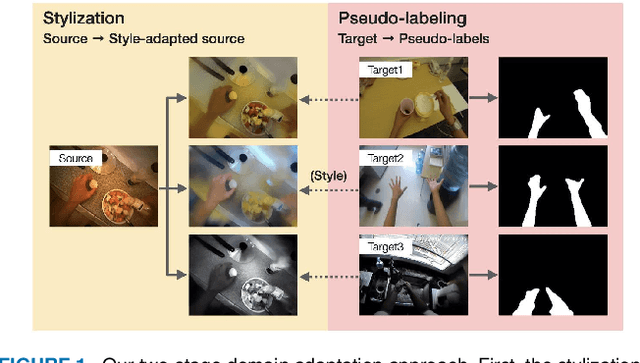
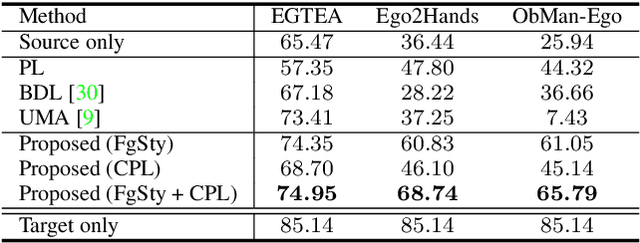
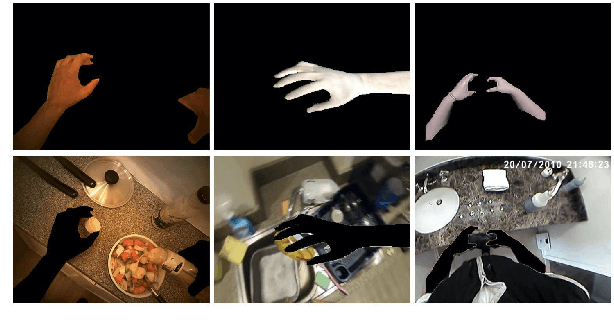

Hand segmentation is a crucial task in first-person vision. Since first-person images exhibit strong bias in appearance among different environments, adapting a pre-trained segmentation model to a new domain is required in hand segmentation. Here, we focus on appearance gaps for hand regions and backgrounds separately. We propose (i) foreground-aware image stylization and (ii) consensus pseudo-labeling for domain adaptation of hand segmentation. We stylize source images independently for the foreground and background using target images as style. To resolve the domain shift that the stylization has not addressed, we apply careful pseudo-labeling by taking a consensus between the models trained on the source and stylized source images. We validated our method on domain adaptation of hand segmentation from real and simulation images. Our method achieved state-of-the-art performance in both settings. We also demonstrated promising results in challenging multi-target domain adaptation and domain generalization settings. Code is available at https://github.com/ut-vision/FgSty-CPL.
Removing Word-Level Spurious Alignment between Images and Pseudo-Captions in Unsupervised Image Captioning
Apr 28, 2021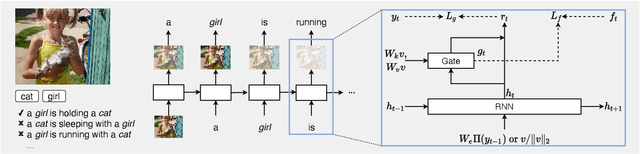


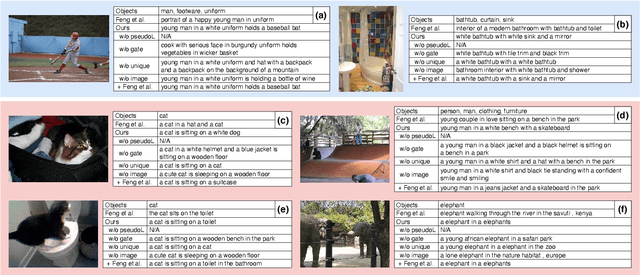
Unsupervised image captioning is a challenging task that aims at generating captions without the supervision of image-sentence pairs, but only with images and sentences drawn from different sources and object labels detected from the images. In previous work, pseudo-captions, i.e., sentences that contain the detected object labels, were assigned to a given image. The focus of the previous work was on the alignment of input images and pseudo-captions at the sentence level. However, pseudo-captions contain many words that are irrelevant to a given image. In this work, we investigate the effect of removing mismatched words from image-sentence alignment to determine how they make this task difficult. We propose a simple gating mechanism that is trained to align image features with only the most reliable words in pseudo-captions: the detected object labels. The experimental results show that our proposed method outperforms the previous methods without introducing complex sentence-level learning objectives. Combined with the sentence-level alignment method of previous work, our method further improves its performance. These results confirm the importance of careful alignment in word-level details.
Divergence Optimization for Noisy Universal Domain Adaptation
Apr 01, 2021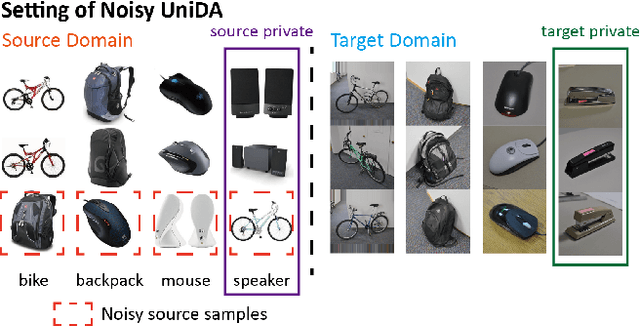
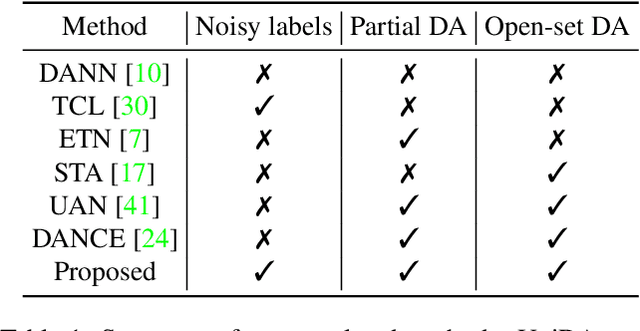
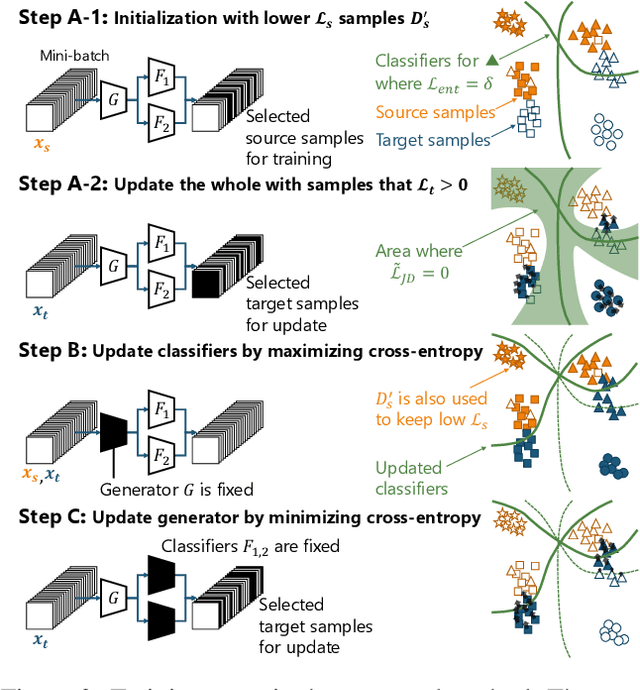
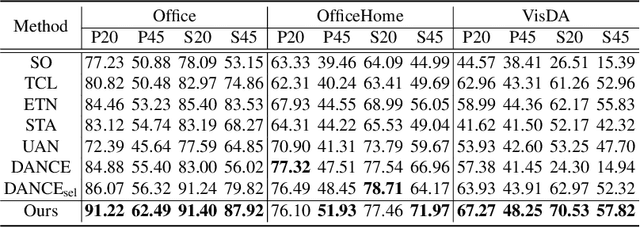
Universal domain adaptation (UniDA) has been proposed to transfer knowledge learned from a label-rich source domain to a label-scarce target domain without any constraints on the label sets. In practice, however, it is difficult to obtain a large amount of perfectly clean labeled data in a source domain with limited resources. Existing UniDA methods rely on source samples with correct annotations, which greatly limits their application in the real world. Hence, we consider a new realistic setting called Noisy UniDA, in which classifiers are trained with noisy labeled data from the source domain and unlabeled data with an unknown class distribution from the target domain. This paper introduces a two-head convolutional neural network framework to solve all problems simultaneously. Our network consists of one common feature generator and two classifiers with different decision boundaries. By optimizing the divergence between the two classifiers' outputs, we can detect noisy source samples, find "unknown" classes in the target domain, and align the distribution of the source and target domains. In an extensive evaluation of different domain adaptation settings, the proposed method outperformed existing methods by a large margin in most settings.
Partially-Shared Variational Auto-encoders for Unsupervised Domain Adaptation with Target Shift
Jan 25, 2020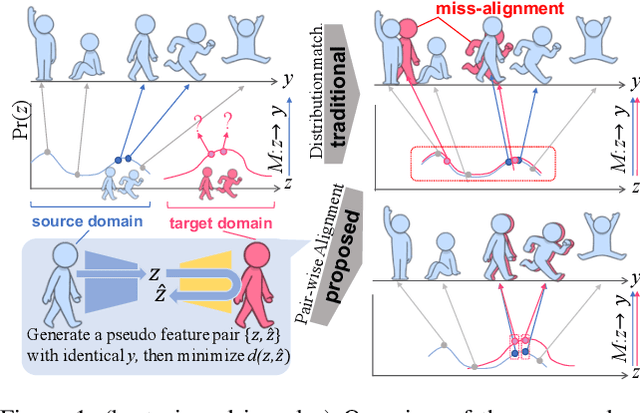
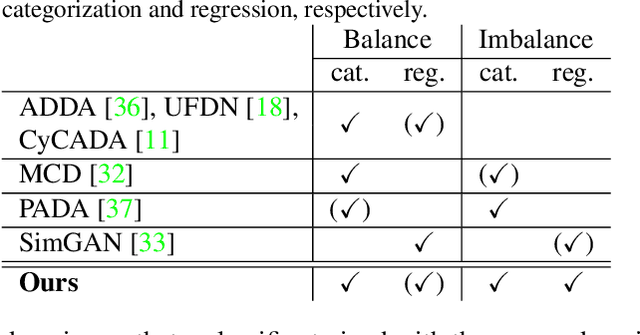
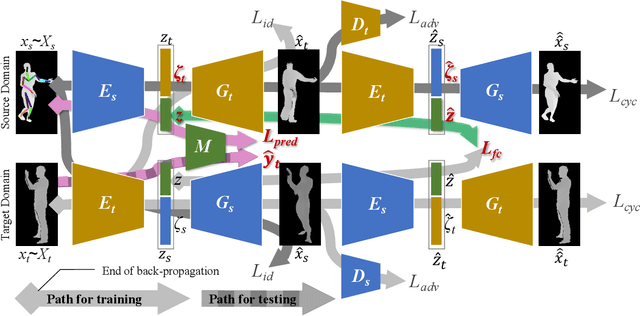
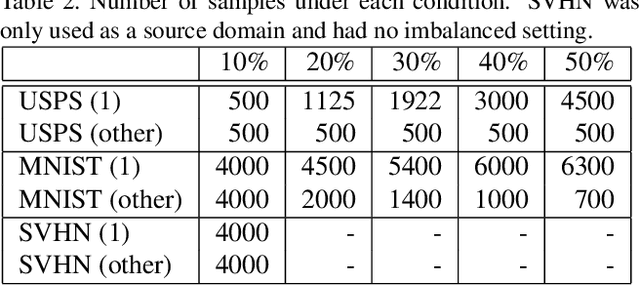
This paper proposes a novel approach for unsupervised domain adaptation (UDA) with target shift. Target shift is a problem of mismatch in label distribution between source and target domains. Typically it appears as class-imbalance in target domain. In practice, this is an important problem in UDA; as we do not know labels in target domain datasets, we do not know whether or not its distribution is identical to that in the source domain dataset. Many traditional approaches achieve UDA with distribution matching by minimizing mean maximum discrepancy or adversarial training; however these approaches implicitly assume a coincidence in the distributions and do not work under situations with target shift. Some recent UDA approaches focus on class boundary and some of them are robust to target shift, but they are only applicable to classification and not to regression. To overcome the target shift problem in UDA, the proposed method, partially shared variational autoencoders (PS-VAEs), uses pair-wise feature alignment instead of feature distribution matching. PS-VAEs inter-convert domain of each sample by a CycleGAN-based architecture while preserving its label-related content. To evaluate the performance of PS-VAEs, we carried out two experiments: UDA with class-unbalanced digits datasets (classification), and UDA from synthesized data to real observation in human-pose-estimation (regression). The proposed method presented its robustness against the class-imbalance in the classification task, and outperformed the other methods in the regression task with a large margin.
Decentralized Learning of Generative Adversarial Networks from Multi-Client Non-iid Data
May 23, 2019
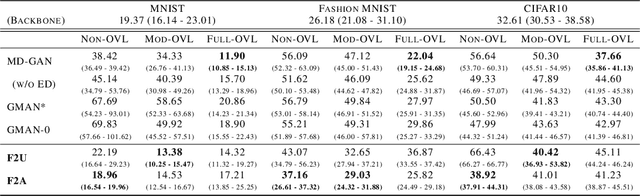
This work addresses a new problem of learning generative adversarial networks (GANs) from multiple data collections that are each i) owned separately and privately by different clients and ii) drawn from a non-identical distribution that comprises different classes. Given such multi-client and non-iid data as input, we aim to achieve a distribution involving all the classes input data can belong to, while keeping the data decentralized and private in each client storage. Our key contribution to this end is a new decentralized approach for learning GANs from non-iid data called Forgiver-First Update (F2U), which a) asks clients to train an individual discriminator with their own data and b) updates a generator to fool the most `forgiving' discriminators who deem generated samples as the most real. Our theoretical analysis proves that this updating strategy indeed allows the decentralized GAN to learn a generator's distribution with all the input classes as its global optimum based on f-divergence minimization. Moreover, we propose a relaxed version of F2U called Forgiver-First Aggregation (F2A), which adaptively aggregates the discriminators while emphasizing forgiving ones to perform well in practice. Our empirical evaluations with image generation tasks demonstrated the effectiveness of our approach over state-of-the-art decentralized learning methods.