 Add to Chrome
 Add to Firefox
 Add to Edge
On the Utility and Factual Reliability of Pruned Mixture-of-Experts Models in the Biomedical Domain
Jul 01, 2026
Mixture-of-Experts (MoE) models offer inference speedups via selective activation but impose substantial memory requirements because the whole network must remain loaded. Structured expert pruning is a practical approach for reducing deployment costs in resource-constrained settings. However, prior studies primarily evaluate benchmark utility, leaving the effect of pruning on factual reliability underexplored, particularly in high-stakes domains such as biomedicine. In this paper, we investigate how domain-specific expert pruning affects both utility and reliability. We assess four MoE models, six pruning methods, and multiple pruning ratios across generation and classification tasks under in-domain (biomedical) and cross-domain settings. Results reveal that moderate pruning preserves in-domain utility without immediate reliability decline, although hallucination risks increase at extreme pruning ratios. When shifting to the general domain, both utility and reliability degrade rapidly. These findings indicate that safe compression depends heavily on the task and domain. Evaluating pruned MoE models solely on utility is inadequate for high-stakes deployment without reliability assessment.

MultiHashFormer: Hash-based Generative Language Models
Jun 26, 2026Language models (LMs) represent tokens using embedding matrices that scale linearly with the vocabulary size. To constrain the parameter footprint, prior work proposes hashing many tokens into a single vector within encoder-only models. While this offers parameter efficiency, many-to-one collisions prevent its use in causal LMs. In this paper, we propose MultiHashFormer, a new framework that allows hash-based autoregression. Each token is represented as a unique hash signature, a short sequence of discrete hash IDs, generated by multiple independent hash functions. A Hash Encoder compresses this signature into a single latent vector for processing by a Transformer decoder. Then, a Hash Decoder generates the hash signature of the next token, which is then mapped back to text. We evaluate our approach at the 100M, 1B and 3B parameter scales, demonstrating that MultiHashFormer consistently outperforms standard Transformer LMs across multiple benchmarks. Furthermore, we show that our model handles multilingual vocabulary expansion with a constant parameter footprint without any modifications.
Rethinking the Idiomaticity Decomposability Hypothesis: Evidence from Distributional Learning
Jun 02, 2026Idioms can be analysed in terms of their decomposability, the extent to which constituent meanings contribute to the figurative whole. Decomposability is thought to predict syntactic flexibility. Usage-based accounts instead attribute idiom behaviour to distributional experience, such as speaker familiarity and predictability. We examine these views using contextualised language models as controlled distributional learners. We propose a model-internal measure of decomposability and relate it to human ratings, syntactic flexibility, and predictability while tracking idiom learning during pretraining. Model-derived decomposability correlates weakly with human judgments and shows a small but consistent negative relationship with syntactic flexibility. Pretraining analyses show that stabilisation of idiom representations in models is not explained by frequency alone. Instead, surprisal, decomposability, and frequency all contribute, with decomposability showing the strongest training-dependent effect.
How Can We Synthesize High-Quality Pretraining Data? A Systematic Study of Prompt Design, Generator Model, and Source Data
Apr 15, 2026Synthetic data is a standard component in training large language models, yet systematic comparisons across design dimensions, including rephrasing strategy, generator model, and source data, remain absent. We conduct extensive controlled experiments, generating over one trillion tokens, to identify critical factors in rephrasing web text into synthetic pretraining data. Our results reveal that structured output formats, such as tables, math problems, FAQs, and tutorials, consistently outperform both curated web baselines and prior synthetic methods. Notably, increasing the size of the generator model beyond 1B parameters provides no additional benefit. Our analysis also demonstrates that the selection of the original data used for mixing substantially influences performance. By applying our findings, we develop \textbf{\textsc{FinePhrase}}, a 486-billion-token open dataset of rephrased web text. We show that \textsc{FinePhrase} outperforms all existing synthetic data baselines while reducing generation costs by up to 30 times. We provide the dataset, all prompts, and the generation framework to the research community.
Enhancing Linguistic Competence of Language Models through Pre-training with Language Learning Tasks
Jan 06, 2026Language models (LMs) are pre-trained on raw text datasets to generate text sequences token-by-token. While this approach facilitates the learning of world knowledge and reasoning, it does not explicitly optimize for linguistic competence. To bridge this gap, we propose L2T, a pre-training framework integrating Language Learning Tasks alongside standard next-token prediction. Inspired by human language acquisition, L2T transforms raw text into structured input-output pairs to provide explicit linguistic stimulation. Pre-training LMs on a mixture of raw text and L2T data not only improves overall performance on linguistic competence benchmarks but accelerates its acquisition, while maintaining competitive performance on general reasoning tasks.
Vocabulary Expansion of Chat Models with Unlabeled Target Language Data
Dec 16, 2024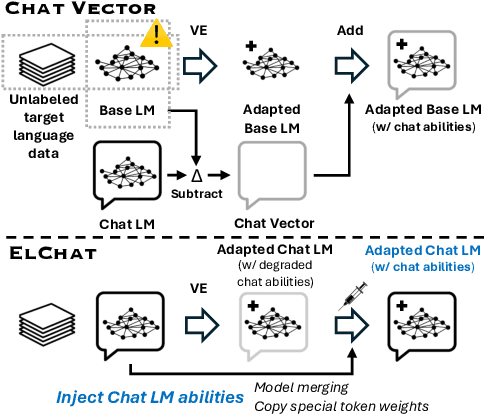
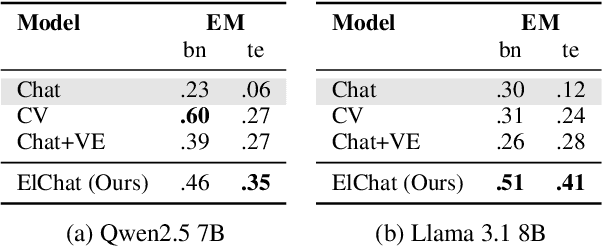
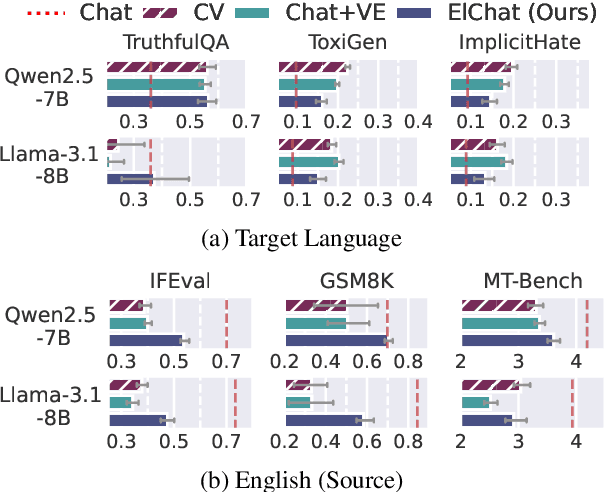
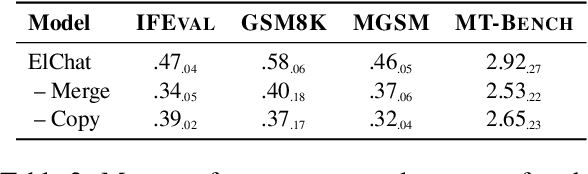
Chat models (i.e. language models trained to follow instructions through conversation with humans) outperform base models (i.e. trained solely on unlabeled data) in both conversation and general task-solving abilities. These models are generally English-centric and require further adaptation for languages that are underrepresented in or absent from their training data. A common technique for adapting base models is to extend the model's vocabulary with target language tokens, i.e. vocabulary expansion (VE), and then continually pre-train it on language-specific data. Using chat data is ideal for chat model adaptation, but often, either this does not exist or is costly to construct. Alternatively, adapting chat models with unlabeled data is a possible solution, but it could result in catastrophic forgetting. In this paper, we investigate the impact of using unlabeled target language data for VE on chat models for the first time. We first show that off-the-shelf VE generally performs well across target language tasks and models in 71% of cases, though it underperforms in scenarios where source chat models are already strong. To further improve adapted models, we propose post-hoc techniques that inject information from the source model without requiring any further training. Experiments reveal the effectiveness of our methods, helping the adapted models to achieve performance improvements in 87% of cases.
Enhancing Reasoning Capabilities of LLMs via Principled Synthetic Logic Corpus
Nov 19, 2024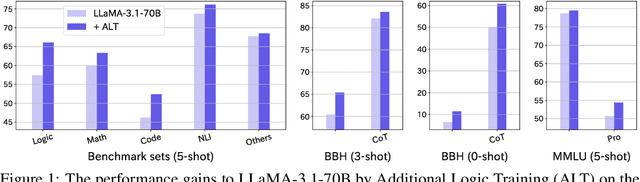
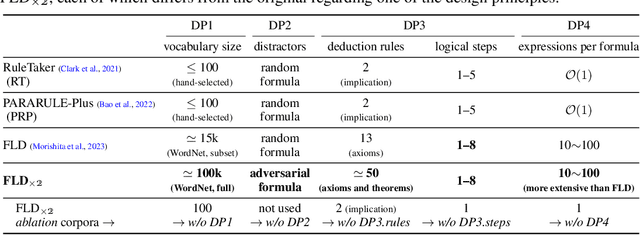
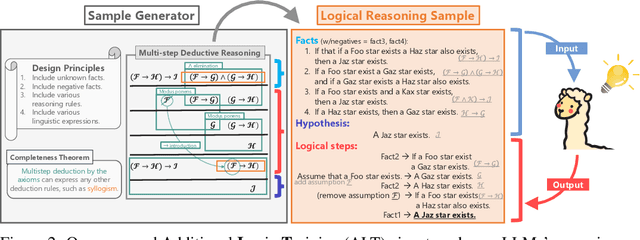
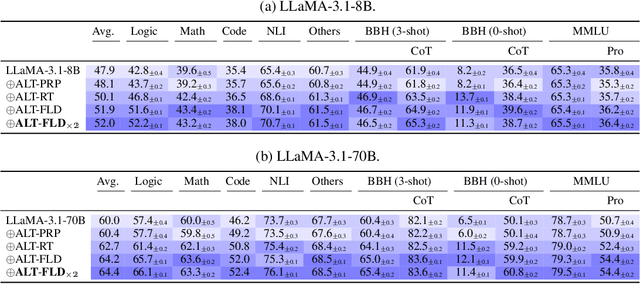
Large language models (LLMs) are capable of solving a wide range of tasks, yet they have struggled with reasoning. To address this, we propose $\textbf{Additional Logic Training (ALT)}$, which aims to enhance LLMs' reasoning capabilities by program-generated logical reasoning samples. We first establish principles for designing high-quality samples by integrating symbolic logic theory and previous empirical insights. Then, based on these principles, we construct a synthetic corpus named $\textbf{Formal Logic Deduction Diverse}$ ($\textbf{FLD}$$^{\times 2}$), comprising numerous samples of multi-step deduction with unknown facts, diverse reasoning rules, diverse linguistic expressions, and challenging distractors. Finally, we empirically show that ALT on FLD$^{\times2}$ substantially enhances the reasoning capabilities of state-of-the-art LLMs, including LLaMA-3.1-70B. Improvements include gains of up to 30 points on logical reasoning benchmarks, up to 10 points on math and coding benchmarks, and 5 points on the benchmark suite BBH.
Vocabulary Expansion for Low-resource Cross-lingual Transfer
Jun 17, 2024Large language models (LLMs) have shown remarkable capabilities in many languages beyond English. Yet, LLMs require more inference steps when generating non-English text due to their reliance on English-centric tokenizers, vocabulary, and pre-training data, resulting in higher usage costs to non-English speakers. Vocabulary expansion with target language tokens is a widely used cross-lingual vocabulary adaptation approach to remedy this issue. Despite its effectiveness in inference speedup, the majority of previous work has focused on high-resource settings assuming access to a substantial amount of target language data to effectively initialize the embeddings of the new tokens and adapt the LLM to the target language. However, vocabulary expansion for LLMs in low-resource settings (i.e. languages and compute) has yet to be explored. In this paper, we investigate sample-efficient adaptation strategies from different angles, including target vocabulary size and initialization methods, and the amount of target data available for adaptation. Extensive experiments across typologically diverse languages, tasks and models show that simpler heuristic-based embedding initialization is more efficient and robust to changes in target vocabulary size and adaptation data in low-resource settings, outperforming a popular random initialization and a more sophisticated state-of-the-art approach that relies on external data and model.
An Empirical Study on Cross-lingual Vocabulary Adaptation for Efficient Generative LLM Inference
Feb 16, 2024The development of state-of-the-art generative large language models (LLMs) disproportionately relies on English-centric tokenizers, vocabulary and pre-training data. Despite the fact that some LLMs have multilingual capabilities, recent studies have shown that their inference efficiency deteriorates when generating text in languages other than English. This results in increased inference time and costs. Cross-lingual vocabulary adaptation methods have been proposed for adapting models to a target language aiming to improve downstream performance. However, the effectiveness of these methods on increasing inference efficiency of generative LLMs has yet to be explored. In this paper, we perform an empirical study of various cross-lingual vocabulary adaptation methods on five generative LLMs (including monolingual and multilingual models) across four typologically-diverse languages and four natural language understanding tasks. We find that cross-lingual vocabulary adaptation substantially contributes to LLM inference speedups of up to 271.5%. We also show that adapting LLMs that have been pre-trained on more balanced multilingual data results in downstream performance comparable to the original models.
appjsonify: An Academic Paper PDF-to-JSON Conversion Toolkit
Oct 03, 2023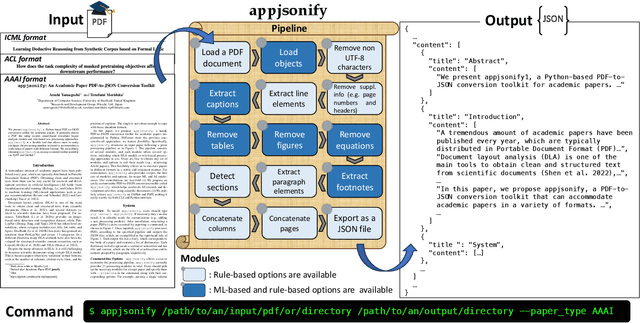
We present appjsonify, a Python-based PDF-to-JSON conversion toolkit for academic papers. It parses a PDF file using several visual-based document layout analysis models and rule-based text processing approaches. appjsonify is a flexible tool that allows users to easily configure the processing pipeline to handle a specific format of a paper they wish to process. We are publicly releasing appjsonify as an easy-to-install toolkit available via PyPI and GitHub.