 Add to Chrome
 Add to Firefox
 Add to Edge
Large language models as synthetic clinical experts to inform longitudinal rare-disease modeling
Aug 17, 2026
Due to the limited amount of information, modeling longitudinal rare-disease data can benefit from integrating clinical knowledge. Yet, elicitation of expert knowledge and formalization for model fitting is challenging, in particular due to limited time of clinical experts. To nevertheless make domain knowledge accessible during model fitting, we use large language models (LLMs) as synthetic clinical experts to supervise a variational-autoencoder-based approach that learns low-dimensional latent summaries of visit-level observations. Specifically, LLMs are queried offline on textual descriptions of patient observations to obtain judgments, e.g., the suspected clinical category. To improve the variational autoencoder fit, we train a differentiable surrogate model on these judgments and augment the loss function to encourage reconstructions that preserve the clinical-label distribution of their corresponding input profile. In an application to longitudinal motor-function assessments from children with spinal muscular atrophy, we map visit-level clinical profiles to low-dimensional representations that are linked by a multivariate mixed-effects model. The synthetic expert loss discourages reconstructions that remain numerically close in data space but alter the clinical interpretation of the reconstructed motor function profile, such as by crossing a disease-type boundary. We thus reduced disagreement between original and reconstructed SMA type labels from about 11 to 7 percent. Furthermore, informing the latent representation by the synthetic expert improved prediction of motor function milestones compared with unsupervised latent representations and a data-level baseline. These results suggest that incorporating LLMs into model fitting can make clinical knowledge available to representation learning and improve clinical faithfulness for longitudinal rare-disease data.

Investigating a domain adaptation approach for integrating different measurement instruments in a longitudinal clinical registry
Dec 01, 2023In a longitudinal clinical registry, different measurement instruments might have been used for assessing individuals at different time points. To combine them, we investigate deep learning techniques for obtaining a joint latent representation, to which the items of different measurement instruments are mapped. This corresponds to domain adaptation, an established concept in computer science for image data. Using the proposed approach as an example, we evaluate the potential of domain adaptation in a longitudinal cohort setting with a rather small number of time points, motivated by an application with different motor function measurement instruments in a registry of spinal muscular atrophy (SMA) patients. There, we model trajectories in the latent representation by ordinary differential equations (ODEs), where person-specific ODE parameters are inferred from baseline characteristics. The goodness of fit and complexity of the ODE solutions then allows to judge the measurement instrument mappings. We subsequently explore how alignment can be improved by incorporating corresponding penalty terms into model fitting. To systematically investigate the effect of differences between measurement instruments, we consider several scenarios based on modified SMA data, including scenarios where a mapping should be feasible in principle and scenarios where no perfect mapping is available. While misalignment increases in more complex scenarios, some structure is still recovered, even if the availability of measurement instruments depends on patient state. A reasonable mapping is feasible also in the more complex real SMA dataset. These results indicate that domain adaptation might be more generally useful in statistical modeling for longitudinal registry data.
A statistical approach to latent dynamic modeling with differential equations
Nov 27, 2023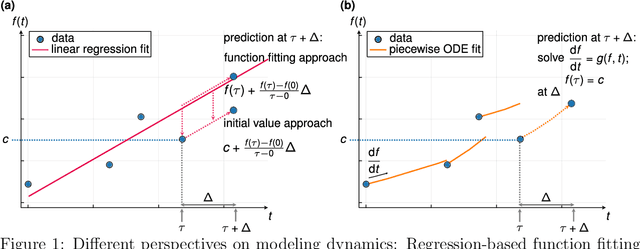

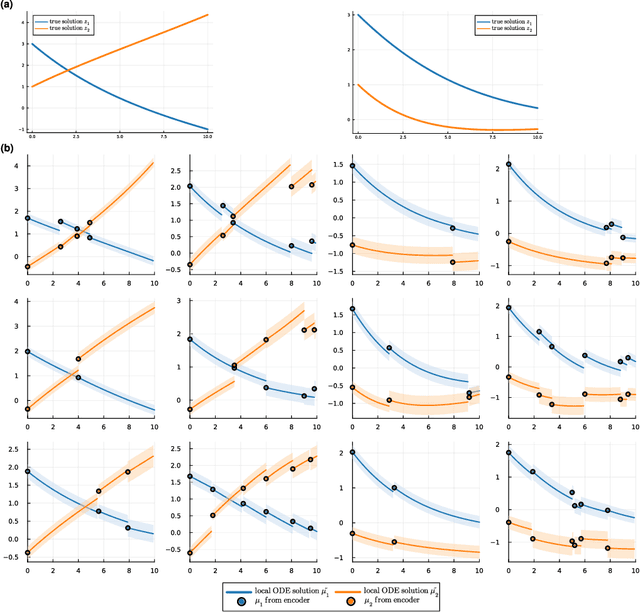
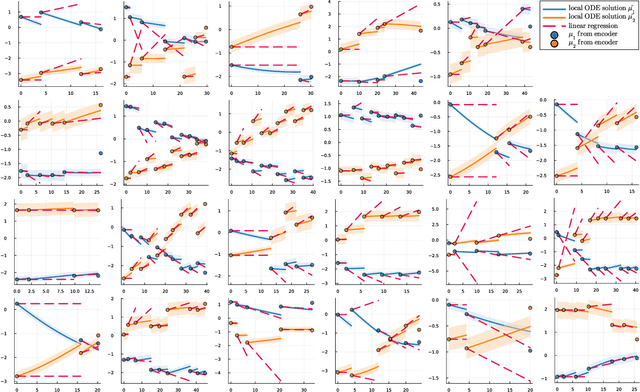
Ordinary differential equations (ODEs) can provide mechanistic models of temporally local changes of processes, where parameters are often informed by external knowledge. While ODEs are popular in systems modeling, they are less established for statistical modeling of longitudinal cohort data, e.g., in a clinical setting. Yet, modeling of local changes could also be attractive for assessing the trajectory of an individual in a cohort in the immediate future given its current status, where ODE parameters could be informed by further characteristics of the individual. However, several hurdles so far limit such use of ODEs, as compared to regression-based function fitting approaches. The potentially higher level of noise in cohort data might be detrimental to ODEs, as the shape of the ODE solution heavily depends on the initial value. In addition, larger numbers of variables multiply such problems and might be difficult to handle for ODEs. To address this, we propose to use each observation in the course of time as the initial value to obtain multiple local ODE solutions and build a combined estimator of the underlying dynamics. Neural networks are used for obtaining a low-dimensional latent space for dynamic modeling from a potentially large number of variables, and for obtaining patient-specific ODE parameters from baseline variables. Simultaneous identification of dynamic models and of a latent space is enabled by recently developed differentiable programming techniques. We illustrate the proposed approach in an application with spinal muscular atrophy patients and a corresponding simulation study. In particular, modeling of local changes in health status at any point in time is contrasted to the interpretation of functions obtained from a global regression. This more generally highlights how different application settings might demand different modeling strategies.