 Add to Chrome
 Add to Firefox
 Add to Edge
Pose-Based Sign Language Spotting via an End-to-End Encoder Architecture
Dec 09, 2025
Automatic Sign Language Recognition (ASLR) has emerged as a vital field for bridging the gap between deaf and hearing communities. However, the problem of sign-to-sign retrieval or detecting a specific sign within a sequence of continuous signs remains largely unexplored. We define this novel task as Sign Language Spotting. In this paper, we present a first step toward sign language retrieval by addressing the challenge of detecting the presence or absence of a query sign video within a sentence-level gloss or sign video. Unlike conventional approaches that rely on intermediate gloss recognition or text-based matching, we propose an end-to-end model that directly operates on pose keypoints extracted from sign videos. Our architecture employs an encoder-only backbone with a binary classification head to determine whether the query sign appears within the target sequence. By focusing on pose representations instead of raw RGB frames, our method significantly reduces computational cost and mitigates visual noise. We evaluate our approach on the Word Presence Prediction dataset from the WSLP 2025 shared task, achieving 61.88\% accuracy and 60.00\% F1-score. These results demonstrate the effectiveness of our pose-based framework for Sign Language Spotting, establishing a strong foundation for future research in automatic sign language retrieval and verification. Code is available at https://github.com/EbimoJohnny/Pose-Based-Sign-Language-Spotting

HumekaFL: Automated Detection of Neonatal Asphyxia Using Federated Learning
Dec 02, 2024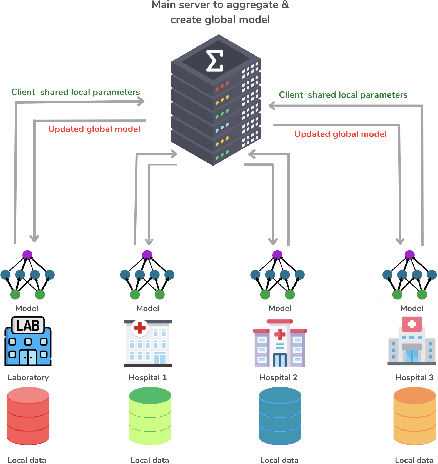
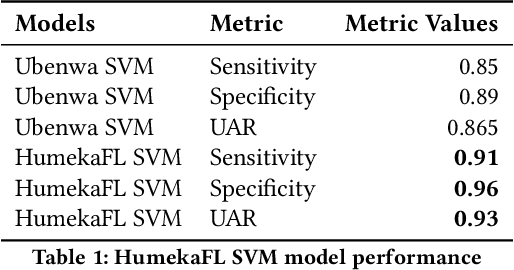
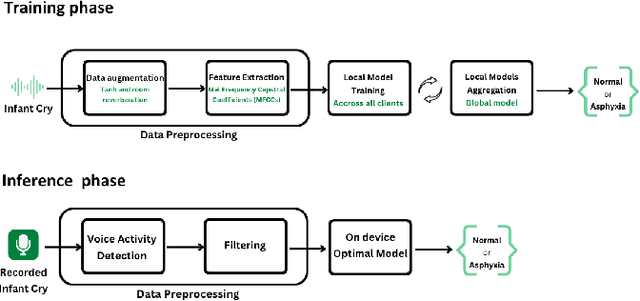
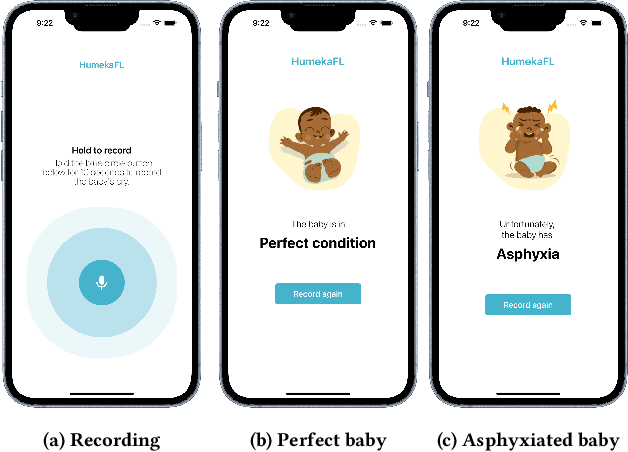
Birth Apshyxia (BA) is a severe condition characterized by insufficient supply of oxygen to a newborn during the delivery. BA is one of the primary causes of neonatal death in the world. Although there has been a decline in neonatal deaths over the past two decades, the developing world, particularly sub-Saharan Africa, continues to experience the highest under-five (<5) mortality rates. While evidence-based methods are commonly used to detect BA in African healthcare settings, they can be subject to physician errors or delays in diagnosis, preventing timely interventions. Centralized Machine Learning (ML) methods demonstrated good performance in early detection of BA but require sensitive health data to leave their premises before training, which does not guarantee privacy and security. Healthcare institutions are therefore reluctant to adopt such solutions in Africa. To address this challenge, we suggest a federated learning (FL)-based software architecture, a distributed learning method that prioritizes privacy and security by design. We have developed a user-friendly and cost-effective mobile application embedding the FL pipeline for early detection of BA. Our Federated SVM model outperformed centralized SVM pipelines and Neural Networks (NN)-based methods in the existing literature
A Learning and Control Perspective for Microfinance
Jul 26, 2022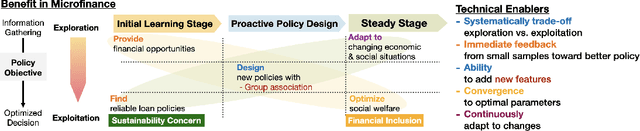
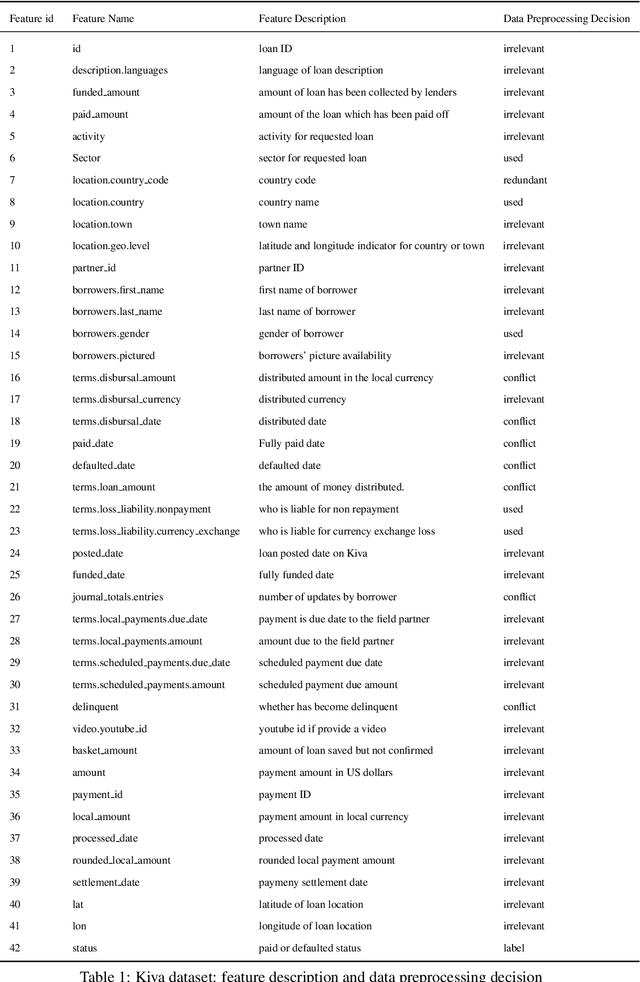
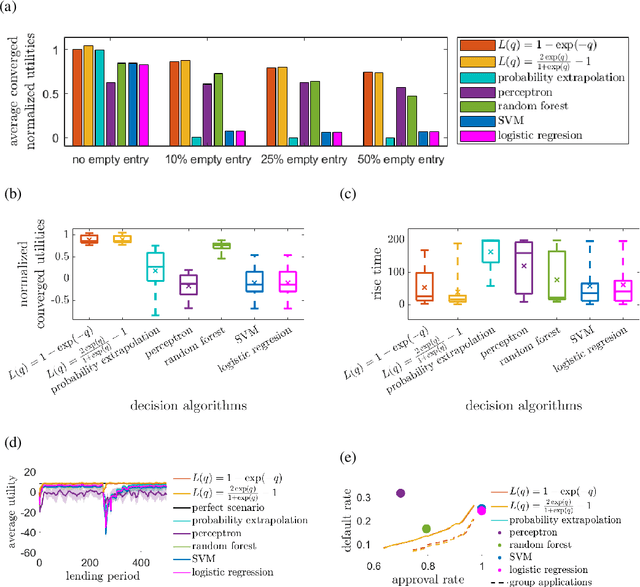
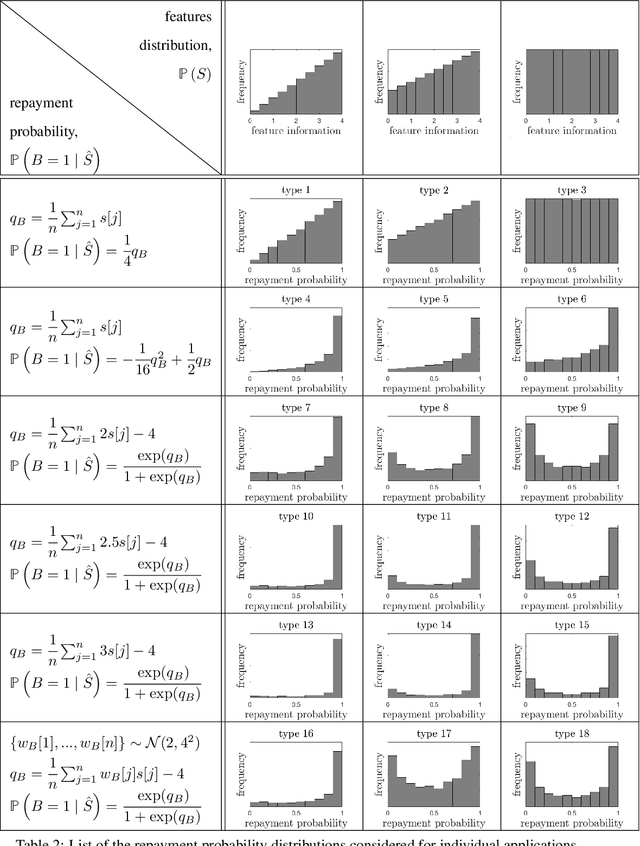
Microfinance in developing areas such as Africa has been proven to improve the local economy significantly. However, many applicants in developing areas cannot provide adequate information required by the financial institution to make a lending decision. As a result, it is challenging for microfinance institutions to assign credit properly based on conventional policies. In this paper, we formulate the decision-making of microfinance into a rigorous optimization-based framework involving learning and control. We propose an algorithm to explore and learn the optimal policy to approve or reject applicants. We provide the conditions under which the algorithms are guaranteed to converge to an optimal one. The proposed algorithm can naturally deal with missing information and systematically tradeoff multiple objectives such as profit maximization, financial inclusion, social benefits, and economic development. Through extensive simulation of both real and synthetic microfinance datasets, we showed our proposed algorithm is superior to existing benchmarks. To the best of our knowledge, this paper is the first to make a connection between microfinance and control and use control-theoretic tools to optimize the policy with a provable guarantee.