 Add to Chrome
 Add to Firefox
 Add to Edge
ArtMine: Discovering and Formalizing Artistic Processes
Jul 09, 2026
Understanding how artworks are created requires reasoning about the iterative decisions, material operations, and contextual influences that shape artistic production. While recent generative AI systems can synthesize artworks with high fidelity, they primarily model distributions over finished artifacts rather than the creative processes underlying their creation. In practice, artistic workflows are only partially documented through fragmented sources such as archival records, preparatory studies, correspondence, etc., making process-level understanding difficult to formalize computationally. In this work, we introduce ArtMine, a framework for discovering and formalizing artistic processes from heterogeneous historical evidence. Our approach synthesizes heterogeneous artwork evidence into a structured repository, from which a Peircean abductive agent infers evidence-grounded production steps. These steps are converted into a compositional graph and rendering prompt, then optimized through self-reflection over deviations between the generated and reference artworks. We provide a preliminary proof-of-concept case study using open-domain historical sources across multiple artists and artistic movements, demonstrating that fragmented documentary evidence can support coherent, interpretable, and auditable representations of artistic workflows. By modeling creative processes rather than only final artifacts, our work moves toward process-centred human-AI co-creativity systems that can support artistic interpretation, creative education, reflective collaboration, and computational studies of cultural production.

Democratic ICAI: Debating Our Way to Steering Principles from Preferences
Jun 26, 2026Preference-based alignment often struggles to capture the reasoning that underlies human judgments. Many evaluations rely on multiple interacting criteria, yet pairwise labels reveal only the final choice rather than the considerations that shape preferences. Inverse Constitutional AI (ICAI) improves interpretability in decision making by summarizing preferences into natural-language principles, but its single-pass explanations miss much of the nuance involved in complex decisions. We introduce Democratic ICAI, a novel approach that gathers multiple competing rationales through structured persona debate, offering a broader and more expressive account of the factors influencing each comparison. From these richer signals, we derive clearer and more comprehensive steering principles and use them to guide decision modeling through both LLM-based and decision-tree judges. Experiments on creative preference benchmarks, MuCE-Pref and LiTBench, across multiple creative task categories show that Democratic ICAI yields a more faithful preference structure. It improves average preference prediction across tasks relative to deliberative prompting and principle-based baselines, while producing constitutions that LLM annotators prefer.
Forgetting is Competition: Rethinking Unlearning as Representation Interference in Diffusion Models
Mar 01, 2026Unlearning in text-to-image diffusion models often leads to uneven concept removal and unintended forgetting of unrelated capabilities. This complicates tasks such as copyright compliance, protected data mitigation, artist opt-outs, and policy-driven content updates. As models grow larger and adopt more diverse architectures, achieving precise and selective unlearning while preserving generative quality becomes increasingly challenging. We introduce SurgUn (pronounced as Surgeon), a surgical unlearning method that applies targeted weight-space updates to remove specific visual concepts in text-conditioned diffusion models. Our approach is motivated by retroactive interference theory, which holds that newly acquired memories can overwrite, suppress, or impede access to prior ones by competing for shared representational pathways. We adapt this principle to diffusion models by inducing retroactive concept interference, enabling focused destabilization of only the target concept while preserving unrelated capabilities through a novel training paradigm. SurgUn achieves high-precision unlearning across diverse settings. It performs strongly on compact U-Net based models such as Stable Diffusion v1.5, scales effectively to the larger U-Net architecture SDXL, and extends to SANA, representing an underexplored Diffusion Transformer based architecture for unlearning.
Improving Sequence-to-Sequence Models for Abstractive Text Summarization Using Meta Heuristic Approaches
Mar 24, 2024
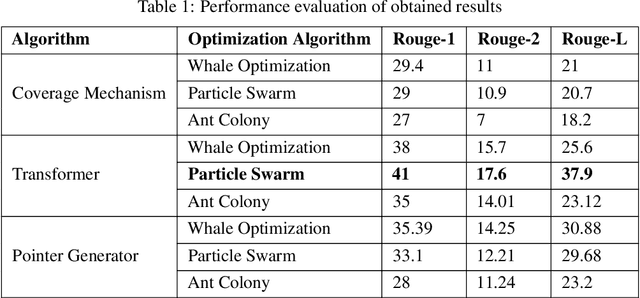
As human society transitions into the information age, reduction in our attention span is a contingency, and people who spend time reading lengthy news articles are decreasing rapidly and the need for succinct information is higher than ever before. Therefore, it is essential to provide a quick overview of important news by concisely summarizing the top news article and the most intuitive headline. When humans try to make summaries, they extract the essential information from the source and add useful phrases and grammatical annotations from the original extract. Humans have a unique ability to create abstractions. However, automatic summarization is a complicated problem to solve. The use of sequence-to-sequence (seq2seq) models for neural abstractive text summarization has been ascending as far as prevalence. Numerous innovative strategies have been proposed to develop the current seq2seq models further, permitting them to handle different issues like saliency, familiarity, and human lucidness and create excellent synopses. In this article, we aimed toward enhancing the present architectures and models for abstractive text summarization. The modifications have been aimed at fine-tuning hyper-parameters, attempting specific encoder-decoder combinations. We examined many experiments on an extensively used CNN/DailyMail dataset to check the effectiveness of various models.