 Add to Chrome
 Add to Firefox
 Add to Edge
Multi-Dimensional Evaluation of Sustainable City Trips with LLM-as-a-Judge and Human-in-the-Loop
Apr 27, 2026
Evaluating nuanced conversational travel recommendations is challenging when human annotations are costly and standard metrics ignore stakeholder-centric goals. We study LLMs-as-Judges for sustainable city-trip lists across four dimensions -- relevance, diversity, sustainability, and popularity balance, and propose a three-phase calibration framework: (1) baseline judging with multiple LLMs, (2) expert evaluation to identify systematic misalignment, and (3) dimension-specific calibration via rules and few-shot examples. Across two recommendation settings, we observe model-specific biases and high dimension-level variance, even when judges agree on overall rankings. Calibration clarifies reasoning per dimension but exposes divergent interpretations of sustainability, highlighting the need for transparent, bias-aware LLM evaluation. Prompts and code are released for reproducibility: https://github.com/ashmibanerjee/trs-llm-calibration.

TRACE: A Conversational Framework for Sustainable Tourism Recommendation with Agentic Counterfactual Explanations
Apr 14, 2026Traditional conversational travel recommender systems primarily optimize for user relevance and convenience, often reinforcing popular, overcrowded destinations and carbon-intensive travel choices. To address this, we present TRACE (Tourism Recommendation with Agentic Counterfactual Explanations), a multi-agent, LLM-based framework that promotes sustainable tourism through interactive nudging. TRACE uses a modular orchestrator-worker architecture where specialized agents elicit latent sustainability preferences, construct structured user personas, and generate recommendations that balance relevance with environmental impact. A key innovation lies in its use of agentic counterfactual explanations and LLM-driven clarifying questions, which together surface greener alternatives and refine understanding of intent, fostering user reflection without coercion. User studies and semantic alignment analyses demonstrate that TRACE effectively supports sustainable decision-making while preserving recommendation quality and interactive responsiveness. TRACE is implemented on Google's Agent Development Kit, with full code, Docker setup, prompts, and a publicly available demo video to ensure reproducibility. A project summary, including all resources, prompts, and demo access, is available at https://ashmibanerjee.github.io/trace-chatbot.
Collab-REC: An LLM-based Agentic Framework for Balancing Recommendations in Tourism
Aug 20, 2025We propose Collab-REC, a multi-agent framework designed to counteract popularity bias and enhance diversity in tourism recommendations. In our setting, three LLM-based agents -- Personalization, Popularity, and Sustainability generate city suggestions from complementary perspectives. A non-LLM moderator then merges and refines these proposals via multi-round negotiation, ensuring each agent's viewpoint is incorporated while penalizing spurious or repeated responses. Experiments on European city queries show that Collab-REC improves diversity and overall relevance compared to a single-agent baseline, surfacing lesser-visited locales that often remain overlooked. This balanced, context-aware approach addresses over-tourism and better aligns with constraints provided by the user, highlighting the promise of multi-stakeholder collaboration in LLM-driven recommender systems.
SynthTRIPs: A Knowledge-Grounded Framework for Benchmark Query Generation for Personalized Tourism Recommenders
Apr 12, 2025Tourism Recommender Systems (TRS) are crucial in personalizing travel experiences by tailoring recommendations to users' preferences, constraints, and contextual factors. However, publicly available travel datasets often lack sufficient breadth and depth, limiting their ability to support advanced personalization strategies -- particularly for sustainable travel and off-peak tourism. In this work, we explore using Large Language Models (LLMs) to generate synthetic travel queries that emulate diverse user personas and incorporate structured filters such as budget constraints and sustainability preferences. This paper introduces a novel SynthTRIPs framework for generating synthetic travel queries using LLMs grounded in a curated knowledge base (KB). Our approach combines persona-based preferences (e.g., budget, travel style) with explicit sustainability filters (e.g., walkability, air quality) to produce realistic and diverse queries. We mitigate hallucination and ensure factual correctness by grounding the LLM responses in the KB. We formalize the query generation process and introduce evaluation metrics for assessing realism and alignment. Both human expert evaluations and automatic LLM-based assessments demonstrate the effectiveness of our synthetic dataset in capturing complex personalization aspects underrepresented in existing datasets. While our framework was developed and tested for personalized city trip recommendations, the methodology applies to other recommender system domains. Code and dataset are made public at https://bit.ly/synthTRIPs
Enhancing Tourism Recommender Systems for Sustainable City Trips Using Retrieval-Augmented Generation
Sep 26, 2024Tourism Recommender Systems (TRS) have traditionally focused on providing personalized travel suggestions, often prioritizing user preferences without considering broader sustainability goals. Integrating sustainability into TRS has become essential with the increasing need to balance environmental impact, local community interests, and visitor satisfaction. This paper proposes a novel approach to enhancing TRS for sustainable city trips using Large Language Models (LLMs) and a modified Retrieval-Augmented Generation (RAG) pipeline. We enhance the traditional RAG system by incorporating a sustainability metric based on a city's popularity and seasonal demand during the prompt augmentation phase. This modification, called Sustainability Augmented Reranking (SAR), ensures the system's recommendations align with sustainability goals. Evaluations using popular open-source LLMs, such as Llama-3.1-Instruct-8B and Mistral-Instruct-7B, demonstrate that the SAR-enhanced approach consistently matches or outperforms the baseline (without SAR) across most metrics, highlighting the benefits of incorporating sustainability into TRS.
Modeling Sustainable City Trips: Integrating CO2 Emissions, Popularity, and Seasonality into Tourism Recommender Systems
Mar 27, 2024In an era of information overload and complex decision-making processes, Recommender Systems (RS) have emerged as indispensable tools across diverse domains, particularly travel and tourism. These systems simplify trip planning by offering personalized recommendations that consider individual preferences and address broader challenges like seasonality, travel regulations, and capacity constraints. The intricacies of the tourism domain, characterized by multiple stakeholders, including consumers, item providers, platforms, and society, underscore the complexity of achieving balance among diverse interests. Although previous research has focused on fairness in Tourism Recommender Systems (TRS) from a multistakeholder perspective, limited work has focused on generating sustainable recommendations. Our paper introduces a novel approach for assigning a sustainability indicator (SF index) for city trips accessible from the users' starting point, integrating Co2e analysis, destination popularity, and seasonal demand. Our methodology involves comprehensive data gathering on transportation modes and emissions, complemented by analyses of destination popularity and seasonal demand. A user study validates our index, showcasing its practicality and efficacy in providing well-rounded and sustainable city trip recommendations. Our findings contribute significantly to the evolution of responsible tourism strategies, harmonizing the interests of tourists, local communities, and the environment while paving the way for future research in responsible and equitable tourism practices.
Towards Individual and Multistakeholder Fairness in Tourism Recommender Systems
Sep 05, 2023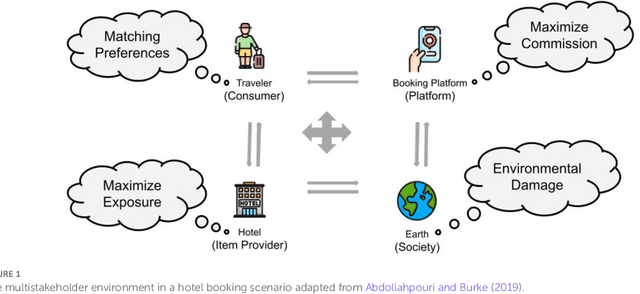
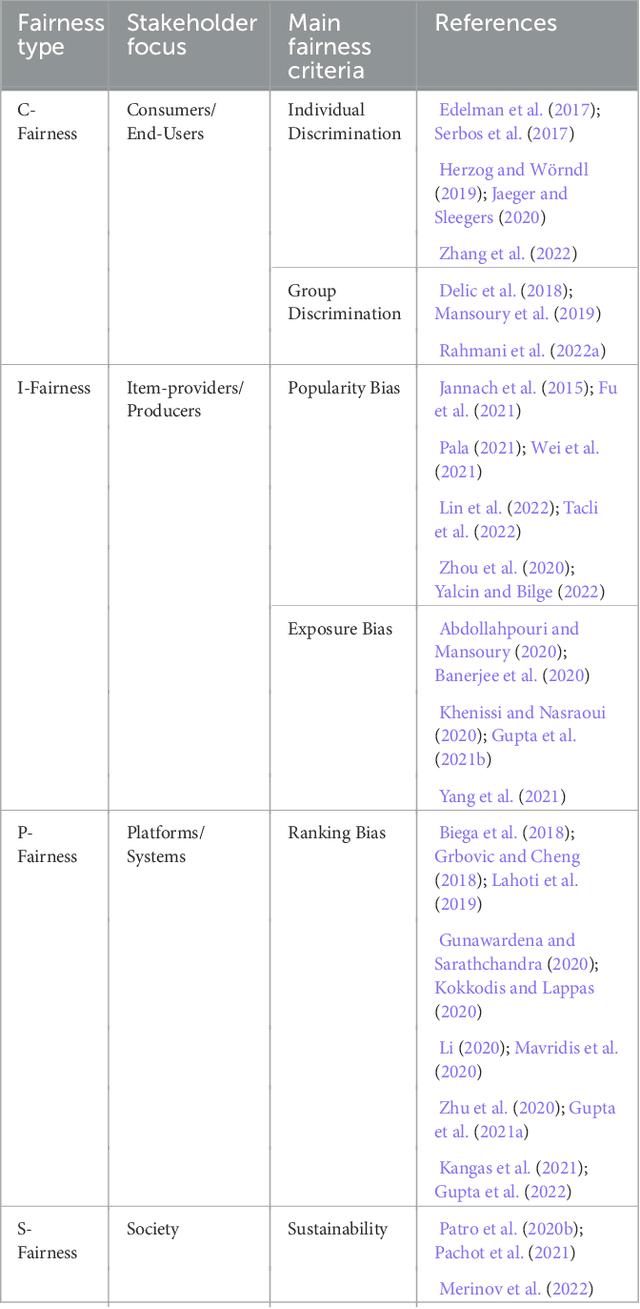
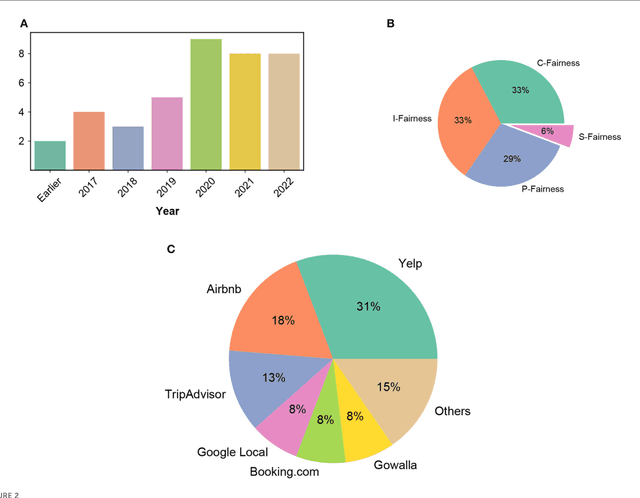
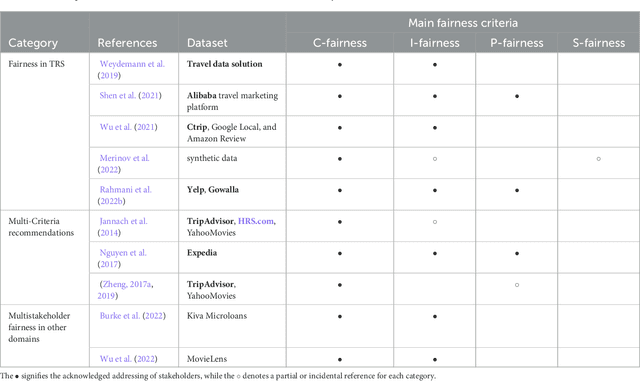
This position paper summarizes our published review on individual and multistakeholder fairness in Tourism Recommender Systems (TRS). Recently, there has been growing attention to fairness considerations in recommender systems (RS). It has been acknowledged in research that fairness in RS is often closely tied to the presence of multiple stakeholders, such as end users, item providers, and platforms, as it raises concerns for the fair treatment of all parties involved. Hence, fairness in RS is a multi-faceted concept that requires consideration of the perspectives and needs of the different stakeholders to ensure fair outcomes for them. However, there may often be instances where achieving the goals of one stakeholder could conflict with those of another, resulting in trade-offs. In this paper, we emphasized addressing the unique challenges of ensuring fairness in RS within the tourism domain. We aimed to discuss potential strategies for mitigating the aforementioned challenges and examine the applicability of solutions from other domains to tackle fairness issues in tourism. By exploring cross-domain approaches and strategies for incorporating S-Fairness, we can uncover valuable insights and determine how these solutions can be adapted and implemented effectively in the context of tourism to enhance fairness in RS.
* Position Paper for FAcctRec 2023 at RecSys 2023