 Add to Chrome
 Add to Firefox
 Add to Edge
Robustness and Reasoning Fidelity of Large Language Models in Long-Context Code Question Answering
Feb 19, 2026
Large language models (LLMs) increasingly assist software engineering tasks that require reasoning over long code contexts, yet their robustness under varying input conditions remains unclear. We conduct a systematic study of long-context code question answering using controlled ablations that test sensitivity to answer format, distractors, and context scale. Extending LongCodeBench Python dataset with new COBOL and Java question-answer sets, we evaluate state-of-the-art models under three settings: (i) shuffled multiple-choice options, (ii) open-ended questions and (iii) needle-in-a-haystack contexts containing relevant and adversarially irrelevant information. Results show substantial performance drops in both shuffled multiple-choice options and open-ended questions, and brittle behavior in the presence of irrelevant cues. Our findings highlight limitations of current long-context evaluations and provide a broader benchmark for assessing code reasoning in both legacy and modern systems.

Mental Disorder Classification via Temporal Representation of Text
Jun 15, 2024
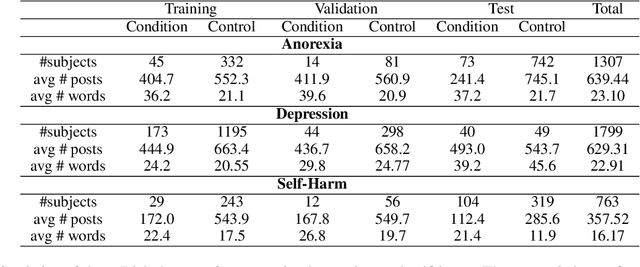


Mental disorders pose a global challenge, aggravated by the shortage of qualified mental health professionals. Mental disorder prediction from social media posts by current LLMs is challenging due to the complexities of sequential text data and the limited context length of language models. Current language model-based approaches split a single data instance into multiple chunks to compensate for limited context size. The predictive model is then applied to each chunk individually, and the most voted output is selected as the final prediction. This results in the loss of inter-post dependencies and important time variant information, leading to poor performance. We propose a novel framework which first compresses the large sequence of chronologically ordered social media posts into a series of numbers. We then use this time variant representation for mental disorder classification. We demonstrate the generalization capabilities of our framework by outperforming the current SOTA in three different mental conditions: depression, self-harm, and anorexia, with an absolute improvement of 5% in the F1 score. We investigate the situation where current data instances fall within the context length of language models and present empirical results highlighting the importance of temporal properties of textual data. Furthermore, we utilize the proposed framework for a cross-domain study, exploring commonalities across disorders and the possibility of inter-domain data usage.