 Add to Chrome
 Add to Firefox
 Add to Edge
Attention Is All You Need
Dec 06, 2017
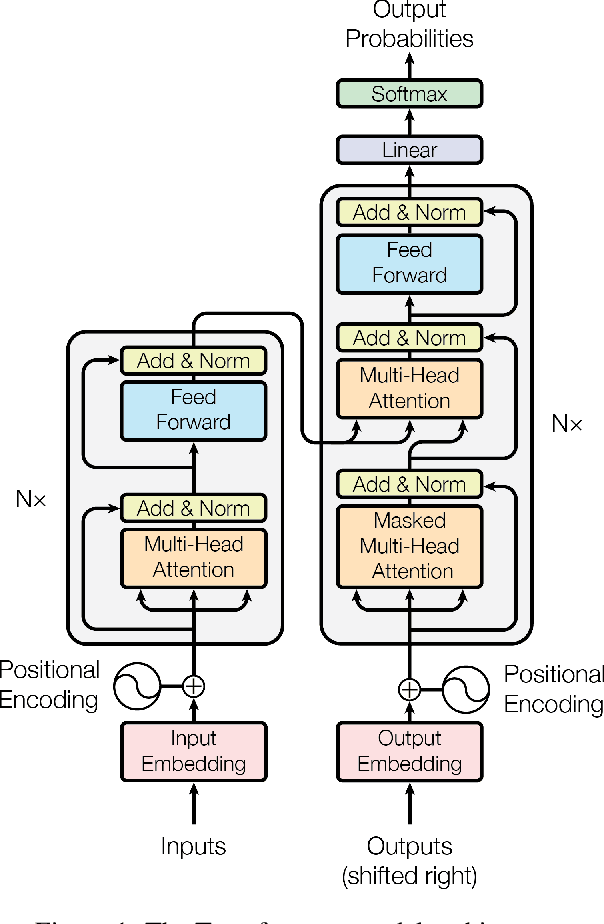
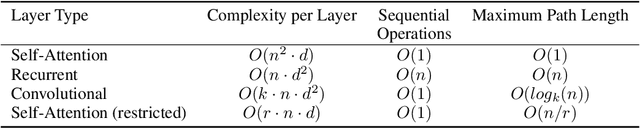
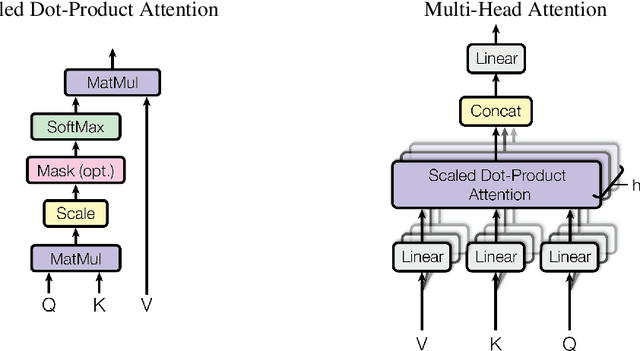
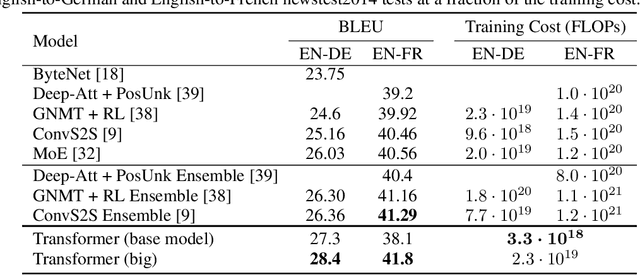
The dominant sequence transduction models are based on complex recurrent or convolutional neural networks in an encoder-decoder configuration. The best performing models also connect the encoder and decoder through an attention mechanism. We propose a new simple network architecture, the Transformer, based solely on attention mechanisms, dispensing with recurrence and convolutions entirely. Experiments on two machine translation tasks show these models to be superior in quality while being more parallelizable and requiring significantly less time to train. Our model achieves 28.4 BLEU on the WMT 2014 English-to-German translation task, improving over the existing best results, including ensembles by over 2 BLEU. On the WMT 2014 English-to-French translation task, our model establishes a new single-model state-of-the-art BLEU score of 41.8 after training for 3.5 days on eight GPUs, a small fraction of the training costs of the best models from the literature. We show that the Transformer generalizes well to other tasks by applying it successfully to English constituency parsing both with large and limited training data.

One Model To Learn Them All
Jun 16, 2017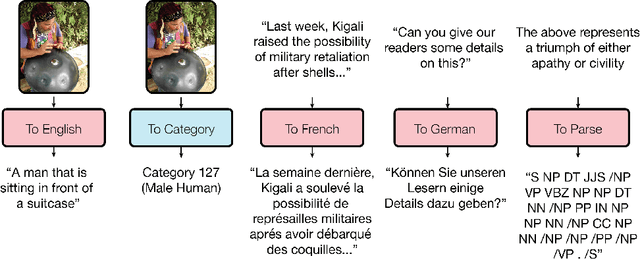

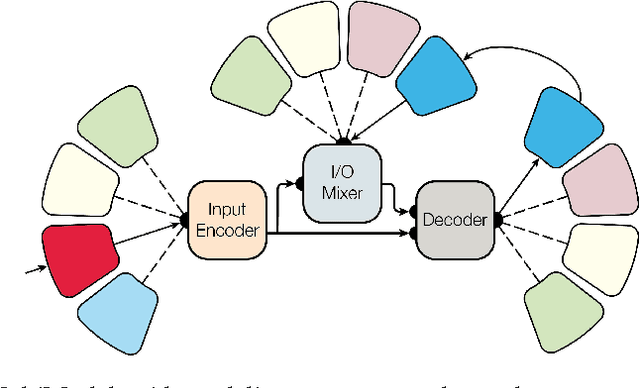
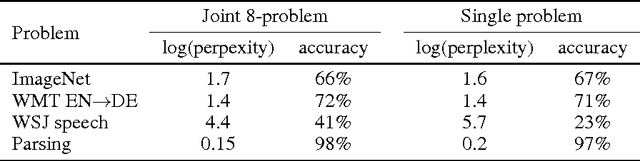
Deep learning yields great results across many fields, from speech recognition, image classification, to translation. But for each problem, getting a deep model to work well involves research into the architecture and a long period of tuning. We present a single model that yields good results on a number of problems spanning multiple domains. In particular, this single model is trained concurrently on ImageNet, multiple translation tasks, image captioning (COCO dataset), a speech recognition corpus, and an English parsing task. Our model architecture incorporates building blocks from multiple domains. It contains convolutional layers, an attention mechanism, and sparsely-gated layers. Each of these computational blocks is crucial for a subset of the tasks we train on. Interestingly, even if a block is not crucial for a task, we observe that adding it never hurts performance and in most cases improves it on all tasks. We also show that tasks with less data benefit largely from joint training with other tasks, while performance on large tasks degrades only slightly if at all.
Unsupervised Neural Hidden Markov Models
Sep 28, 2016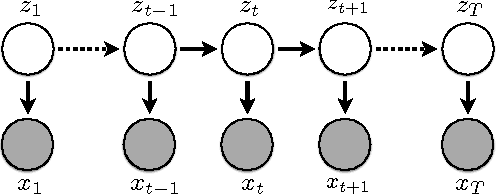
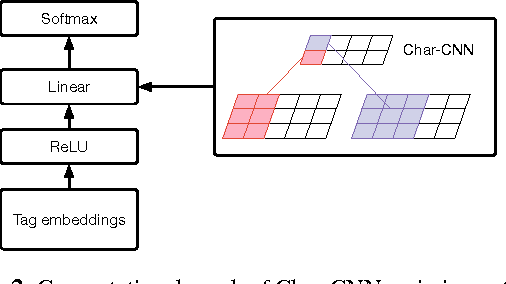
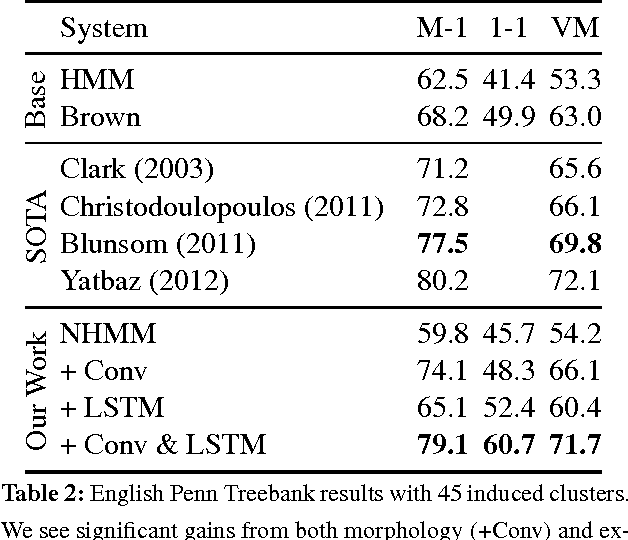
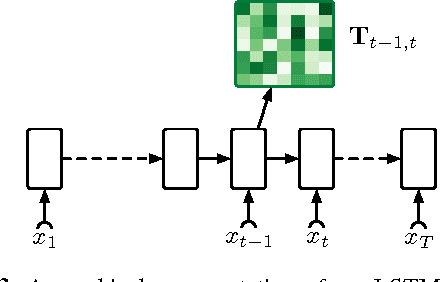
In this work, we present the first results for neuralizing an Unsupervised Hidden Markov Model. We evaluate our approach on tag in- duction. Our approach outperforms existing generative models and is competitive with the state-of-the-art though with a simpler model easily extended to include additional context.