 Add to Chrome
 Add to Firefox
 Add to Edge
SDNGuardStack: An Explainable Ensemble Learning Framework for High-Accuracy Intrusion Detection in Software-Defined Networks
Apr 22, 2026
Software-Defined Networking (SDN) is another technology that has been developing in the last few years as a relevant technique to improve network programmability and administration. Nonetheless, its centralized design presents a major security issue, which requires effective intrusion detection systems. The SDN-specific machine learning-based intrusion detection system described in this paper is innovative because it is trained and tested on the InSDN dataset which models attack scenarios and realistic traffic patterns in SDN. Our approach incorporates a comprehensive preprocessing pipeline, feature selection via Mutual Information, and a novel ensemble learning model, SDNGuardStack, which combines multiple base learners to enhance detection accuracy and efficiency. In addition, we include explainable AI methods, including SHAP to add transparency to model predictions, which helps security analysts respond to incidents. The experiments prove that SDNGuard-Stack has an accuracy rate of 99.98% and a Cohen Kappa of 0.9998, surpassing other models, and at the same time being interpretable and practically executable. It is interesting to see such features like Flow ID, Bwd Header Len, and Src Port as the most important factors in the model predictions. The work is a step towards closing the gap between performance intrusion detection and realistic deployment in SDN, which will lead to the creation of secure and resilient network infrastructures.

An Optimized Decision Tree-Based Framework for Explainable IoT Anomaly Detection
Jan 18, 2026The increase in the number of Internet of Things (IoT) devices has tremendously increased the attack surface of cyber threats thus making a strong intrusion detection system (IDS) with a clear explanation of the process essential towards resource-constrained environments. Nevertheless, current IoT IDS systems are usually traded off with detection quality, model elucidability, and computational effectiveness, thus the deployment on IoT devices. The present paper counteracts these difficulties by suggesting an explainable AI (XAI) framework based on an optimized Decision Tree classifier with both local and global importance methods: SHAP values that estimate feature attribution using local explanations, and Morris sensitivity analysis that identifies the feature importance in a global view. The proposed system attains the state of art on the test performance with 99.91% accuracy, F1-score of 99.51% and Cohen Kappa of 0.9960 and high stability is confirmed by a cross validation mean accuracy of 98.93%. Efficiency is also enhanced in terms of computations to provide faster inferences compared to those that are generalized in ensemble models. SrcMac has shown as the most significant predictor in feature analyses according to SHAP and Morris methods. Compared to the previous work, our solution eliminates its major drawback lack because it allows us to apply it to edge devices and, therefore, achieve real-time processing, adhere to the new regulation of transparency in AI, and achieve high detection rates on attacks of dissimilar classes. This combination performance of high accuracy, explainability, and low computation make the framework useful and reliable as a resource-constrained IoT security problem in real environments.
StackLiverNet: A Novel Stacked Ensemble Model for Accurate and Interpretable Liver Disease Detection
Jul 31, 2025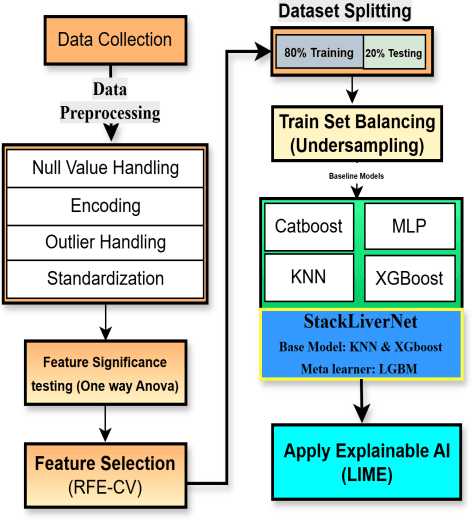

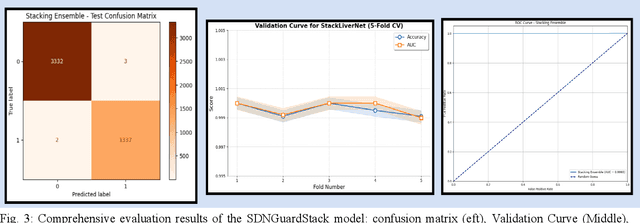
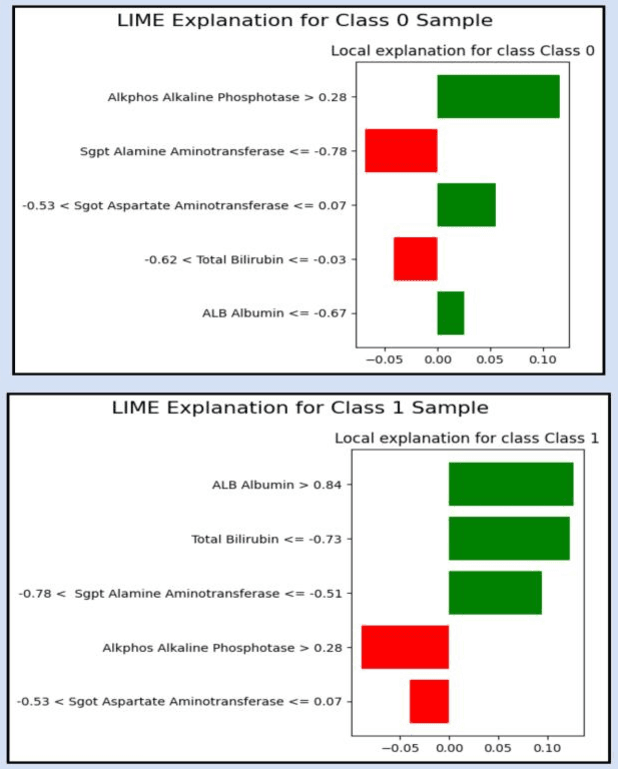
Liver diseases are a serious health concern in the world, which requires precise and timely diagnosis to enhance the survival chances of patients. The current literature implemented numerous machine learning and deep learning models to classify liver diseases, but most of them had some issues like high misclassification error, poor interpretability, prohibitive computational expense, and lack of good preprocessing strategies. In order to address these drawbacks, we introduced StackLiverNet in this study; an interpretable stacked ensemble model tailored to the liver disease detection task. The framework uses advanced data preprocessing and feature selection technique to increase model robustness and predictive ability. Random undersampling is performed to deal with class imbalance and make the training balanced. StackLiverNet is an ensemble of several hyperparameter-optimized base classifiers, whose complementary advantages are used through a LightGBM meta-model. The provided model demonstrates excellent performance, with the testing accuracy of 99.89%, Cohen Kappa of 0.9974, and AUC of 0.9993, having only 5 misclassifications, and efficient training and inference speeds that are amenable to clinical practice (training time 4.2783 seconds, inference time 0.1106 seconds). Besides, Local Interpretable Model-Agnostic Explanations (LIME) are applied to generate transparent explanations of individual predictions, revealing high concentrations of Alkaline Phosphatase and moderate SGOT as important observations of liver disease. Also, SHAP was used to rank features by their global contribution to predictions, while the Morris method confirmed the most influential features through sensitivity analysis.