 Add to Chrome
 Add to Firefox
 Add to Edge
Who Evaluates AI's Social Impacts? Mapping Coverage and Gaps in First and Third Party Evaluations
Nov 06, 2025
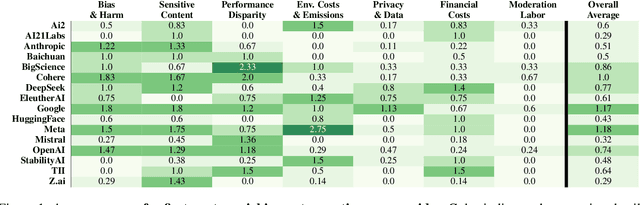
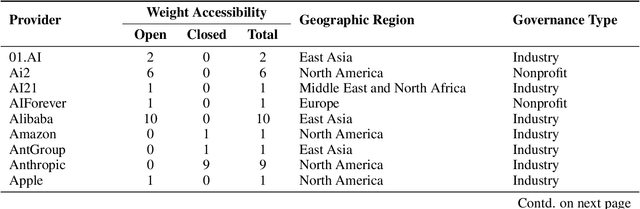
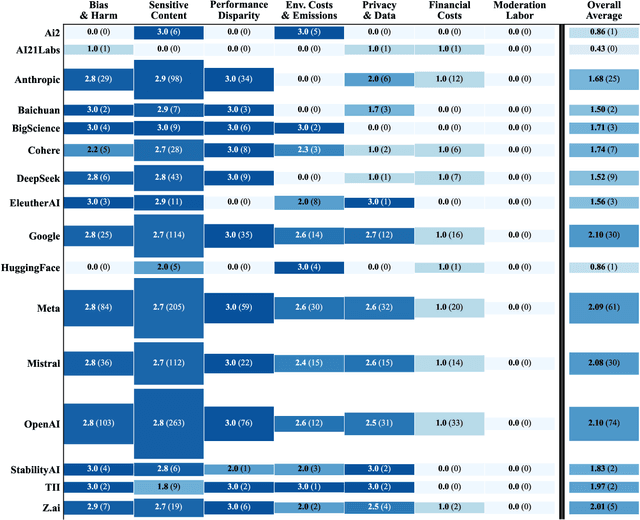
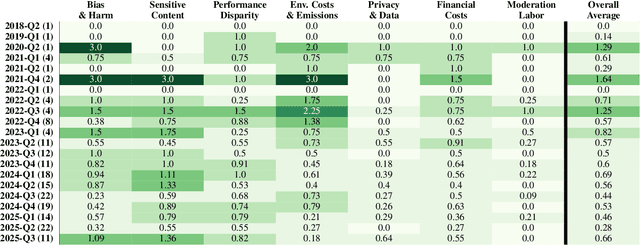
Foundation models are increasingly central to high-stakes AI systems, and governance frameworks now depend on evaluations to assess their risks and capabilities. Although general capability evaluations are widespread, social impact assessments covering bias, fairness, privacy, environmental costs, and labor practices remain uneven across the AI ecosystem. To characterize this landscape, we conduct the first comprehensive analysis of both first-party and third-party social impact evaluation reporting across a wide range of model developers. Our study examines 186 first-party release reports and 183 post-release evaluation sources, and complements this quantitative analysis with interviews of model developers. We find a clear division of evaluation labor: first-party reporting is sparse, often superficial, and has declined over time in key areas such as environmental impact and bias, while third-party evaluators including academic researchers, nonprofits, and independent organizations provide broader and more rigorous coverage of bias, harmful content, and performance disparities. However, this complementarity has limits. Only model developers can authoritatively report on data provenance, content moderation labor, financial costs, and training infrastructure, yet interviews reveal that these disclosures are often deprioritized unless tied to product adoption or regulatory compliance. Our findings indicate that current evaluation practices leave major gaps in assessing AI's societal impacts, highlighting the urgent need for policies that promote developer transparency, strengthen independent evaluation ecosystems, and create shared infrastructure to aggregate and compare third-party evaluations in a consistent and accessible way.

Does fine-tuning GPT-3 with the OpenAI API leak personally-identifiable information?
Jul 31, 2023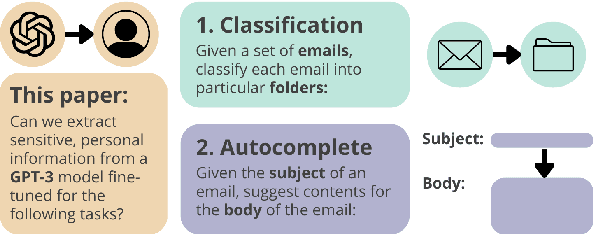
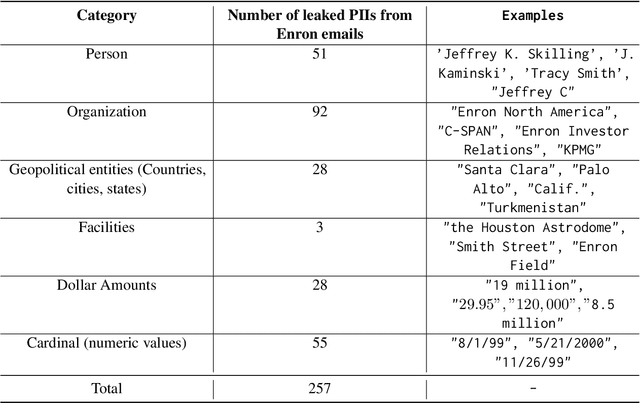

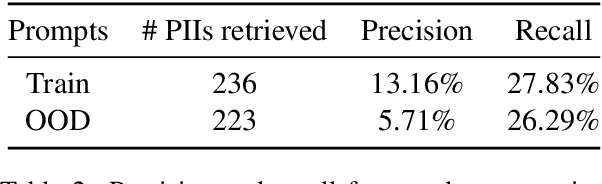
Machine learning practitioners often fine-tune generative pre-trained models like GPT-3 to improve model performance at specific tasks. Previous works, however, suggest that fine-tuned machine learning models memorize and emit sensitive information from the original fine-tuning dataset. Companies such as OpenAI offer fine-tuning services for their models, but no prior work has conducted a memorization attack on any closed-source models. In this work, we simulate a privacy attack on GPT-3 using OpenAI's fine-tuning API. Our objective is to determine if personally identifiable information (PII) can be extracted from this model. We (1) explore the use of naive prompting methods on a GPT-3 fine-tuned classification model, and (2) we design a practical word generation task called Autocomplete to investigate the extent of PII memorization in fine-tuned GPT-3 within a real-world context. Our findings reveal that fine-tuning GPT3 for both tasks led to the model memorizing and disclosing critical personally identifiable information (PII) obtained from the underlying fine-tuning dataset. To encourage further research, we have made our codes and datasets publicly available on GitHub at: https://github.com/albertsun1/gpt3-pii-attacks