 Add to Chrome
 Add to Firefox
 Add to Edge
A Novel Approach to Distributed Multi-Class SVM
Dec 07, 2015


With data sizes constantly expanding, and with classical machine learning algorithms that analyze such data requiring larger and larger amounts of computation time and storage space, the need to distribute computation and memory requirements among several computers has become apparent. Although substantial work has been done in developing distributed binary SVM algorithms and multi-class SVM algorithms individually, the field of multi-class distributed SVMs remains largely unexplored. This research proposes a novel algorithm that implements the Support Vector Machine over a multi-class dataset and is efficient in a distributed environment (here, Hadoop). The idea is to divide the dataset into half recursively and thus compute the optimal Support Vector Machine for this half during the training phase, much like a divide and conquer approach. While testing, this structure has been effectively exploited to significantly reduce the prediction time. Our algorithm has shown better computation time during the prediction phase than the traditional sequential SVM methods (One vs. One, One vs. Rest) and out-performs them as the size of the dataset grows. This approach also classifies the data with higher accuracy than the traditional multi-class algorithms.
* 8 Pages

Hybrid Approach for Inductive Semi Supervised Learning using Label Propagation and Support Vector Machine
Dec 02, 2015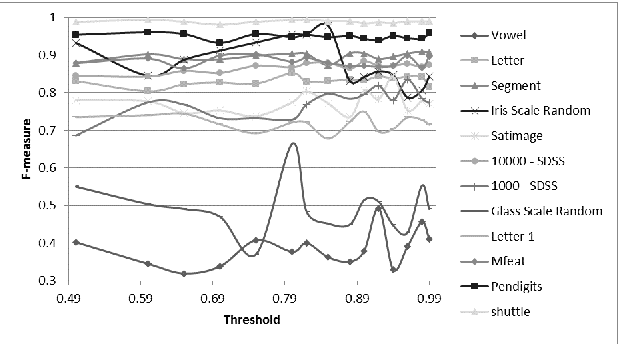


Semi supervised learning methods have gained importance in today's world because of large expenses and time involved in labeling the unlabeled data by human experts. The proposed hybrid approach uses SVM and Label Propagation to label the unlabeled data. In the process, at each step SVM is trained to minimize the error and thus improve the prediction quality. Experiments are conducted by using SVM and logistic regression(Logreg). Results prove that SVM performs tremendously better than Logreg. The approach is tested using 12 datasets of different sizes ranging from the order of 1000s to the order of 10000s. Results show that the proposed approach outperforms Label Propagation by a large margin with F-measure of almost twice on average. The parallel version of the proposed approach is also designed and implemented, the analysis shows that the training time decreases significantly when parallel version is used.
Centroid Based Binary Tree Structured SVM for Multi Classification
Dec 02, 2015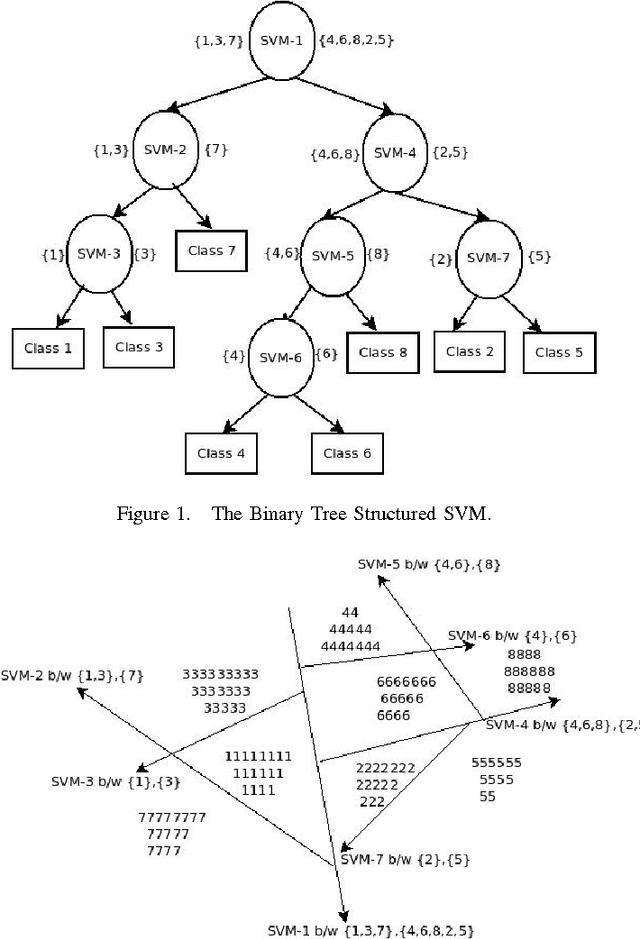


Support Vector Machines (SVMs) were primarily designed for 2-class classification. But they have been extended for N-class classification also based on the requirement of multiclasses in the practical applications. Although N-class classification using SVM has considerable research attention, getting minimum number of classifiers at the time of training and testing is still a continuing research. We propose a new algorithm CBTS-SVM (Centroid based Binary Tree Structured SVM) which addresses this issue. In this we build a binary tree of SVM models based on the similarity of the class labels by finding their distance from the corresponding centroids at the root level. The experimental results demonstrates the comparable accuracy for CBTS with OVO with reasonable gamma and cost values. On the other hand when CBTS is compared with OVA, it gives the better accuracy with reduced training time and testing time. Furthermore CBTS is also scalable as it is able to handle the large data sets.
* Presented in ICACCI, Kochi, India, 2015