 Add to Chrome
 Add to Firefox
 Add to Edge
Policy-Aligned Estimation of Conditional Average Treatment Effects
Dec 15, 2025
Firms often develop targeting policies to personalize marketing actions and improve incremental profits. Effective targeting depends on accurately separating customers with positive versus negative treatment effects. We propose an approach to estimate the conditional average treatment effects (CATEs) of marketing actions that aligns their estimation with the firm's profit objective. The method recognizes that, for many customers, treatment effects are so extreme that additional accuracy is unlikely to change the recommended actions. However, accuracy matters near the decision boundary, as small errors can alter targeting decisions. By modifying the firm's objective function in the standard profit maximization problem, our method yields a near-optimal targeting policy while simultaneously estimating CATEs. This introduces a new perspective on CATE estimation, reframing it as a problem of profit optimization rather than prediction accuracy. We establish the theoretical properties of the proposed method and demonstrate its performance and trade-offs using synthetic data.

POA: Passable Obstacles Aware Path-planning Algorithm for Navigation of a Two-wheeled Robot in Highly Cluttered Environments
Jul 16, 2023This paper focuses on Passable Obstacles Aware (POA) planner - a novel navigation method for two-wheeled robots in a highly cluttered environment. The navigation algorithm detects and classifies objects to distinguish two types of obstacles - passable and unpassable. Our algorithm allows two-wheeled robots to find a path through passable obstacles. Such a solution helps the robot working in areas inaccessible to standard path planners and find optimal trajectories in scenarios with a high number of objects in the robot's vicinity. The POA planner can be embedded into other planning algorithms and enables them to build a path through obstacles. Our method decreases path length and the total travel time to the final destination up to 43% and 39%, respectively, comparing to standard path planners such as GVD, A*, and RRT*
Design and Evaluation of Product Aesthetics: A Human-Machine Hybrid Approach
Jul 17, 2019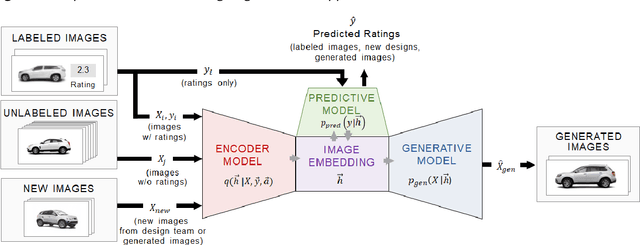
Aesthetics are critically important to market acceptance in many product categories. In the automotive industry in particular, an improved aesthetic design can boost sales by 30% or more. Firms invest heavily in designing and testing new product aesthetics. A single automotive "theme clinic" costs between \$100,000 and \$1,000,000, and hundreds are conducted annually. We use machine learning to augment human judgment when designing and testing new product aesthetics. The model combines a probabilistic variational autoencoder (VAE) and adversarial components from generative adversarial networks (GAN), along with modeling assumptions that address managerial requirements for firm adoption. We train our model with data from an automotive partner-7,000 images evaluated by targeted consumers and 180,000 high-quality unrated images. Our model predicts well the appeal of new aesthetic designs-38% improvement relative to a baseline and substantial improvement over both conventional machine learning models and pretrained deep learning models. New automotive designs are generated in a controllable manner for the design team to consider, which we also empirically verify are appealing to consumers. These results, combining human and machine inputs for practical managerial usage, suggest that machine learning offers significant opportunity to augment aesthetic design.