 Add to Chrome
 Add to Firefox
 Add to Edge
HiVAE: Hierarchical Latent Variables for Scalable Theory of Mind
Feb 18, 2026
Theory of mind (ToM) enables AI systems to infer agents' hidden goals and mental states, but existing approaches focus mainly on small human understandable gridworld spaces. We introduce HiVAE, a hierarchical variational architecture that scales ToM reasoning to realistic spatiotemporal domains. Inspired by the belief-desire-intention structure of human cognition, our three-level VAE hierarchy achieves substantial performance improvements on a 3,185-node campus navigation task. However, we identify a critical limitation: while our hierarchical structure improves prediction, learned latent representations lack explicit grounding to actual mental states. We propose self-supervised alignment strategies and present this work to solicit community feedback on grounding approaches.

SANGO: Socially Aware Navigation through Grouped Obstacles
Nov 29, 2024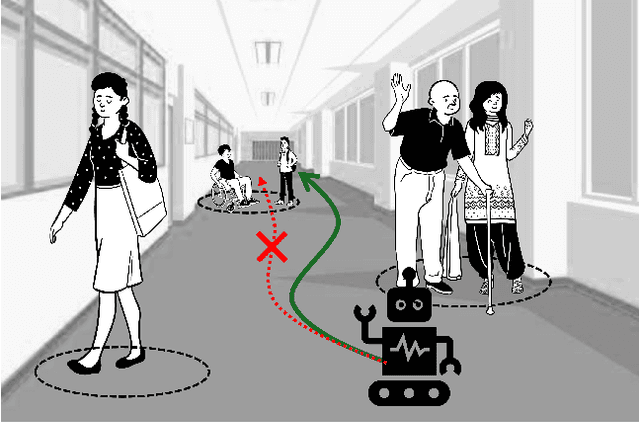
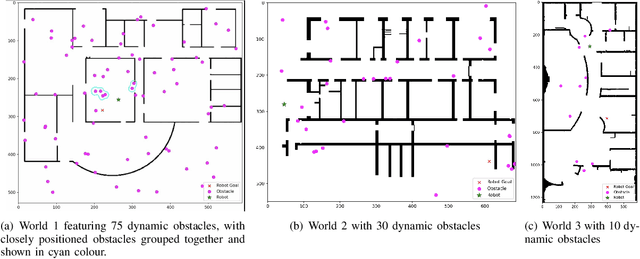
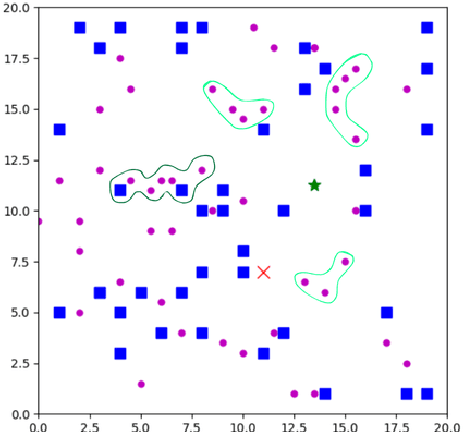
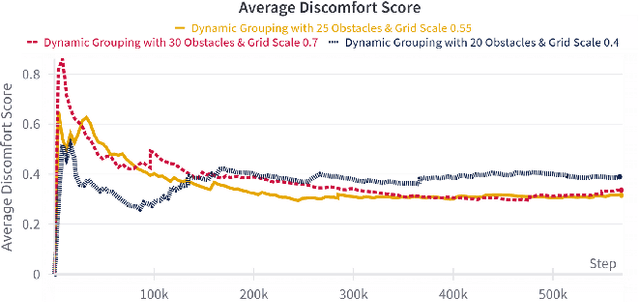
This paper introduces SANGO (Socially Aware Navigation through Grouped Obstacles), a novel method that ensures socially appropriate behavior by dynamically grouping obstacles and adhering to social norms. Using deep reinforcement learning, SANGO trains agents to navigate complex environments leveraging the DBSCAN algorithm for obstacle clustering and Proximal Policy Optimization (PPO) for path planning. The proposed approach improves safety and social compliance by maintaining appropriate distances and reducing collision rates. Extensive experiments conducted in custom simulation environments demonstrate SANGO's superior performance in significantly reducing discomfort (by up to 83.5%), reducing collision rates (by up to 29.4%) and achieving higher successful navigation in dynamic and crowded scenarios. These findings highlight the potential of SANGO for real-world applications, paving the way for advanced socially adept robotic navigation systems.