 Add to Chrome
 Add to Firefox
 Add to Edge
Beyond Benchmarks of IUGC: Rethinking Requirements of Deep Learning Methods for Intrapartum Ultrasound Biometry from Fetal Ultrasound Videos
Feb 13, 2026
A substantial proportion (45\%) of maternal deaths, neonatal deaths, and stillbirths occur during the intrapartum phase, with a particularly high burden in low- and middle-income countries. Intrapartum biometry plays a critical role in monitoring labor progression; however, the routine use of ultrasound in resource-limited settings is hindered by a shortage of trained sonographers. To address this challenge, the Intrapartum Ultrasound Grand Challenge (IUGC), co-hosted with MICCAI 2024, was launched. The IUGC introduces a clinically oriented multi-task automatic measurement framework that integrates standard plane classification, fetal head-pubic symphysis segmentation, and biometry, enabling algorithms to exploit complementary task information for more accurate estimation. Furthermore, the challenge releases the largest multi-center intrapartum ultrasound video dataset to date, comprising 774 videos (68,106 frames) collected from three hospitals, providing a robust foundation for model training and evaluation. In this study, we present a comprehensive overview of the challenge design, review the submissions from eight participating teams, and analyze their methods from five perspectives: preprocessing, data augmentation, learning strategy, model architecture, and post-processing. In addition, we perform a systematic analysis of the benchmark results to identify key bottlenecks, explore potential solutions, and highlight open challenges for future research. Although encouraging performance has been achieved, our findings indicate that the field remains at an early stage, and further in-depth investigation is required before large-scale clinical deployment. All benchmark solutions and the complete dataset have been publicly released to facilitate reproducible research and promote continued advances in automatic intrapartum ultrasound biometry.

TiBiX: Leveraging Temporal Information for Bidirectional X-ray and Report Generation
Mar 20, 2024
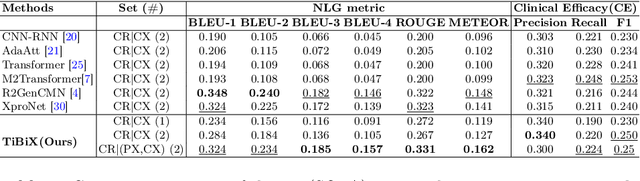
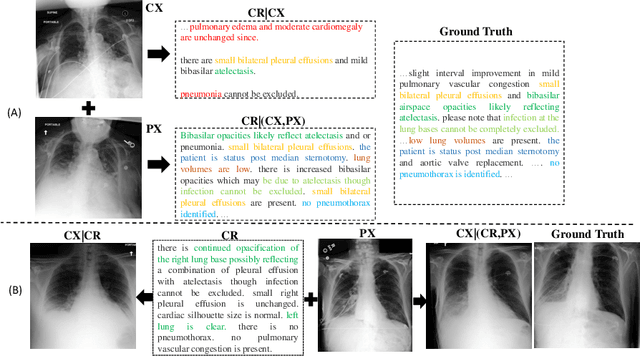
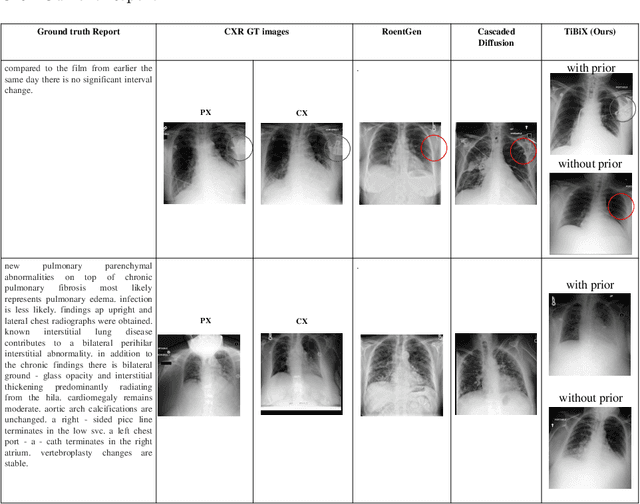
With the emergence of vision language models in the medical imaging domain, numerous studies have focused on two dominant research activities: (1) report generation from Chest X-rays (CXR), and (2) synthetic scan generation from text or reports. Despite some research incorporating multi-view CXRs into the generative process, prior patient scans and reports have been generally disregarded. This can inadvertently lead to the leaving out of important medical information, thus affecting generation quality. To address this, we propose TiBiX: Leveraging Temporal information for Bidirectional X-ray and Report Generation. Considering previous scans, our approach facilitates bidirectional generation, primarily addressing two challenging problems: (1) generating the current image from the previous image and current report and (2) generating the current report based on both the previous and current images. Moreover, we extract and release a curated temporal benchmark dataset derived from the MIMIC-CXR dataset, which focuses on temporal data. Our comprehensive experiments and ablation studies explore the merits of incorporating prior CXRs and achieve state-of-the-art (SOTA) results on the report generation task. Furthermore, we attain on-par performance with SOTA image generation efforts, thus serving as a new baseline in longitudinal bidirectional CXR-to-report generation. The code is available at https://github.com/BioMedIA-MBZUAI/TiBiX.