 Add to Chrome
 Add to Firefox
 Add to Edge
4D Gaussian Splatting as a Learned Dynamical System
Dec 22, 2025
We reinterpret 4D Gaussian Splatting as a continuous-time dynamical system, where scene motion arises from integrating a learned neural dynamical field rather than applying per-frame deformations. This formulation, which we call EvoGS, treats the Gaussian representation as an evolving physical system whose state evolves continuously under a learned motion law. This unlocks capabilities absent in deformation-based approaches:(1) sample-efficient learning from sparse temporal supervision by modeling the underlying motion law; (2) temporal extrapolation enabling forward and backward prediction beyond observed time ranges; and (3) compositional dynamics that allow localized dynamics injection for controllable scene synthesis. Experiments on dynamic scene benchmarks show that EvoGS achieves better motion coherence and temporal consistency compared to deformation-field baselines while maintaining real-time rendering

MedAutoCorrect: Image-Conditioned Autocorrection in Medical Reporting
Dec 04, 2024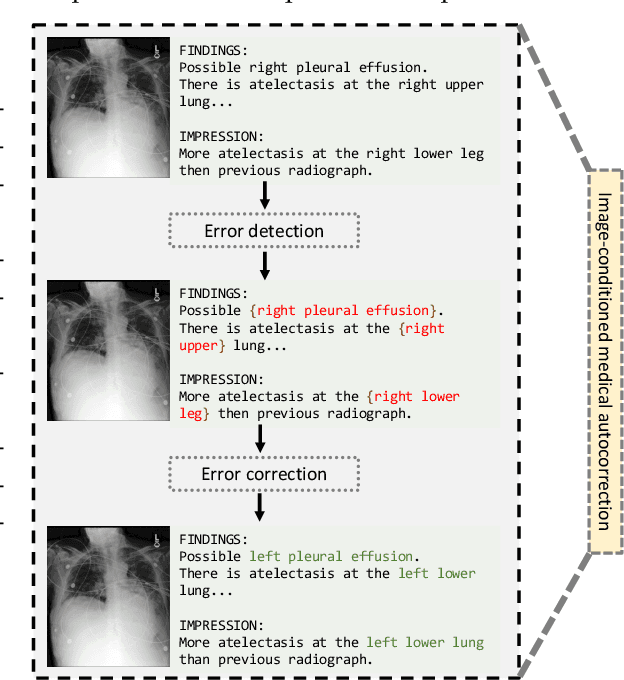


In medical reporting, the accuracy of radiological reports, whether generated by humans or machine learning algorithms, is critical. We tackle a new task in this paper: image-conditioned autocorrection of inaccuracies within these reports. Using the MIMIC-CXR dataset, we first intentionally introduce a diverse range of errors into reports. Subsequently, we propose a two-stage framework capable of pinpointing these errors and then making corrections, simulating an \textit{autocorrection} process. This method aims to address the shortcomings of existing automated medical reporting systems, like factual errors and incorrect conclusions, enhancing report reliability in vital healthcare applications. Importantly, our approach could serve as a guardrail, ensuring the accuracy and trustworthiness of automated report generation. Experiments on established datasets and state of the art report generation models validate this method's potential in correcting medical reporting errors.