 Add to Chrome
 Add to Firefox
 Add to Edge
A methodology for analyzing financial needs hierarchy from social discussions using LLM
Feb 06, 2026
This study examines the hierarchical structure of financial needs as articulated in social media discourse, employing generative AI techniques to analyze large-scale textual data. While human needs encompass a broad spectrum from fundamental survival to psychological fulfillment financial needs are particularly critical, influencing both individual well-being and day-to-day decision-making. Our research advances the understanding of financial behavior by utilizing large language models (LLMs) to extract and analyze expressions of financial needs from social media posts. We hypothesize that financial needs are organized hierarchically, progressing from short-term essentials to long-term aspirations, consistent with theoretical frameworks established in the behavioral sciences. Through computational analysis, we demonstrate the feasibility of identifying these needs and validate the presence of a hierarchical structure within them. In addition to confirming this structure, our findings provide novel insights into the content and themes of financial discussions online. By inferring underlying needs from naturally occurring language, this approach offers a scalable and data-driven alternative to conventional survey methodologies, enabling a more dynamic and nuanced understanding of financial behavior in real-world contexts.

Leveraging LLMs for Mental Health: Detection and Recommendations from Social Discussions
Mar 03, 2025Textual data from social platforms captures various aspects of mental health through discussions around and across issues, while users reach out for help and others sympathize and offer support. We propose a comprehensive framework that leverages Natural Language Processing (NLP) and Generative AI techniques to identify and assess mental health disorders, detect their severity, and create recommendations for behavior change and therapeutic interventions based on users' posts on Reddit. To classify the disorders, we use rule-based labeling methods as well as advanced pre-trained NLP models to extract nuanced semantic features from the data. We fine-tune domain-adapted and generic pre-trained NLP models based on predictions from specialized Large Language Models (LLMs) to improve classification accuracy. Our hybrid approach combines the generalization capabilities of pre-trained models with the domain-specific insights captured by LLMs, providing an improved understanding of mental health discourse. Our findings highlight the strengths and limitations of each model, offering valuable insights into their practical applicability. This research potentially facilitates early detection and personalized care to aid practitioners and aims to facilitate timely interventions and improve overall well-being, thereby contributing to the broader field of mental health surveillance and digital health analytics.
CAMTA: Casual Attention Model for Multi-touch Attribution
Dec 21, 2020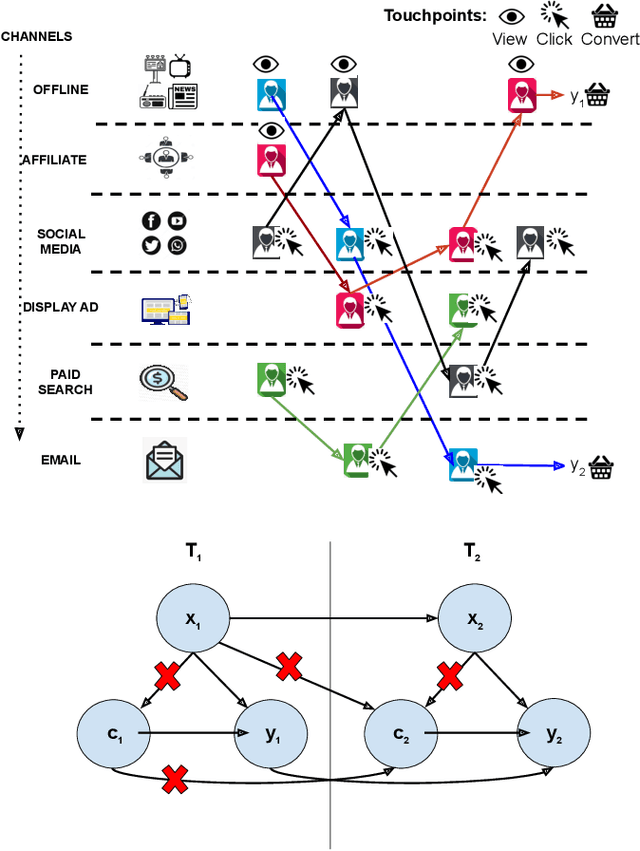
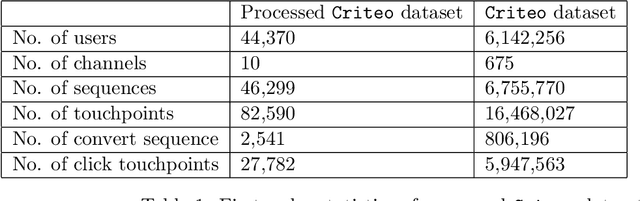
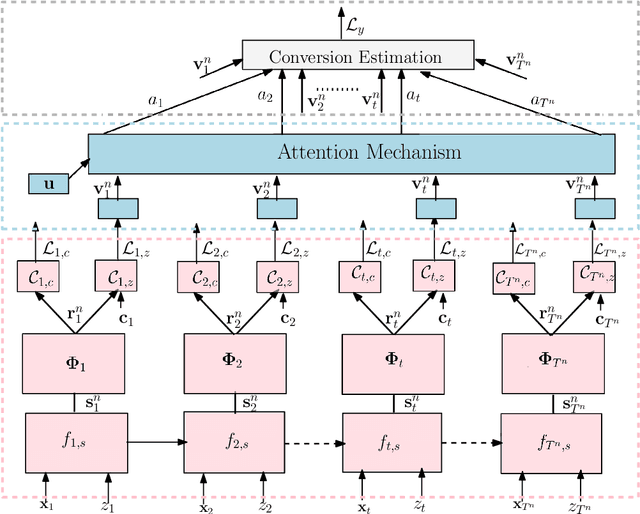
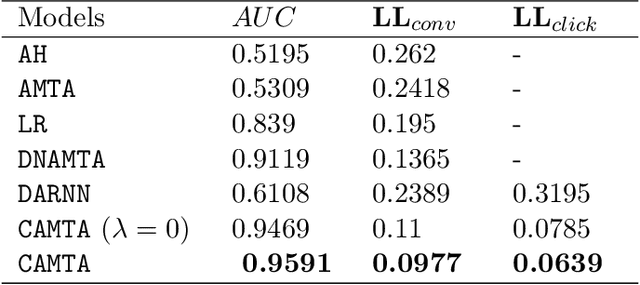
Advertising channels have evolved from conventional print media, billboards and radio advertising to online digital advertising (ad), where the users are exposed to a sequence of ad campaigns via social networks, display ads, search etc. While advertisers revisit the design of ad campaigns to concurrently serve the requirements emerging out of new ad channels, it is also critical for advertisers to estimate the contribution from touch-points (view, clicks, converts) on different channels, based on the sequence of customer actions. This process of contribution measurement is often referred to as multi-touch attribution (MTA). In this work, we propose CAMTA, a novel deep recurrent neural network architecture which is a casual attribution mechanism for user-personalised MTA in the context of observational data. CAMTA minimizes the selection bias in channel assignment across time-steps and touchpoints. Furthermore, it utilizes the users' pre-conversion actions in a principled way in order to predict pre-channel attribution. To quantitatively benchmark the proposed MTA model, we employ the real world Criteo dataset and demonstrate the superior performance of CAMTA with respect to prediction accuracy as compared to several baselines. In addition, we provide results for budget allocation and user-behaviour modelling on the predicted channel attribution.
Hi-CI: Deep Causal Inference in High Dimensions
Aug 22, 2020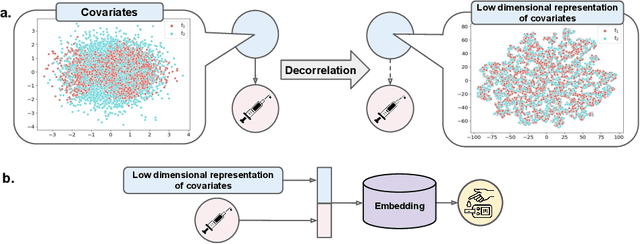
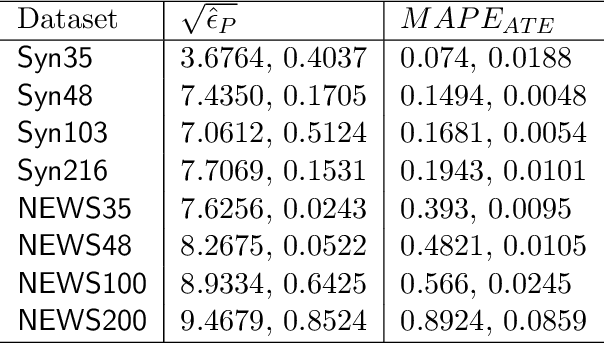
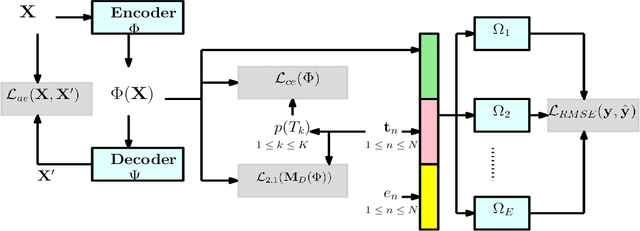
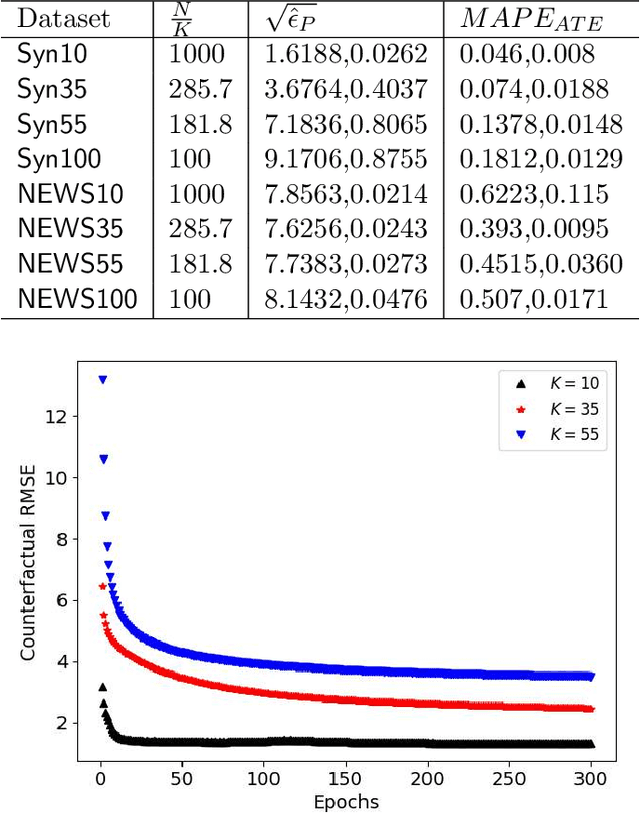
We address the problem of counterfactual regression using causal inference (CI) in observational studies consisting of high dimensional covariates and high cardinality treatments. Confounding bias, which leads to inaccurate treatment effect estimation, is attributed to covariates that affect both treatments and outcome. The presence of high-dimensional co-variates exacerbates the impact of bias as it is harder to isolate and measure the impact of these confounders. In the presence of high-cardinality treatment variables, CI is rendered ill-posed due to the increase in the number of counterfactual outcomes to be predicted. We propose Hi-CI, a deep neural network (DNN) based framework for estimating causal effects in the presence of large number of covariates, and high-cardinal and continuous treatment variables. The proposed architecture comprises of a decorrelation network and an outcome prediction network. In the decorrelation network, we learn a data representation in lower dimensions as compared to the original covariates and addresses confounding bias alongside. Subsequently, in the outcome prediction network, we learn an embedding of high-cardinality and continuous treatments, jointly with the data representation. We demonstrate the efficacy of causal effect prediction of the proposed Hi-CI network using synthetic and real-world NEWS datasets.
MultiMBNN: Matched and Balanced Causal Inference with Neural Networks
Apr 29, 2020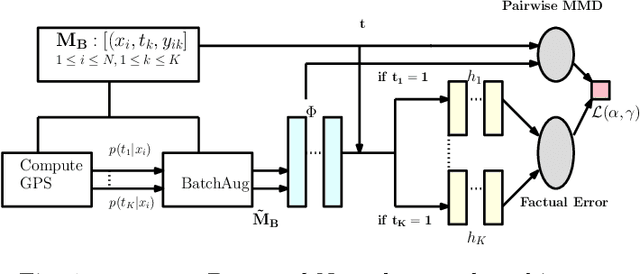
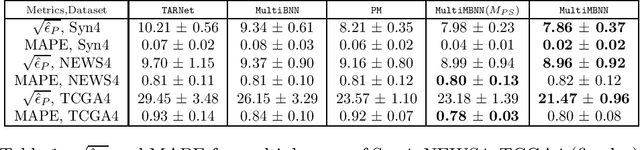
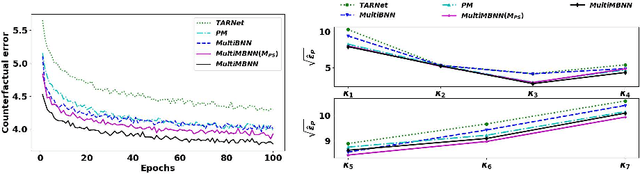
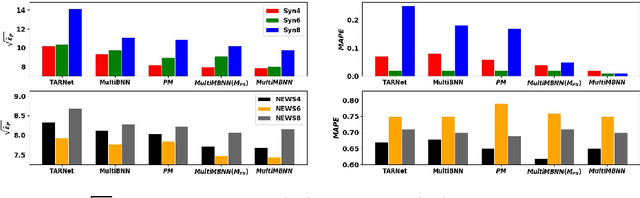
Causal inference (CI) in observational studies has received a lot of attention in healthcare, education, ad attribution, policy evaluation, etc. Confounding is a typical hazard, where the context affects both, the treatment assignment and response. In a multiple treatment scenario, we propose the neural network based MultiMBNN, where we overcome confounding by employing generalized propensity score based matching, and learning balanced representations. We benchmark the performance on synthetic and real-world datasets using PEHE, and mean absolute percentage error over ATE as metrics. MultiMBNN outperforms the state-of-the-art algorithms for CI such as TARNet and Perfect Match (PM).
MetaCI: Meta-Learning for Causal Inference in a Heterogeneous Population
Dec 09, 2019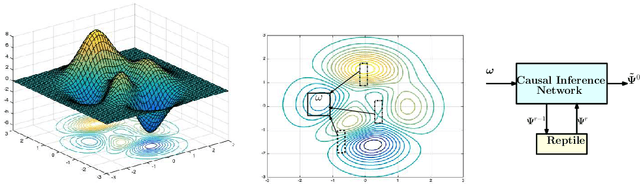
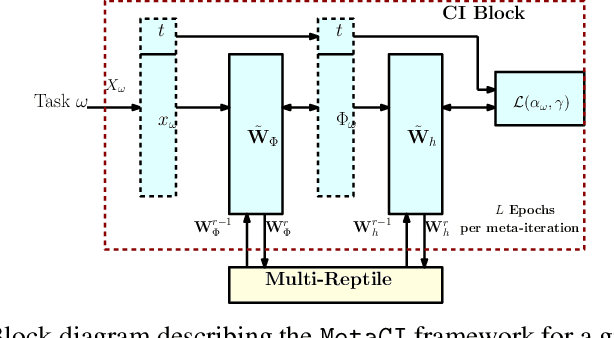
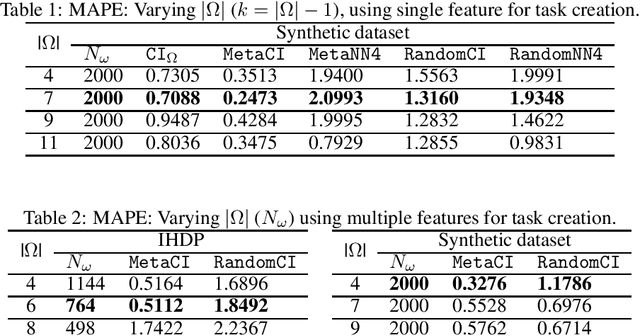
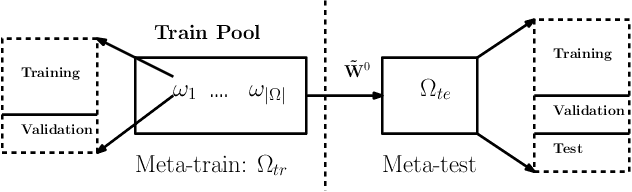
Performing inference on data obtained through observational studies is becoming extremely relevant due to the widespread availability of data in fields such as healthcare, education, retail, etc. Furthermore, this data is accrued from multiple homogeneous subgroups of a heterogeneous population, and hence, generalizing the inference mechanism over such data is essential. We propose the MetaCI framework with the goal of answering counterfactual questions in the context of causal inference (CI), where the factual observations are obtained from several homogeneous subgroups. While the CI network is designed to generalize from factual to counterfactual distribution in order to tackle covariate shift, MetaCI employs the meta-learning paradigm to tackle the shift in data distributions between training and test phase due to the presence of heterogeneity in the population, and due to drifts in the target distribution, also known as concept shift. We benchmark the performance of the MetaCI algorithm using the mean absolute percentage error over the average treatment effect as the metric, and demonstrate that meta initialization has significant gains compared to randomly initialized networks, and other methods.
Prosocial or Selfish? Agents with different behaviors for Contract Negotiation using Reinforcement Learning
Sep 19, 2018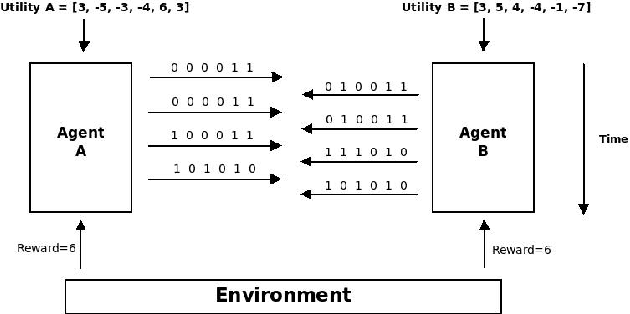
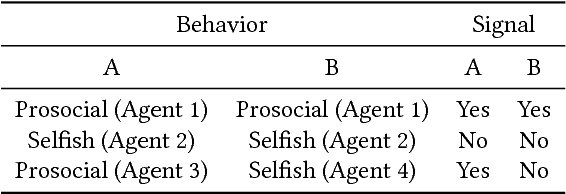
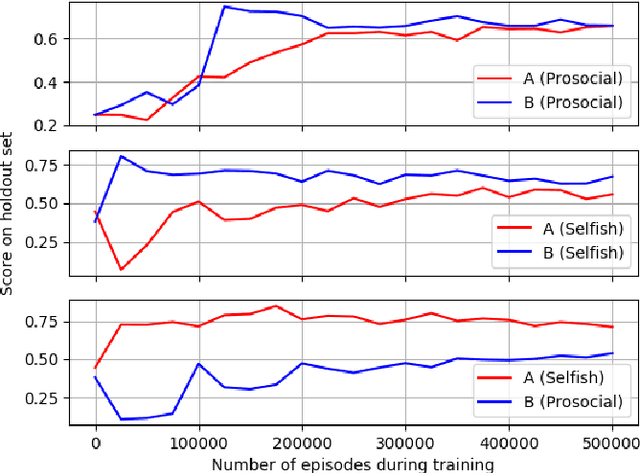
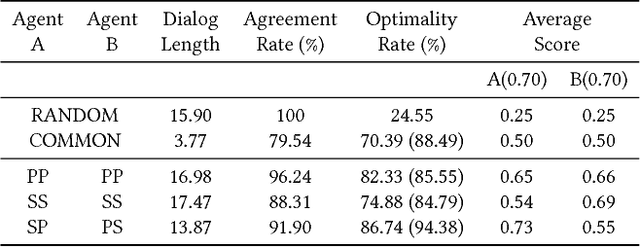
We present an effective technique for training deep learning agents capable of negotiating on a set of clauses in a contract agreement using a simple communication protocol. We use Multi Agent Reinforcement Learning to train both agents simultaneously as they negotiate with each other in the training environment. We also model selfish and prosocial behavior to varying degrees in these agents. Empirical evidence is provided showing consistency in agent behaviors. We further train a meta agent with a mixture of behaviors by learning an ensemble of different models using reinforcement learning. Finally, to ascertain the deployability of the negotiating agents, we conducted experiments pitting the trained agents against human players. Results demonstrate that the agents are able to hold their own against human players, often emerging as winners in the negotiation. Our experiments demonstrate that the meta agent is able to reasonably emulate human behavior.