 Add to Chrome
 Add to Firefox
 Add to Edge
Learning Quantised Structure-Preserving Motion Representations for Dance Fingerprinting
Apr 01, 2026
We present DANCEMATCH, an end-to-end framework for motion-based dance retrieval, the task of identifying semantically similar choreographies directly from raw video, defined as DANCE FINGERPRINTING. While existing motion analysis and retrieval methods can compare pose sequences, they rely on continuous embeddings that are difficult to index, interpret, or scale. In contrast, DANCEMATCH constructs compact, discrete motion signatures that capture the spatio-temporal structure of dance while enabling efficient large-scale retrieval. Our system integrates Skeleton Motion Quantisation (SMQ) with Spatio-Temporal Transformers (STT) to encode human poses, extracted via Apple CoMotion, into a structured motion vocabulary. We further design DANCE RETRIEVAL ENGINE (DRE), which performs sub-linear retrieval using a histogram-based index followed by re-ranking for refined matching. To facilitate reproducible research, we release DANCETYPESBENCHMARK, a pose-aligned dataset annotated with quantised motion tokens. Experiments demonstrate robust retrieval across diverse dance styles and strong generalisation to unseen choreographies, establishing a foundation for scalable motion fingerprinting and quantitative choreographic analysis.

Exposing Hidden Interfaces: LLM-Guided Type Inference for Reverse Engineering macOS Private Frameworks
Jan 04, 2026Private macOS frameworks underpin critical services and daemons but remain undocumented and distributed only as stripped binaries, complicating security analysis. We present MOTIF, an agentic framework that integrates tool-augmented analysis with a finetuned large language model specialized for Objective-C type inference. The agent manages runtime metadata extraction, binary inspection, and constraint checking, while the model generates candidate method signatures that are validated and refined into compilable headers. On MOTIF-Bench, a benchmark built from public frameworks with groundtruth headers, MOTIF improves signature recovery from 15% to 86% compared to baseline static analysis tooling, with consistent gains in tool-use correctness and inference stability. Case studies on private frameworks show that reconstructed headers compile, link, and facilitate downstream security research and vulnerability studies. By transforming opaque binaries into analyzable interfaces, MOTIF establishes a scalable foundation for systematic auditing of macOS internals.
FlexInfer: Breaking Memory Constraint via Flexible and Efficient Offloading for On-Device LLM Inference
Mar 04, 2025
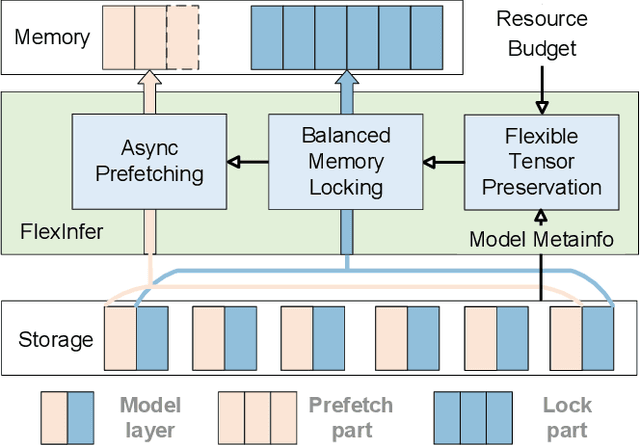
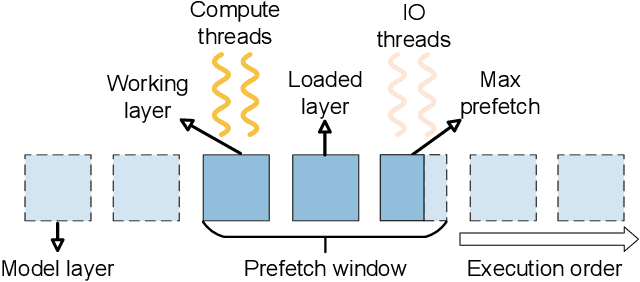
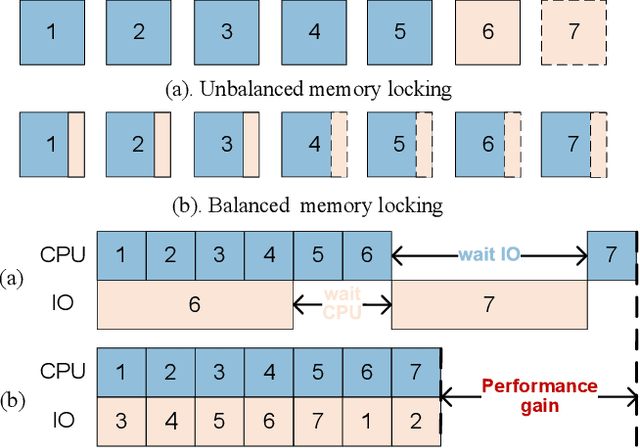
Large Language Models (LLMs) face challenges for on-device inference due to high memory demands. Traditional methods to reduce memory usage often compromise performance and lack adaptability. We propose FlexInfer, an optimized offloading framework for on-device inference, addressing these issues with techniques like asynchronous prefetching, balanced memory locking, and flexible tensor preservation. These strategies enhance memory efficiency and mitigate I/O bottlenecks, ensuring high performance within user-specified resource constraints. Experiments demonstrate that FlexInfer significantly improves throughput under limited resources, achieving up to 12.5 times better performance than existing methods and facilitating the deployment of large models on resource-constrained devices.