 Add to Chrome
 Add to Firefox
 Add to Edge
Ambient Diffusion Policy: Imitation Learning from Suboptimal Data in Robotics
Jun 10, 2026
We propose Ambient Diffusion Policy, a simple and principled method for imitation learning from suboptimal data in robotics. High-quality, task-specific robot data is expensive and time-consuming to collect, while suboptimal datasets with lower-quality or out-of-distribution demonstrations are abundant. Existing methods that co-train on both data sources in robotics often fail to separate the meaningful and the harmful features in the suboptimal samples. In contrast, our method extracts only the useful features by introducing a new axis to co-training in robotics: noise-dependent data usage. Ambient Diffusion Policy restricts the contribution of suboptimal data during training to only the high and low diffusion times. To rigorously justify our approach, we first observe that robot action data exhibits a spectral power law. This induces two important properties on the optimal Diffusion Policy that we exploit: a global-to-local hierarchy and locality. We theoretically formalize this discussion using a simplified model. Our experiments validate Ambient Diffusion Policy on four types of suboptimal action data (noisy trajectories, sim-to-real gap, task mismatch, and large-scale data mixtures) across six tasks. The results show that it effectively learns from arbitrary sources of suboptimal data. Notably, it outperforms existing co-training baselines by up to 33% when scaled to Open X-Embodiment - a large dataset with heterogeneous data quality and unstructured distribution shifts. Overall, Ambient Diffusion Policy increases the utility of suboptimal demonstrations and expands the set of usable data sources in robotics.

Fast Distributed Optimization over Directed Graphs under Malicious Attacks using Trust
Jul 09, 2024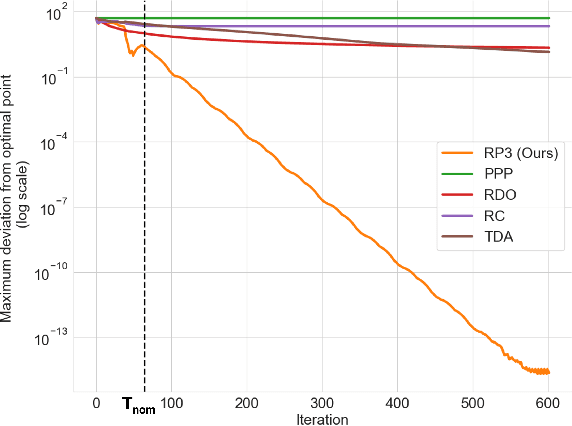

In this work, we introduce the Resilient Projected Push-Pull (RP3) algorithm designed for distributed optimization in multi-agent cyber-physical systems with directed communication graphs and the presence of malicious agents. Our algorithm leverages stochastic inter-agent trust values and gradient tracking to achieve geometric convergence rates in expectation even in adversarial environments. We introduce growing constraint sets to limit the impact of the malicious agents without compromising the geometric convergence rate of the algorithm. We prove that RP3 converges to the nominal optimal solution almost surely and in the $r$-th mean for any $r\geq 1$, provided the step sizes are sufficiently small and the constraint sets are appropriately chosen. We validate our approach with numerical studies on average consensus and multi-robot target tracking problems, demonstrating that RP3 effectively mitigates the impact of malicious agents and achieves the desired geometric convergence.