 Add to Chrome
 Add to Firefox
 Add to Edge
Grounding AI-in-Education Development in Teachers' Voices: Findings from a National Survey in Indonesia
Apr 02, 2026
Despite emerging use in Indonesian classrooms, there is limited large-scale, teacher-centred evidence on how AI is used in practice and what support teachers need, hindering the development of context-appropriate AI systems and policies. To address this gap, we conduct a nationwide survey of 349 K-12 teachers across elementary, junior high, and senior high schools. We find increasing use of AI for pedagogy, content development, and teaching media, although adoption remains uneven. Elementary teachers report more consistent use, while senior high teachers engage less; mid-career teachers assign higher importance to AI, and teachers in Eastern Indonesia perceive greater value. Across levels, teachers primarily use AI to reduce instructional preparation workload (e.g., assessment, lesson planning, and material development). However, generic outputs, infrastructure constraints, and limited contextual alignment continue to hinder effective classroom integration.

Evaluating Vision-Language and Large Language Models for Automated Student Assessment in Indonesian Classrooms
Jun 05, 2025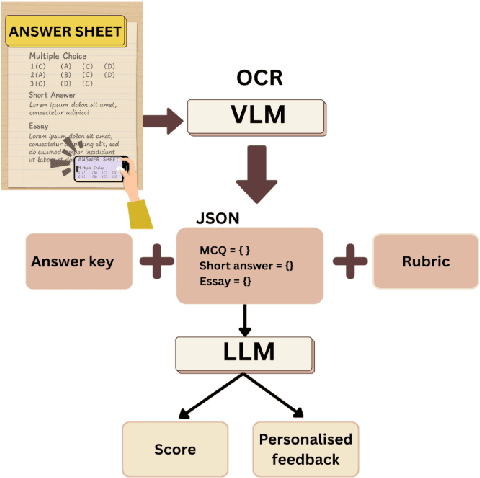
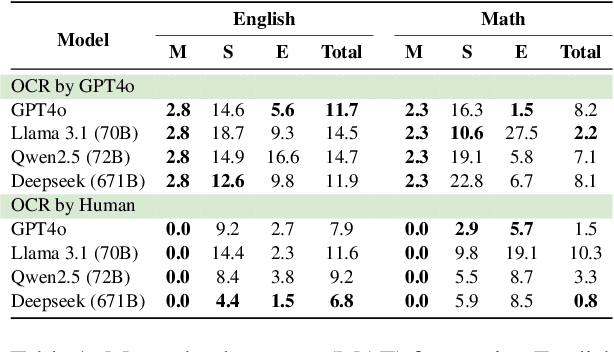
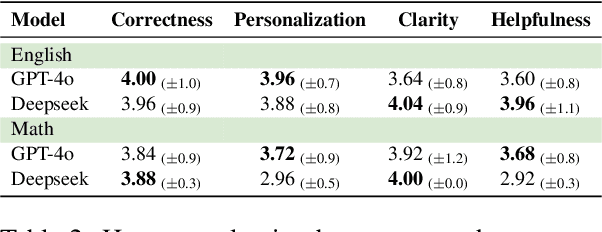
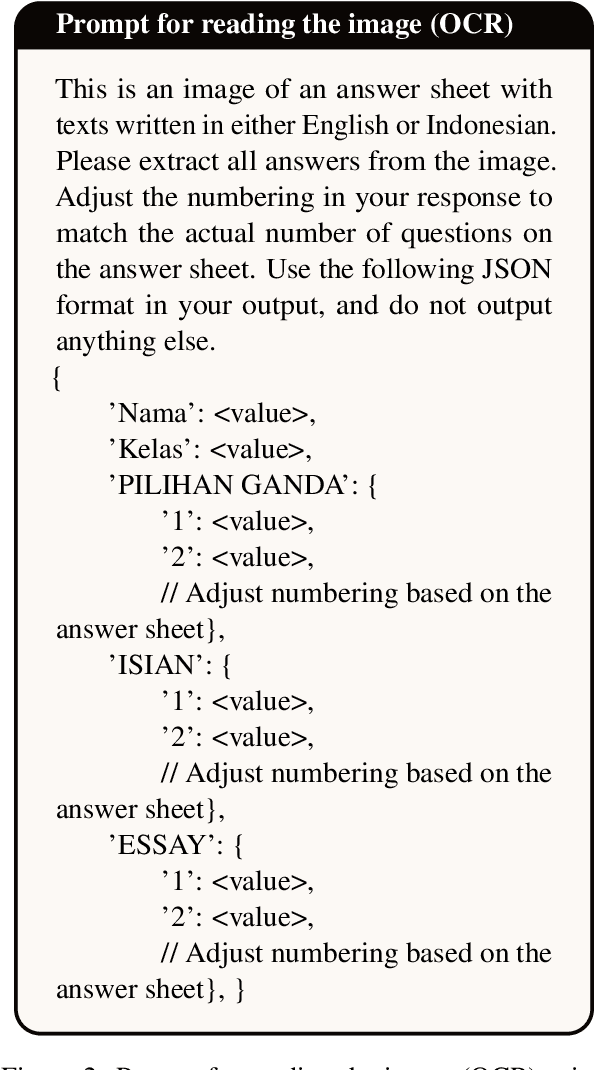
Although vision-language and large language models (VLM and LLM) offer promising opportunities for AI-driven educational assessment, their effectiveness in real-world classroom settings, particularly in underrepresented educational contexts, remains underexplored. In this study, we evaluated the performance of a state-of-the-art VLM and several LLMs on 646 handwritten exam responses from grade 4 students in six Indonesian schools, covering two subjects: Mathematics and English. These sheets contain more than 14K student answers that span multiple choice, short answer, and essay questions. Assessment tasks include grading these responses and generating personalized feedback. Our findings show that the VLM often struggles to accurately recognize student handwriting, leading to error propagation in downstream LLM grading. Nevertheless, LLM-generated feedback retains some utility, even when derived from imperfect input, although limitations in personalization and contextual relevance persist.