 Add to Chrome
 Add to Firefox
 Add to Edge
SICAGE: Speaker-Independent Culture-Aware Gesture Generation using TED4C-L Dataset
Jun 29, 2026
Recent co-speech gesture generation methods often overlook cultural differences, limiting their effectiveness in human-agent interaction. Moreover, culture-conditioned models are rarely evaluated under speaker-disjoint splits, so apparent "cultural" behavior may be confounded with speaker-specific gesturing style. We introduce SICAGE, a modular framework for culture-aware co-speech gesture generation that conditions motion synthesis models on speaker-independent cultural representations. SICAGE learns these representations from audio and text by treating each speaker as a separate domain while imposing invariance across speakers. This encourages representations to remain culture-discriminative while reducing dependence on speaker identity. The resulting cultural embeddings condition a multimodal generator to produce culturally appropriate gestures. We instantiate this idea with two domain generalization approaches: adversarial learning and Fishr regularization. We further introduce ALaDiT, a real-time diffusion-based gesture generator designed to efficiently incorporate the learned cultural embeddings. To validate our method, we built TED4C-L, a 106-hour multimodal dataset of 764 TED speakers from four cultural groups. Experiments show that SICAGE improves motion realism, diversity, beat synchronization, semantic relevance, and cultural consistency.

Labeling Sentences with Symbolic and Deictic Gestures via Semantic Similarity
Jul 03, 2024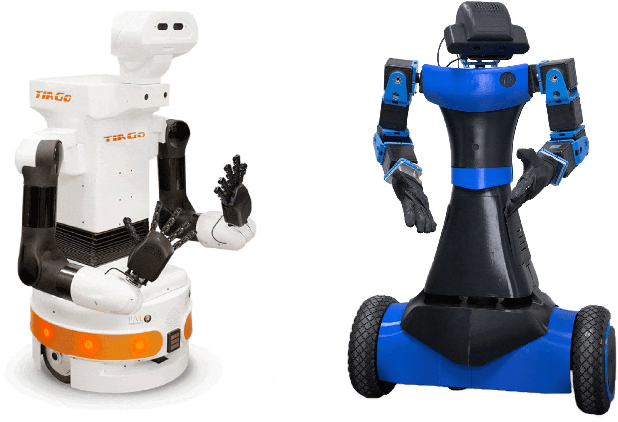
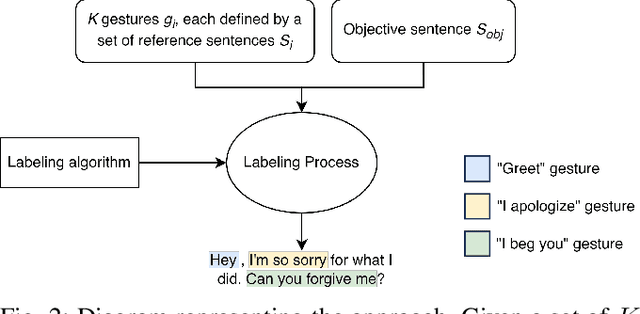
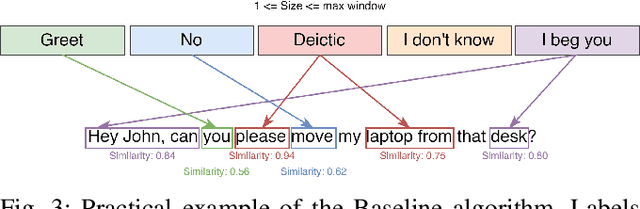
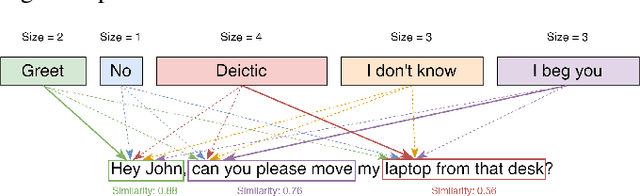
Co-speech gesture generation on artificial agents has gained attention recently, mainly when it is based on data-driven models. However, end-to-end methods often fail to generate co-speech gestures related to semantics with specific forms, i.e., Symbolic and Deictic gestures. In this work, we identify which words in a sentence are contextually related to Symbolic and Deictic gestures. Firstly, we appropriately chose 12 gestures recognized by people from the Italian culture, which different humanoid robots can reproduce. Then, we implemented two rule-based algorithms to label sentences with Symbolic and Deictic gestures. The rules depend on the semantic similarity scores computed with the RoBerta model between sentences that heuristically represent gestures and sub-sentences inside an objective sentence that artificial agents have to pronounce. We also implemented a baseline algorithm that assigns gestures without computing similarity scores. Finally, to validate the results, we asked 30 persons to label a set of sentences with Deictic and Symbolic gestures through a Graphical User Interface (GUI), and we compared the labels with the ones produced by our algorithms. For this scope, we computed Average Precision (AP) and Intersection Over Union (IOU) scores, and we evaluated the Average Computational Time (ACT). Our results show that semantic similarity scores are useful for finding Symbolic and Deictic gestures in utterances.