 Add to Chrome
 Add to Firefox
 Add to Edge
Inverted Detection and Control in Steering Vectors
Aug 03, 2026
Steering vectors (SVs) are widely used to influence the expression of concepts (e.g., truthfulness) in large language model outputs. A key assumption underpinning SVs is that they are linearly discriminative with respect to the concept: representations of texts that exhibit the concept are more aligned with the SV than those that do not, motivating shifts along the positive or negative SV direction to respectively promote or suppress the concept. In this work, we identify an inverted detection-control phenomenon in which some highly discriminative SVs that are aligned with positive representations can consistently promote the opposite behavior. We refer to such vectors as inverted-steering vectors (ISVs). We provide a geometric characterization of ISVs' effects, finding that steering along these directions systematically pushes representations in discriminative downstream heads as if the concept were absent, even prior to decoding. Motivated by this analysis, we propose an approach for distinguishing ISVs without requiring generation or associated response scoring. This enables targeted sign flips, which we use to improve a foundational detection-based steering pipeline via Inference Time Intervention (ITI). Our approach improves results in 27/30 experiments, ranging from +0.9% to +138%. We evaluate our findings on Gemma 3 12B, Qwen 2.5 14B, and Olmo 3 7B across 5 concepts.

Geometric Signatures of Reasoning: A Spectral Perspective on Task Hardness
Jul 02, 2026Chain-of-thought (CoT) reasoning enables large language models (LLMs) to solve complex problems by generating intermediate reasoning steps. While much attention has been paid to the length and content of these reasoning chains, far less is known about their internal geometry. We study the \emph{geometry} of CoT trajectories in the hidden state space of transformer models, formalizing each reasoning chain as a discrete curve in $\mathbb{R}^d$ and characterizing it through spectral, positional, and kinematic geometric functionals. We introduce the effective dimension $d_ρ$ as a measure of trajectory complexity and show theoretically that trajectories with flatter eigenvalue spectra correspond to harder tasks, as they explore more of the hidden dimensions. Lastly, we explore how kinematic features of the trajectory, mean position, positional dispersion, initial and current hidden states, mean velocity, mean speed, and speed dispersion, can be used to predict solution correctness before generation is complete, and may inform future early-stopping strategies. Experimentally, on mathematical reasoning problems from the MATH500 dataset, $d_ρ$ achieves $0.93$ AUC in distinguishing easy from hard problems, while kinematic features potentially can predict correctness from only the first $20\%$ of generated tokens. These correctness signatures transfer across questions of varying difficulty, establishing that the shape of a model's internal reasoning trajectory is a principled window into both task hardness and solution quality.
OrdShap: Feature Position Importance for Sequential Black-Box Models
Jul 16, 2025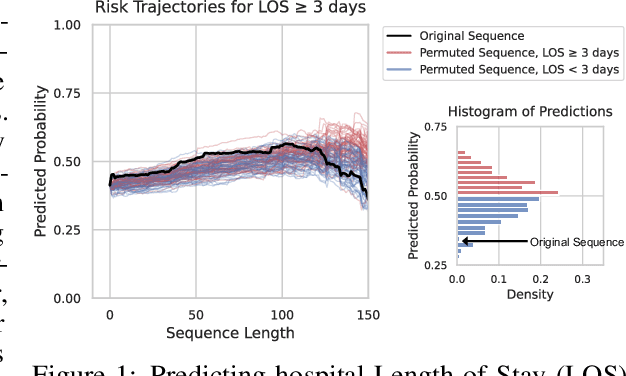
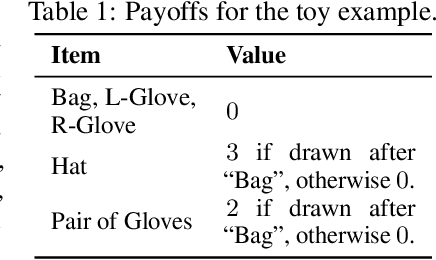
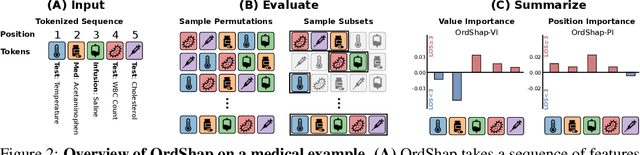
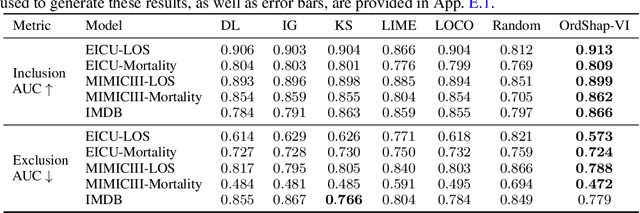
Sequential deep learning models excel in domains with temporal or sequential dependencies, but their complexity necessitates post-hoc feature attribution methods for understanding their predictions. While existing techniques quantify feature importance, they inherently assume fixed feature ordering - conflating the effects of (1) feature values and (2) their positions within input sequences. To address this gap, we introduce OrdShap, a novel attribution method that disentangles these effects by quantifying how a model's predictions change in response to permuting feature position. We establish a game-theoretic connection between OrdShap and Sanchez-Berganti\~nos values, providing a theoretically grounded approach to position-sensitive attribution. Empirical results from health, natural language, and synthetic datasets highlight OrdShap's effectiveness in capturing feature value and feature position attributions, and provide deeper insight into model behavior.
Axiomatic Explainer Globalness via Optimal Transport
Nov 02, 2024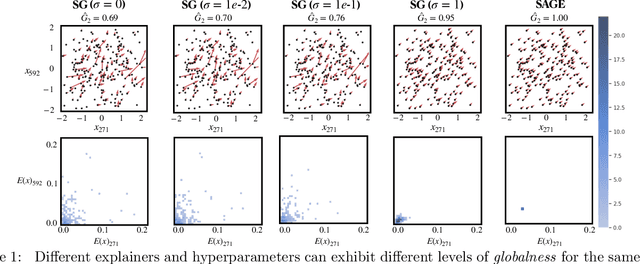
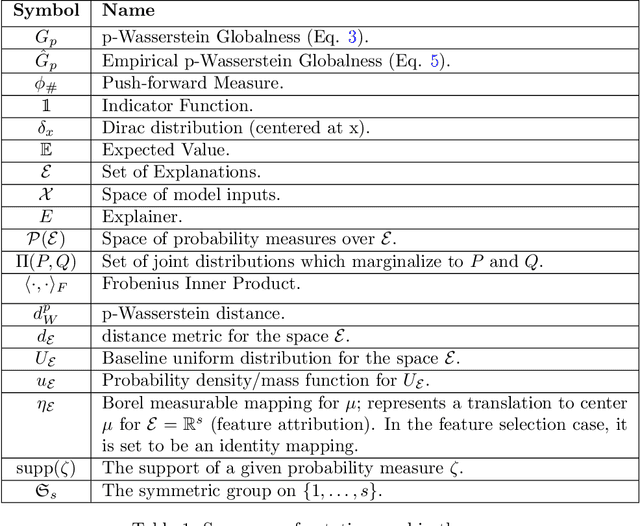
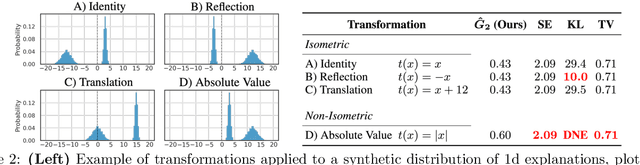
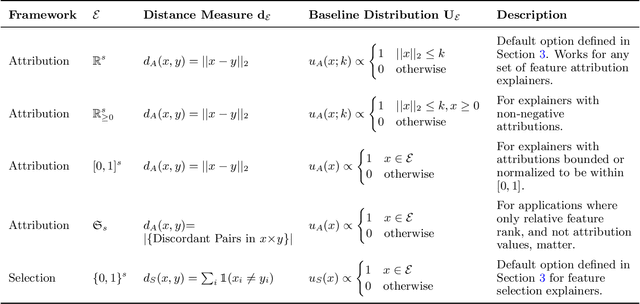
Explainability methods are often challenging to evaluate and compare. With a multitude of explainers available, practitioners must often compare and select explainers based on quantitative evaluation metrics. One particular differentiator between explainers is the diversity of explanations for a given dataset; i.e. whether all explanations are identical, unique and uniformly distributed, or somewhere between these two extremes. In this work, we define a complexity measure for explainers, globalness, which enables deeper understanding of the distribution of explanations produced by feature attribution and feature selection methods for a given dataset. We establish the axiomatic properties that any such measure should possess and prove that our proposed measure, Wasserstein Globalness, meets these criteria. We validate the utility of Wasserstein Globalness using image, tabular, and synthetic datasets, empirically showing that it both facilitates meaningful comparison between explainers and improves the selection process for explainability methods.
SmoothHess: ReLU Network Feature Interactions via Stein's Lemma
Nov 01, 2023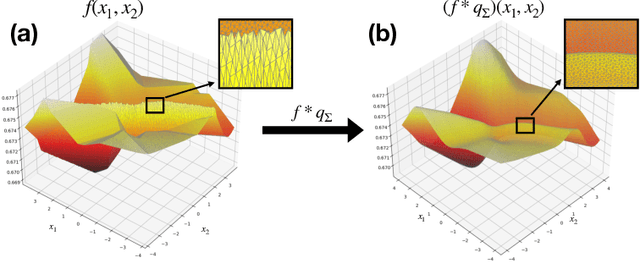
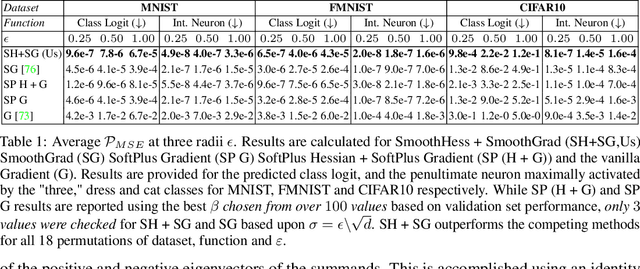

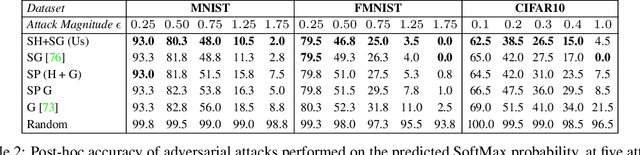
Several recent methods for interpretability model feature interactions by looking at the Hessian of a neural network. This poses a challenge for ReLU networks, which are piecewise-linear and thus have a zero Hessian almost everywhere. We propose SmoothHess, a method of estimating second-order interactions through Stein's Lemma. In particular, we estimate the Hessian of the network convolved with a Gaussian through an efficient sampling algorithm, requiring only network gradient calls. SmoothHess is applied post-hoc, requires no modifications to the ReLU network architecture, and the extent of smoothing can be controlled explicitly. We provide a non-asymptotic bound on the sample complexity of our estimation procedure. We validate the superior ability of SmoothHess to capture interactions on benchmark datasets and a real-world medical spirometry dataset.
Explanations of Black-Box Models based on Directional Feature Interactions
Apr 16, 2023As machine learning algorithms are deployed ubiquitously to a variety of domains, it is imperative to make these often black-box models transparent. Several recent works explain black-box models by capturing the most influential features for prediction per instance; such explanation methods are univariate, as they characterize importance per feature. We extend univariate explanation to a higher-order; this enhances explainability, as bivariate methods can capture feature interactions in black-box models, represented as a directed graph. Analyzing this graph enables us to discover groups of features that are equally important (i.e., interchangeable), while the notion of directionality allows us to identify the most influential features. We apply our bivariate method on Shapley value explanations, and experimentally demonstrate the ability of directional explanations to discover feature interactions. We show the superiority of our method against state-of-the-art on CIFAR10, IMDB, Census, Divorce, Drug, and gene data.
Geometry of Score Based Generative Models
Feb 09, 2023In this work, we look at Score-based generative models (also called diffusion generative models) from a geometric perspective. From a new view point, we prove that both the forward and backward process of adding noise and generating from noise are Wasserstein gradient flow in the space of probability measures. We are the first to prove this connection. Our understanding of Score-based (and Diffusion) generative models have matured and become more complete by drawing ideas from different fields like Bayesian inference, control theory, stochastic differential equation and Schrodinger bridge. However, many open questions and challenges remain. One problem, for example, is how to decrease the sampling time? We demonstrate that looking from geometric perspective enables us to answer many of these questions and provide new interpretations to some known results. Furthermore, geometric perspective enables us to devise an intuitive geometric solution to the problem of faster sampling. By augmenting traditional score-based generative models with a projection step, we show that we can generate high quality images with significantly fewer sampling-steps.
Divide and Compose with Score Based Generative Models
Feb 05, 2023While score based generative models, or diffusion models, have found success in image synthesis, they are often coupled with text data or image label to be able to manipulate and conditionally generate images. Even though manipulation of images by changing the text prompt is possible, our understanding of the text embedding and our ability to modify it to edit images is quite limited. Towards the direction of having more control over image manipulation and conditional generation, we propose to learn image components in an unsupervised manner so that we can compose those components to generate and manipulate images in informed manner. Taking inspiration from energy based models, we interpret different score components as the gradient of different energy functions. We show how score based learning allows us to learn interesting components and we can visualize them through generation. We also show how this novel decomposition allows us to compose, generate and modify images in interesting ways akin to dreaming. We make our code available at https://github.com/sandeshgh/Score-based-disentanglement
Inv-SENnet: Invariant Self Expression Network for clustering under biased data
Nov 13, 2022Subspace clustering algorithms are used for understanding the cluster structure that explains the dataset well. These methods are extensively used for data-exploration tasks in various areas of Natural Sciences. However, most of these methods fail to handle unwanted biases in datasets. For datasets where a data sample represents multiple attributes, naively applying any clustering approach can result in undesired output. To this end, we propose a novel framework for jointly removing unwanted attributes (biases) while learning to cluster data points in individual subspaces. Assuming we have information about the bias, we regularize the clustering method by adversarially learning to minimize the mutual information between the data and the unwanted attributes. Our experimental result on synthetic and real-world datasets demonstrate the effectiveness of our approach.
Explanation Uncertainty with Decision Boundary Awareness
Oct 05, 2022
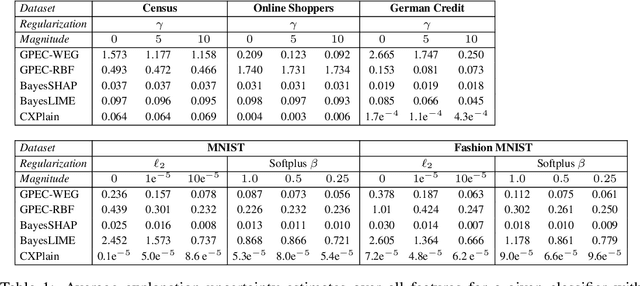
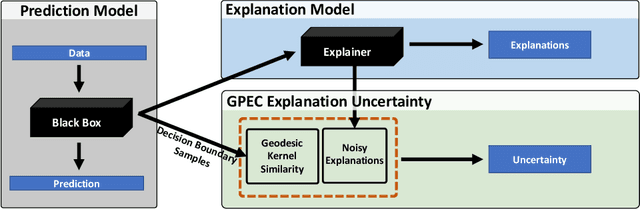
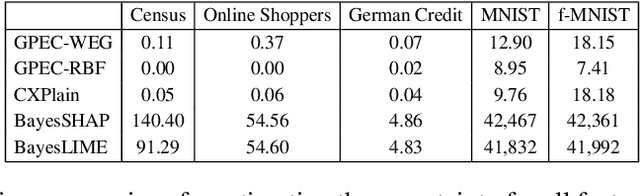
Post-hoc explanation methods have become increasingly depended upon for understanding black-box classifiers in high-stakes applications, precipitating a need for reliable explanations. While numerous explanation methods have been proposed, recent works have shown that many existing methods can be inconsistent or unstable. In addition, high-performing classifiers are often highly nonlinear and can exhibit complex behavior around the decision boundary, leading to brittle or misleading local explanations. Therefore, there is an impending need to quantify the uncertainty of such explanation methods in order to understand when explanations are trustworthy. We introduce a novel uncertainty quantification method parameterized by a Gaussian Process model, which combines the uncertainty approximation of existing methods with a novel geodesic-based similarity which captures the complexity of the target black-box decision boundary. The proposed framework is highly flexible; it can be used with any black-box classifier and feature attribution method to amortize uncertainty estimates for explanations. We show theoretically that our proposed geodesic-based kernel similarity increases with the complexity of the decision boundary. Empirical results on multiple tabular and image datasets show that our decision boundary-aware uncertainty estimate improves understanding of explanations as compared to existing methods.