 Add to Chrome
 Add to Firefox
 Add to Edge
FORTE: FOL-guided Optimal Refinement for Text-audio rEtrieval
Jun 04, 2026
Text-to-audio retrieval has made significant progress with shared embedding models such as CLAP and Pengi, yet they often struggle with fine-grained semantic alignment due to the inherent modality gap between text and audio. In this work, we propose FORTE, a unified framework that integrates structured logical reasoning with parameter-efficient cross-modal alignment to improve retrieval precision. Our approach first transforms queries into first-order logic and refines them via a constrained search that preserves semantic invariance while introducing discriminative attributes. The refined representation is then aligned with audio embeddings using a lightweight projection module, followed by a predicate-aware re-ranking step that enforces logical consistency at inference. Extensive experiments on AudioCaps and Clotho demonstrate consistent improvements over strong baselines, particularly in challenging fine-grained scenarios. Our results highlight the effectiveness of combining symbolic reasoning with representation learning for cross-modal retrieval.

Liquid Neural Networks as a Drop-in Continuous-Time Deformation Field for Dynamic 3D Gaussian Splatting
Jun 04, 2026Deformable 3D Gaussian Splatting (D-3DGS) re-constructs dynamic scenes from monocular video by deforming a canonical set of 3D Gaussians through a positional-encoded MLP of frame time t. Although fitted to a continuous variable, the MLP couples no two values of t in its architecture and effectively predicts discrete per-frame offsets, leaving temporal smoothness to emerge only as a byproduct of optimisation. We redesign the deformation field as a stack of Closed-form Continuous-time (CfC) cells, a Liquid Neural Network (LNN), that is the closed-form solution of the Liquid Time-constant ODE while preserving every other part of the D-3DGS pipeline. Each cell exposes a sigmoidal time gate that interpolates between two candidate hidden states, baking a learned smooth response to t into the loss landscape without invoking any numerical solver. On the eight D-NeRF and seven NeRF-DS scenes the liquid field matches or exceeds the MLP baseline in aggregate, with its largest gains concentrated on the scenes with the most high-frequency articulated motion. The result is a near-zero-friction architectural design that turns the discrete MLP deformation field into an explicit continuous-time function of t.
Forgive or forget: Understanding the context of hate in audio retrieval systems
Jun 04, 2026Handling toxic retrieval in text-to-audio systems is challenging due to contextual dependencies. Existing strategies (e.g., rephrasing, summarization) risk altering intent or omitting details. We propose a post hoc causal debiasing framework with a sentiment-controlled mediator to preserve semantic relevance while suppressing harmful speech. Our approach is model-agnostic and integrates seamlessly with existing retrieval pipelines. We introduce two variants: Forgive, which re-ranks and filters toxic audio via logit adjustment, and Forget, which generates counterfactual toxic prompts to mitigate harmful retrievals. Experiments show consistent toxicity reduction with minimal loss in retrieval accuracy, improving both safety and reliability.
FLAG-4D: Flow-Guided Local-Global Dual-Deformation Model for 4D Reconstruction
Feb 09, 2026We introduce FLAG-4D, a novel framework for generating novel views of dynamic scenes by reconstructing how 3D Gaussian primitives evolve through space and time. Existing methods typically rely on a single Multilayer Perceptron (MLP) to model temporal deformations, and they often struggle to capture complex point motions and fine-grained dynamic details consistently over time, especially from sparse input views. Our approach, FLAG-4D, overcomes this by employing a dual-deformation network that dynamically warps a canonical set of 3D Gaussians over time into new positions and anisotropic shapes. This dual-deformation network consists of an Instantaneous Deformation Network (IDN) for modeling fine-grained, local deformations and a Global Motion Network (GMN) for capturing long-range dynamics, refined through mutual learning. To ensure these deformations are both accurate and temporally smooth, FLAG-4D incorporates dense motion features from a pretrained optical flow backbone. We fuse these motion cues from adjacent timeframes and use a deformation-guided attention mechanism to align this flow information with the current state of each evolving 3D Gaussian. Extensive experiments demonstrate that FLAG-4D achieves higher-fidelity and more temporally coherent reconstructions with finer detail preservation than state-of-the-art methods.
GSAT: Graph Structure Attention Networks
May 27, 2025Graph Neural Networks (GNNs) have emerged as a powerful tool for processing data represented in graph structures, achieving remarkable success across a wide range of applications. However, to further improve the performance on graph classification benchmarks, structural representation of each node that encodes rich local topological information in the neighbourhood of nodes is an important type of feature that is often overlooked in the modeling. The consequence of neglecting the structural information has resulted high number of layers to connect messages from distant nodes which by itself produces other problems such as oversmoothing. In the present paper, we leverage these structural information that are modeled by anonymous random walks (ARWs) and introduce graph structure attention network (GSAT) which is a generalization of graph attention network(GAT) to integrate the original attribute and the structural representation to enforce the model to automatically find patterns for attending to different edges in the node neighbourhood to enrich graph representation. Our experiments show GSAT slightly improves SOTA on some graph classification benchmarks.
Learning Energy-Based Generative Models via Potential Flow: A Variational Principle Approach to Probability Density Homotopy Matching
Apr 22, 2025Energy-based models (EBMs) are a powerful class of probabilistic generative models due to their flexibility and interpretability. However, relationships between potential flows and explicit EBMs remain underexplored, while contrastive divergence training via implicit Markov chain Monte Carlo (MCMC) sampling is often unstable and expensive in high-dimensional settings. In this paper, we propose Variational Potential Flow Bayes (VPFB), a new energy-based generative framework that eliminates the need for implicit MCMC sampling and does not rely on auxiliary networks or cooperative training. VPFB learns an energy-parameterized potential flow by constructing a flow-driven density homotopy that is matched to the data distribution through a variational loss minimizing the Kullback-Leibler divergence between the flow-driven and marginal homotopies. This principled formulation enables robust and efficient generative modeling while preserving the interpretability of EBMs. Experimental results on image generation, interpolation, out-of-distribution detection, and compositional generation confirm the effectiveness of VPFB, showing that our method performs competitively with existing approaches in terms of sample quality and versatility across diverse generative modeling tasks.
LGRPool: Hierarchical Graph Pooling Via Local-Global Regularisation
Apr 11, 2025Hierarchical graph pooling(HGP) are designed to consider the fact that conventional graph neural networks(GNN) are inherently flat and are also not multiscale. However, most HGP methods suffer not only from lack of considering global topology of the graph and focusing on the feature learning aspect, but also they do not align local and global features since graphs should inherently be analyzed in a multiscale way. LGRPool is proposed in the present paper as a HGP in the framework of expectation maximization in machine learning that aligns local and global aspects of message passing with each other using a regularizer to force the global topological information to be inline with the local message passing at different scales through the representations at different layers of HGP. Experimental results on some graph classification benchmarks show that it slightly outperforms some baselines.
Causal-Ex: Causal Graph-based Micro and Macro Expression Spotting
Mar 12, 2025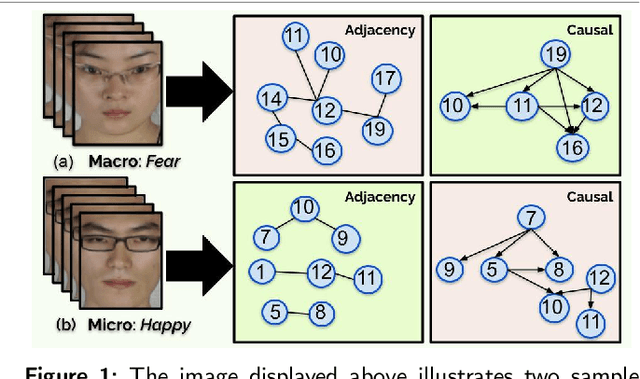

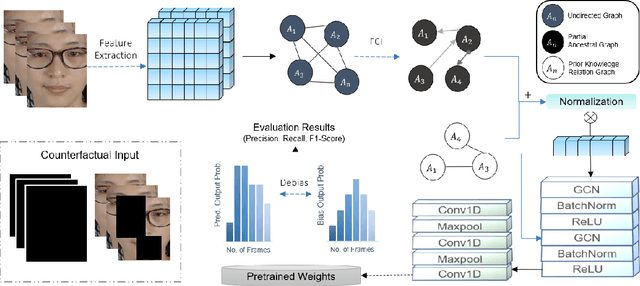
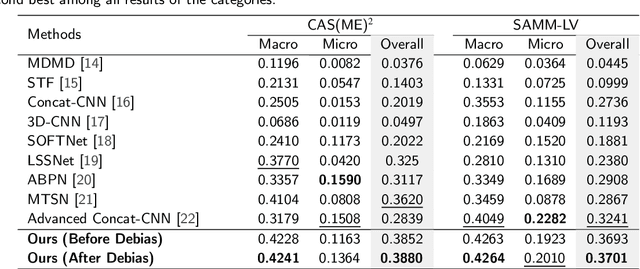
Detecting concealed emotions within apparently normal expressions is crucial for identifying potential mental health issues and facilitating timely support and intervention. The task of spotting macro and micro-expressions involves predicting the emotional timeline within a video, accomplished by identifying the onset, apex, and offset frames of the displayed emotions. Utilizing foundational facial muscle movement cues, known as facial action units, boosts the accuracy. However, an overlooked challenge from previous research lies in the inadvertent integration of biases into the training model. These biases arising from datasets can spuriously link certain action unit movements to particular emotion classes. We tackle this issue by novel replacement of action unit adjacency information with the action unit causal graphs. This approach aims to identify and eliminate undesired spurious connections, retaining only unbiased information for classification. Our model, named Causal-Ex (Causal-based Expression spotting), employs a rapid causal inference algorithm to construct a causal graph of facial action units. This enables us to select causally relevant facial action units. Our work demonstrates improvement in overall F1-scores compared to state-of-the-art approaches with 0.388 on CAS(ME)^2 and 0.3701 on SAMM-Long Video datasets.
Denoising via Repainting: an image denoising method using layer wise medical image repainting
Mar 11, 2025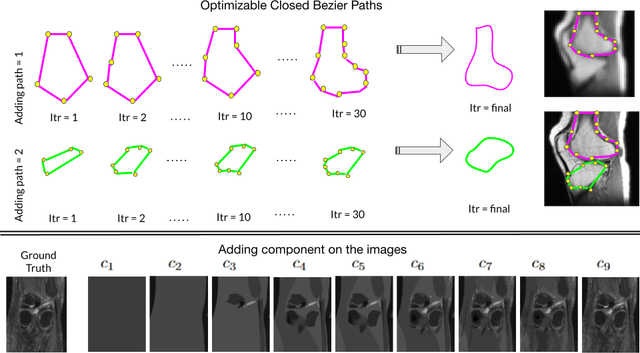
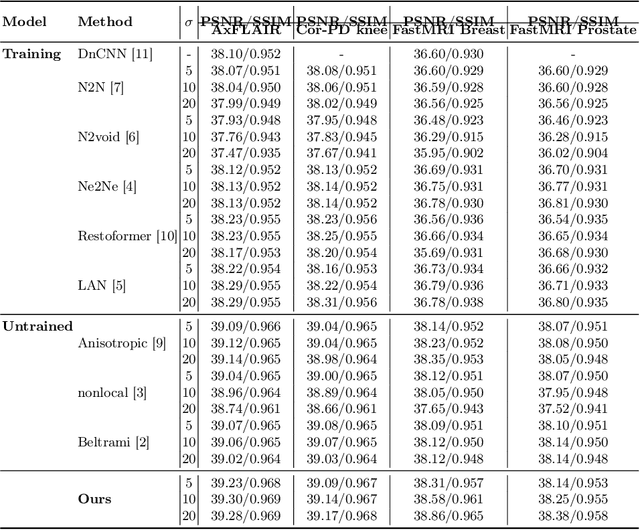

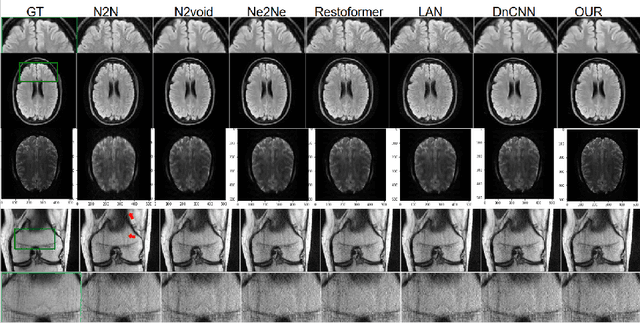
Medical image denoising is essential for improving the reliability of clinical diagnosis and guiding subsequent image-based tasks. In this paper, we propose a multi-scale approach that integrates anisotropic Gaussian filtering with progressive Bezier-path redrawing. Our method constructs a scale-space pyramid to mitigate noise while preserving critical structural details. Starting at the coarsest scale, we segment partially denoised images into coherent components and redraw each using a parametric Bezier path with representative color. Through iterative refinements at finer scales, small and intricate structures are accurately reconstructed, while large homogeneous regions remain robustly smoothed. We employ both mean square error and self-intersection constraints to maintain shape coherence during path optimization. Empirical results on multiple MRI datasets demonstrate consistent improvements in PSNR and SSIM over competing methods. This coarse-to-fine framework offers a robust, data-efficient solution for cross-domain denoising, reinforcing its potential clinical utility and versatility. Future work extends this technique to three-dimensional data.
Leveraging Full Dependency Parsing Graph Information For Biomedical Event Extraction
Jan 02, 2025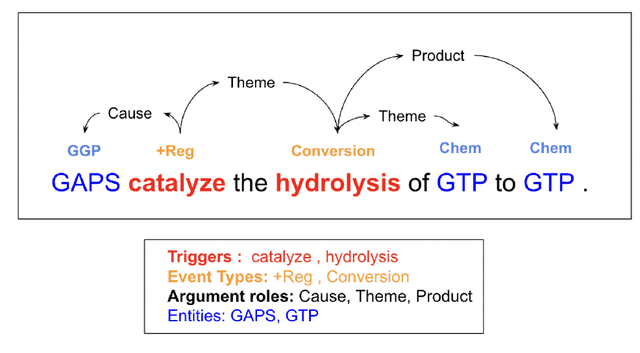

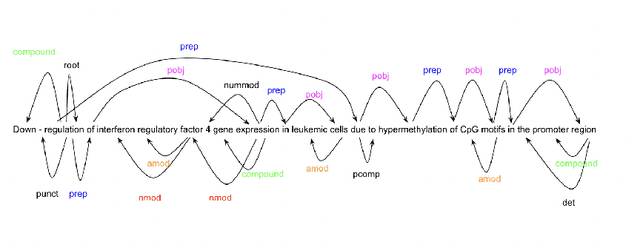

Many models are proposed in the literature on biomedical event extraction(BEE). Some of them use the shortest dependency path(SDP) information to represent the argument classification task. There is an issue with this representation since even missing one word from the dependency parsing graph may totally change the final prediction. To this end, the full adjacency matrix of the dependency graph is used to embed individual tokens using a graph convolutional network(GCN). An ablation study is also done to show the effect of the dependency graph on the overall performance. The results show a significant improvement when dependency graph information is used. The proposed model slightly outperforms state-of-the-art models on BEE over different datasets.