 Add to Chrome
 Add to Firefox
 Add to Edge
A Reliable Context-Aware and Temporal Planning Framework for Autonomous Driving
Jul 06, 2026
Safe operation of autonomous vehicles in dense urban traffic depends on perception and planning that remain reliable when onboard sensing is degraded. In real driving conditions, camera observations are frequently corrupted by occlusion, motion blur, illumination change, and sensor noise, and when such degraded observations are aggregated indiscriminately over time, trajectory planning becomes unstable and collision risk rises for both the ego vehicle and surrounding road users. Recent Bird's-Eye-View (BEV) approaches unify perception and planning through a shared spatial representation, but most fuse temporal information across frames without assessing the reliability of the underlying observations. We present a Reliable Context-Aware and Temporal Planning framework for Autonomous Driving (RCT-AD) that explicitly models feature quality and temporal consistency to support safer, more consistent planning. A Reliable Context Awareness module scores per-frame reliability and selectively retains trustworthy features through a quality-gated First-In-Last-Out (FILO) memory mechanism, reconstructing degraded observations from reliable historical context so that corrupted inputs do not destabilize the scene representation. A Temporal Trajectory Planner captures long-term dependencies and multi-agent interactions to produce smoother, safety-aware trajectories, while a joint detection-and-segmentation head injects semantic and motion cues into the shared BEV space to strengthen scene understanding. Experiments on the nuScenes autonomous driving benchmark show that RCT-AD improves perception accuracy, motion prediction, and planning robustness over recent end-to-end baselines, achieving 61.5 nuScenes Detection Score, 52.9 mean Average Precision, and 52.3 mean Intersection over Union, while maintaining competitive computational efficiency suitable for real-time deployment.

RESAR-BEV: An Explainable Progressive Residual Autoregressive Approach for Camera-Radar Fusion in BEV Segmentation
May 10, 2025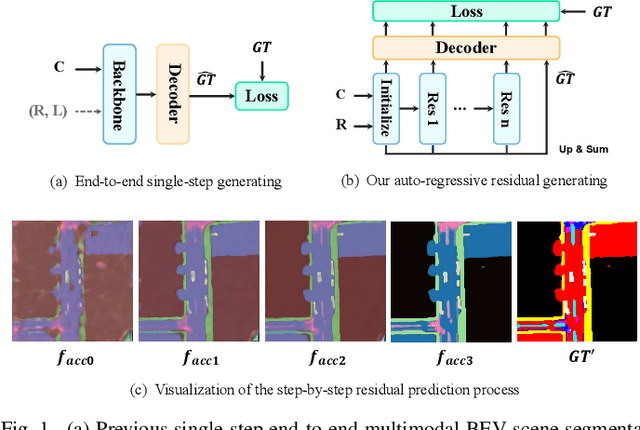
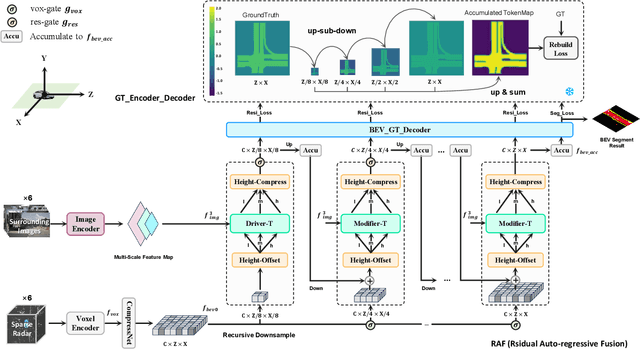
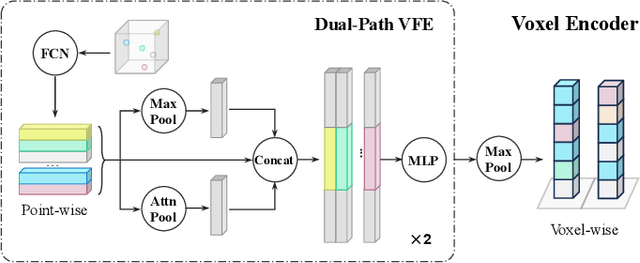
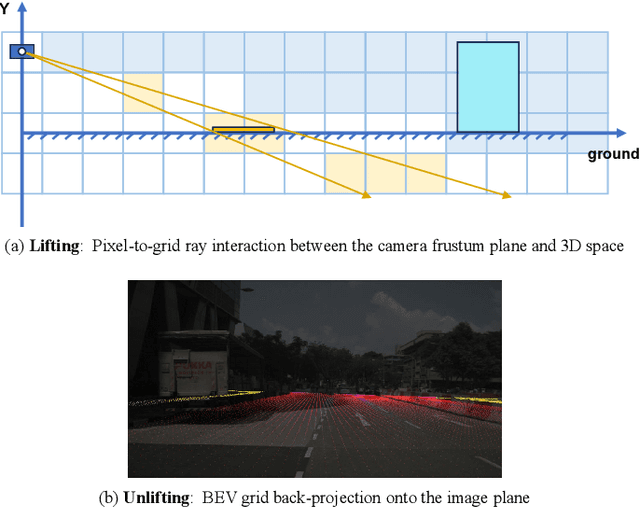
Bird's-Eye-View (BEV) semantic segmentation provides comprehensive environmental perception for autonomous driving but suffers multi-modal misalignment and sensor noise. We propose RESAR-BEV, a progressive refinement framework that advances beyond single-step end-to-end approaches: (1) progressive refinement through residual autoregressive learning that decomposes BEV segmentation into interpretable coarse-to-fine stages via our Drive-Transformer and Modifier-Transformer residual prediction cascaded architecture, (2) robust BEV representation combining ground-proximity voxels with adaptive height offsets and dual-path voxel feature encoding (max+attention pooling) for efficient feature extraction, and (3) decoupled supervision with offline Ground Truth decomposition and online joint optimization to prevent overfitting while ensuring structural coherence. Experiments on nuScenes demonstrate RESAR-BEV achieves state-of-the-art performance with 54.0% mIoU across 7 essential driving-scene categories while maintaining real-time capability at 14.6 FPS. The framework exhibits robustness in challenging scenarios of long-range perception and adverse weather conditions.