 Add to Chrome
 Add to Firefox
 Add to Edge
IHUBERT: Vector-Based Semantic Deduplication and Domain-Balanced Pretraining for Persian Resources
Jun 18, 2026
Persian pretrained language models (PLMs) are still limited by the scarcity of large-scale, high-quality pretraining corpora and by insufficient evaluation beyond standard classification and NER tasks. We present IHUBERT, a monolingual Persian PLM trained from scratch with the RoBERTa-base encoder (125M parameters) on a 45 GB curated subset of the Sepahr-Danesh collection (about 7-8B tokens). To improve corpus quality and reduce redundancy, we employ a multi-stage preprocessing pipeline that includes normalization, exact and near-duplicate removal, anonymization, and vector-database-based semantic deduplication for distribution balancing control across domains and registers. We additionally train a 139k-vocabulary BPE tokenizer on the full pretraining corpus to better capture Persian morphology and orthographic variation. IHUBERT is evaluated on seven Persian NLU benchmarks covering NER, sentiment analysis, topic classification, NLI, extractive question answering, and relation extraction, using task-standard metrics (entity-level F1, Macro-F1, EM/F1). IHUBERT achieves its strongest gains on extractive QA, ranking first on both PQuAD (F1 88.3542) and ParsiNLU-RC (F1 49.0987), and attains the best result on FarsTail (Macro-F1 0.8350). On NER and topic classification, it remains competitive (e.g., 0.8308 F1 on ParsTwiNER; 0.7953 Macro-F1 on DigiMag), while relation extraction remains the main remaining gap (0.6684 Macro-F1 on PERLEX). A controlled tokenizer ablation on the IHUBERT pretraining corpus shows that BPE yields slightly lower subword fragmentation than WordPiece at matched vocabulary size, supporting our tokenization design. Overall, IHUBERT advances Persian language modeling through semantically curated large-scale pretraining and broad evaluation across both classification and comprehension-oriented tasks.

Bactrainus: Optimizing Large Language Models for Multi-hop Complex Question Answering Tasks
Jan 10, 2025
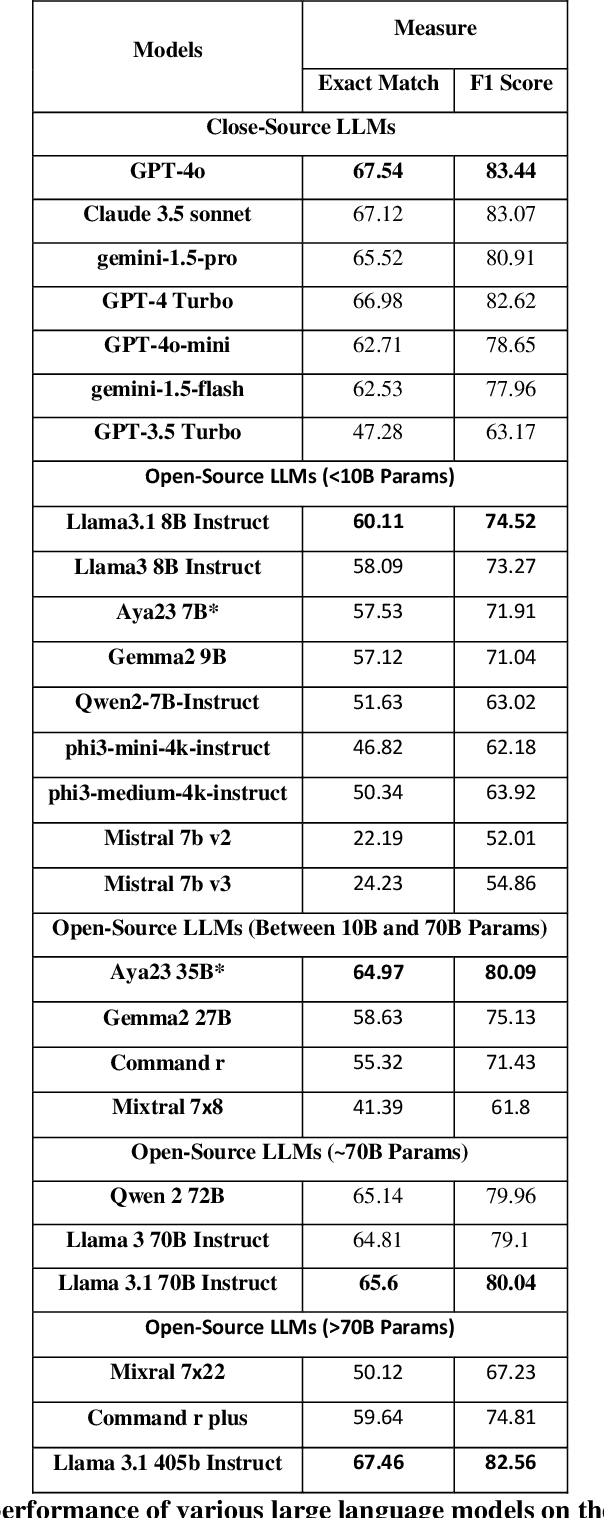

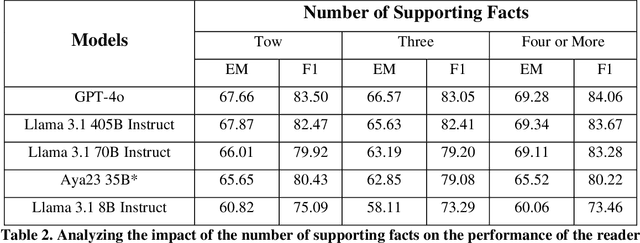
In recent years, the use of large language models (LLMs) has significantly increased, and these models have demonstrated remarkable performance in a variety of general language tasks. However, the evaluation of their performance in domain-specific tasks, particularly those requiring deep natural language understanding, has received less attention. In this research, we evaluate the ability of large language models in performing domain-specific tasks, focusing on the multi-hop question answering (MHQA) problem using the HotpotQA dataset. This task, due to its requirement for reasoning and combining information from multiple textual sources, serves as a challenging benchmark for assessing the language comprehension capabilities of these models. To tackle this problem, we have designed a two-stage selector-reader architecture, where each stage utilizes an independent LLM. In addition, methods such as Chain of Thought (CoT) and question decomposition have been employed to investigate their impact on improving the model's performance. The results of the study show that the integration of large language models with these techniques can lead to up to a 4% improvement in F1 score for finding answers, providing evidence of the models' ability to handle domain-specific tasks and their understanding of complex language.
PersianLLaMA: Towards Building First Persian Large Language Model
Dec 25, 2023Despite the widespread use of the Persian language by millions globally, limited efforts have been made in natural language processing for this language. The use of large language models as effective tools in various natural language processing tasks typically requires extensive textual data and robust hardware resources. Consequently, the scarcity of Persian textual data and the unavailability of powerful hardware resources have hindered the development of large language models for Persian. This paper introduces the first large Persian language model, named PersianLLaMA, trained on a collection of Persian texts and datasets. This foundational model comes in two versions, with 7 and 13 billion parameters, trained on formal and colloquial Persian texts using two different approaches. PersianLLaMA has been evaluated for natural language generation tasks based on the latest evaluation methods, namely using larger language models, and for natural language understanding tasks based on automated machine metrics. The results indicate that PersianLLaMA significantly outperforms its competitors in both understanding and generating Persian text. PersianLLaMA marks an important step in the development of Persian natural language processing and can be a valuable resource for the Persian-speaking community. This large language model can be used for various natural language processing tasks, especially text generation like chatbots, question-answering, machine translation, and text summarization
IslamicPCQA: A Dataset for Persian Multi-hop Complex Question Answering in Islamic Text Resources
Apr 23, 2023Nowadays, one of the main challenges for Question Answering Systems is to answer complex questions using various sources of information. Multi-hop questions are a type of complex questions that require multi-step reasoning to answer. In this article, the IslamicPCQA dataset is introduced. This is the first Persian dataset for answering complex questions based on non-structured information sources and consists of 12,282 question-answer pairs extracted from 9 Islamic encyclopedias. This dataset has been created inspired by the HotpotQA English dataset approach, which was customized to suit the complexities of the Persian language. Answering questions in this dataset requires more than one paragraph and reasoning. The questions are not limited to any prior knowledge base or ontology, and to provide robust reasoning ability, the dataset also includes supporting facts and key sentences. The prepared dataset covers a wide range of Islamic topics and aims to facilitate answering complex Persian questions within this subject matter