 Add to Chrome
 Add to Firefox
 Add to Edge
IHUBERT: Vector-Based Semantic Deduplication and Domain-Balanced Pretraining for Persian Resources
Jun 18, 2026
Persian pretrained language models (PLMs) are still limited by the scarcity of large-scale, high-quality pretraining corpora and by insufficient evaluation beyond standard classification and NER tasks. We present IHUBERT, a monolingual Persian PLM trained from scratch with the RoBERTa-base encoder (125M parameters) on a 45 GB curated subset of the Sepahr-Danesh collection (about 7-8B tokens). To improve corpus quality and reduce redundancy, we employ a multi-stage preprocessing pipeline that includes normalization, exact and near-duplicate removal, anonymization, and vector-database-based semantic deduplication for distribution balancing control across domains and registers. We additionally train a 139k-vocabulary BPE tokenizer on the full pretraining corpus to better capture Persian morphology and orthographic variation. IHUBERT is evaluated on seven Persian NLU benchmarks covering NER, sentiment analysis, topic classification, NLI, extractive question answering, and relation extraction, using task-standard metrics (entity-level F1, Macro-F1, EM/F1). IHUBERT achieves its strongest gains on extractive QA, ranking first on both PQuAD (F1 88.3542) and ParsiNLU-RC (F1 49.0987), and attains the best result on FarsTail (Macro-F1 0.8350). On NER and topic classification, it remains competitive (e.g., 0.8308 F1 on ParsTwiNER; 0.7953 Macro-F1 on DigiMag), while relation extraction remains the main remaining gap (0.6684 Macro-F1 on PERLEX). A controlled tokenizer ablation on the IHUBERT pretraining corpus shows that BPE yields slightly lower subword fragmentation than WordPiece at matched vocabulary size, supporting our tokenization design. Overall, IHUBERT advances Persian language modeling through semantically curated large-scale pretraining and broad evaluation across both classification and comprehension-oriented tasks.

Generating and Detecting Various Types of Fake Image and Audio Content: A Review of Modern Deep Learning Technologies and Tools
Jan 07, 2025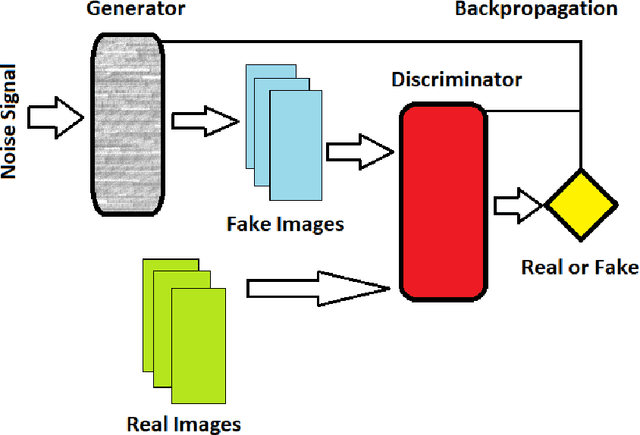
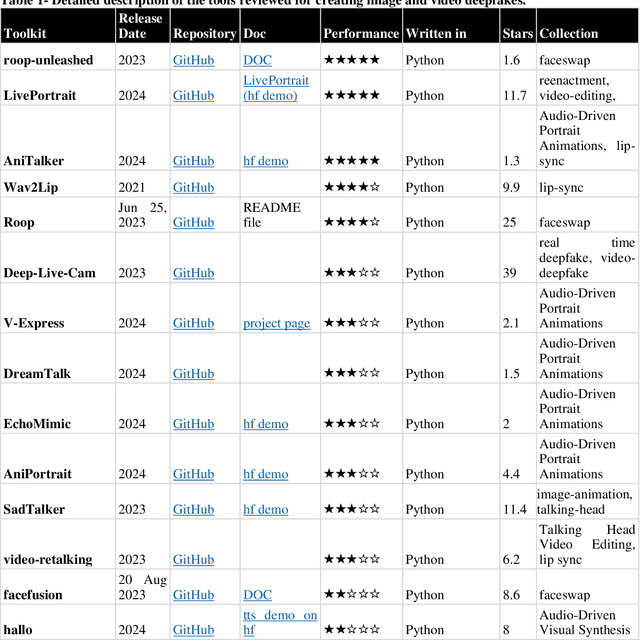
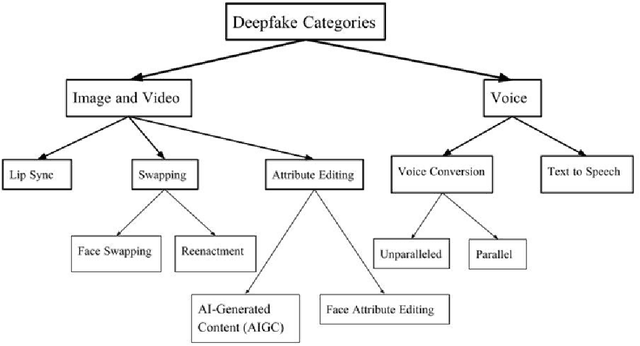
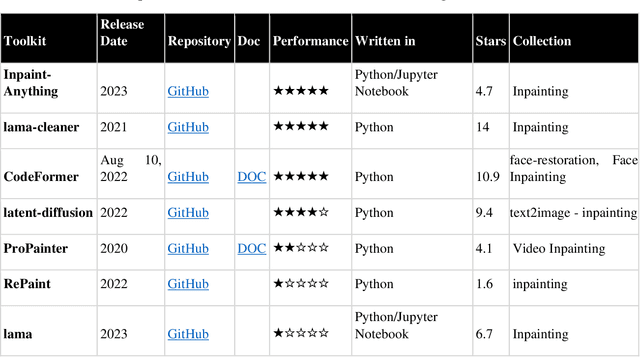
This paper reviews the state-of-the-art in deepfake generation and detection, focusing on modern deep learning technologies and tools based on the latest scientific advancements. The rise of deepfakes, leveraging techniques like Variational Autoencoders (VAEs), Generative Adversarial Networks (GANs), Diffusion models and other generative models, presents significant threats to privacy, security, and democracy. This fake media can deceive individuals, discredit real people and organizations, facilitate blackmail, and even threaten the integrity of legal, political, and social systems. Therefore, finding appropriate solutions to counter the potential threats posed by this technology is essential. We explore various deepfake methods, including face swapping, voice conversion, reenactment and lip synchronization, highlighting their applications in both benign and malicious contexts. The review critically examines the ongoing "arms race" between deepfake generation and detection, analyzing the challenges in identifying manipulated contents. By examining current methods and highlighting future research directions, this paper contributes to a crucial understanding of this rapidly evolving field and the urgent need for robust detection strategies to counter the misuse of this powerful technology. While focusing primarily on audio, image, and video domains, this study allows the reader to easily grasp the latest advancements in deepfake generation and detection.