 Add to Chrome
 Add to Firefox
 Add to Edge
Sparse Network Inference under Imperfect Detection and its Application to Ecological Networks
Apr 20, 2026
Recovering latent structure from count data has received considerable attention in network inference, particularly when one seeks both cross-group interactions and within-group similarity patterns in bipartite networks, which is widely used in ecology research. Such networks are often sparse and inherently imperfect in their detection. Existing models mainly focus on interaction recovery, while the induced similarity graphs are much less studied. Moreover, sparsity is often not controlled, and scale is unbalanced, leading to oversparse or poorly rescaled estimates with degrading structural recovery. To address these issues, we propose a framework for structured sparse nonnegative low-rank factorization with detection probability estimation. We impose nonconvex $\ell_{1/2}$ regularization on the latent similarity and connectivity structures to promote sparsity within-group similarity and cross-group connectivity with better relative scale. The resulting optimization problem is nonconvex and nonsmooth. To solve it, we develop an ADMM-based algorithm with adaptive penalization and scale-aware initialization and establish its asymptotic feasibility and KKT stationarity of cluster points under mild regularity conditions. Experiments on synthetic and real-world ecological datasets demonstrate improved recovery of latent factors and similarity/connectivity structure relative to existing baselines.

Recurrent Neural Goodness-of-Fit Test for Time Series
Oct 17, 2024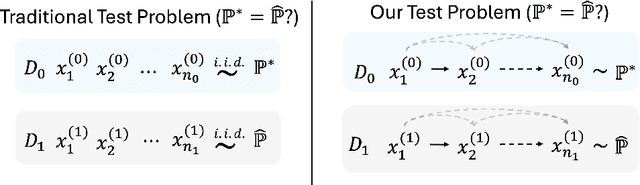
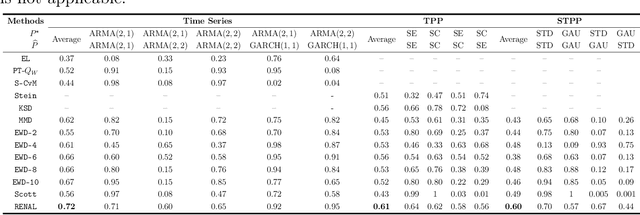
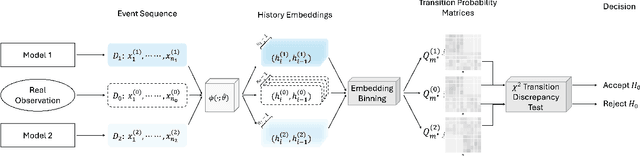

Time series data are crucial across diverse domains such as finance and healthcare, where accurate forecasting and decision-making rely on advanced modeling techniques. While generative models have shown great promise in capturing the intricate dynamics inherent in time series, evaluating their performance remains a major challenge. Traditional evaluation metrics fall short due to the temporal dependencies and potential high dimensionality of the features. In this paper, we propose the REcurrent NeurAL (RENAL) Goodness-of-Fit test, a novel and statistically rigorous framework for evaluating generative time series models. By leveraging recurrent neural networks, we transform the time series into conditionally independent data pairs, enabling the application of a chi-square-based goodness-of-fit test to the temporal dependencies within the data. This approach offers a robust, theoretically grounded solution for assessing the quality of generative models, particularly in settings with limited time sequences. We demonstrate the efficacy of our method across both synthetic and real-world datasets, outperforming existing methods in terms of reliability and accuracy. Our method fills a critical gap in the evaluation of time series generative models, offering a tool that is both practical and adaptable to high-stakes applications.