 Add to Chrome
 Add to Firefox
 Add to Edge
PathWISE: Multi-Agent Cancer Pathway Triaging Ontology Learning from Clinical Flowcharts
May 25, 2026
Clinical pathways are disseminated as visual flowcharts where spatial topology, arrow direction, colour coding, and font weight encode critical triage logic that remains inaccessible to computational systems. We present PathWISE, a five-phase pipeline combining four LLM-based agents with a deterministic depth-first search auditor and a Java compiler critic, transforming these non-computable artefacts into validated, executable HL7 Clinical Quality Language (CQL) libraries deployable as FHIR CDS Hooks services. Purpose-built agents extract flowchart structure into a typed directed graph, perform deterministic path enumeration, conduct a structured semantic audit of every node's computability, generate terminology-constrained CQL definitions verified by the official Java CQL-to-ELM compiler, and produce routing logic covering 100% of enumerated patient journeys. Demonstrated across five UK NHS cancer pathways (colorectal, lung, skin, upper GI, and breast), PathWISE audits up to 183 nodes (182 under the Hybrid configuration), identifies 544 structured governance findings across four issue categories, achieves 100% syntactic compilation success, with UNCOMPUTABLE nodes receiving false placeholders that preserve compilability while surfacing governance gaps for clinical review, and produces zero hallucinated terminology codes for dictionary-covered concepts. Critically, PathWISE confines non-deterministic LLM inference to knowledge extraction while deterministic graph mathematics and a standard compiler underpin every verification step.

RAPTOR+: A Visually Grounded Vision-Language Framework to Improve Clinical Trust and Auditability in Automated Cancer Referral Processing
May 25, 2026Urgent suspected colorectal cancer (CRC) referrals create operational bottlenecks because semi-structured clinical documents often require manual review and transcription. The original RAPTOR system used Large Language Models for structured extraction but relied on a separate OCR stage, making it vulnerable to handwriting, layout variation, and loss of visual evidence linkage. We present RAPTOR+, a multimodal extension that uses Vision-Language Models (VLMs) for end-to-end referral understanding. We evaluate fine-tuned VLMs, commercial and open-source zero-shot VLMs, and the original OCR-based pipeline on 223 clinically curated CRC urgent referral forms. We also introduce a grounding-aware evaluation framework that measures both extraction accuracy and evidence localisation. Results show a clear grounding gap in zero-shot models. Gemini 2.5 Flash achieved 92.6% Reading Accuracy but only 1.2% Strict Safety. In contrast, fine-tuned Qwen3-VL-8B achieved 96.1% Reading Accuracy and 60.6% Strict Safety, substantially improving verifiable evidence grounding. These findings show that task-specific fine-tuning is essential for reliable, auditable clinical document understanding. RAPTOR+ enables extracted referral decisions to be linked to visual evidence, supporting safer and more efficient cancer referral triage.
MedISure: Towards Assuring Machine Learning-based Medical Image Classifiers using Mixup Boundary Analysis
Nov 23, 2023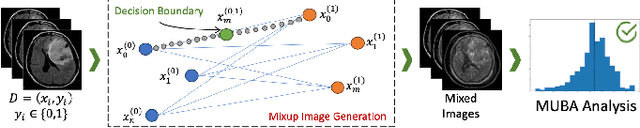
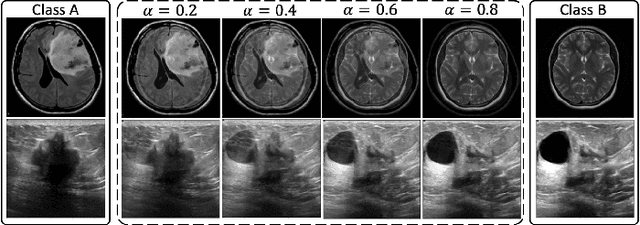
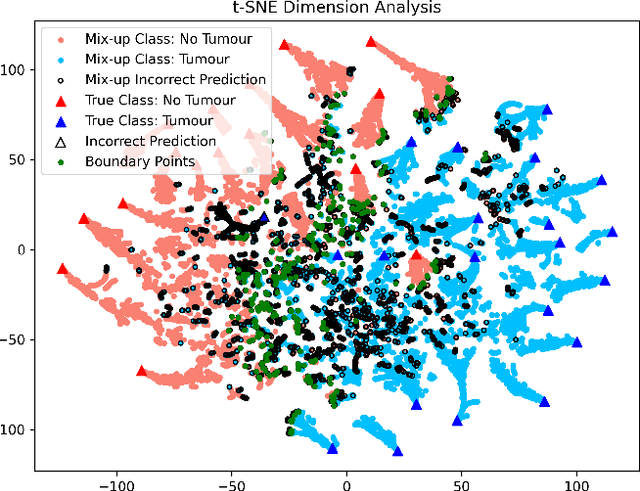
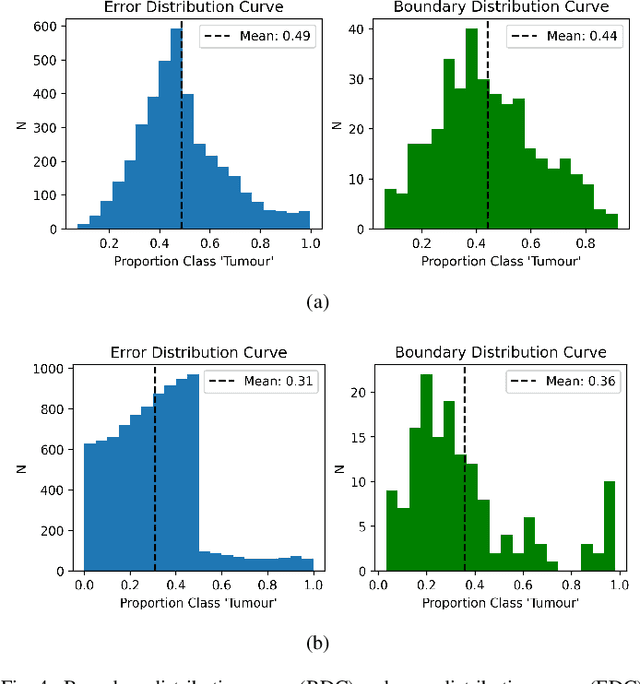
Machine learning (ML) models are becoming integral in healthcare technologies, presenting a critical need for formal assurance to validate their safety, fairness, robustness, and trustworthiness. These models are inherently prone to errors, potentially posing serious risks to patient health and could even cause irreparable harm. Traditional software assurance techniques rely on fixed code and do not directly apply to ML models since these algorithms are adaptable and learn from curated datasets through a training process. However, adapting established principles, such as boundary testing using synthetic test data can effectively bridge this gap. To this end, we present a novel technique called Mix-Up Boundary Analysis (MUBA) that facilitates evaluating image classifiers in terms of prediction fairness. We evaluated MUBA for two important medical imaging tasks -- brain tumour classification and breast cancer classification -- and achieved promising results. This research aims to showcase the importance of adapting traditional assurance principles for assessing ML models to enhance the safety and reliability of healthcare technologies. To facilitate future research, we plan to publicly release our code for MUBA.