 Add to Chrome
 Add to Firefox
 Add to Edge
Impact of Terminal Noise on Polarization Rotation Vector for Sensing Applications
Aug 10, 2026
State-of-Polarization sensing with coherent transponders enables wide-area geophysical monitoring over existing submarine cables, but its performance is limited by polarization noise from both the fiber and terminal hardware. This work investigates how terminal noise affects polarization rotation estimates derived from receiver equalizer coefficients and how it can obscure stochastic polarization drift used for sensing. We analyze Jones-matrix time series from two deployed receivers in the Sparkle Mediterranean link MedNautilus (approximately 2000 km and 450 km) and compare them with a laboratory back-to-back reference. Power Spectral Density (PSD) analysis reveals a low-frequency random-walk regime and a high-frequency white-noise floor, separated by a link-dependent corner frequency. The rotation innovation variance increases with link length, while the longest field link also shows elevated white noise consistent with accumulated amplifier and terminal contributions. Additionally, harmonic spectral components are observed, indicating a transponder-related artifact that should be considered in practical sensing applications.

On the SNR Statistics in Coupled-Core Multi-Core Fiber Transmissions with Mode-Dependent Loss
Mar 09, 2026We investigate the impact of mode-dependent loss (MDL) on the statistics of the signal-to-noise ratio (SNR) in coupled-core multi-core fiber (CC-MCF) systems. Through numerical and theoretical simulations, we present an in-depth analysis of the impact of MDL on received amplified spontaneous emission (ASE) noise and nonlinear interference (NLI), as well as their joint contribution to the SNR. We show that MDL induces different statistics on the two noises and discuss the differences with single-mode polarization-dependent loss. Moreover, we investigate the impact of spatial mode dispersion (SMD) on the MDL-induced impairment, offering insights on their joint effects on ASE and NLI.
Closed-form Expression for the Power Profile in Wideband Systems with Inter-channel Stimulated Raman Scattering
Jul 31, 2025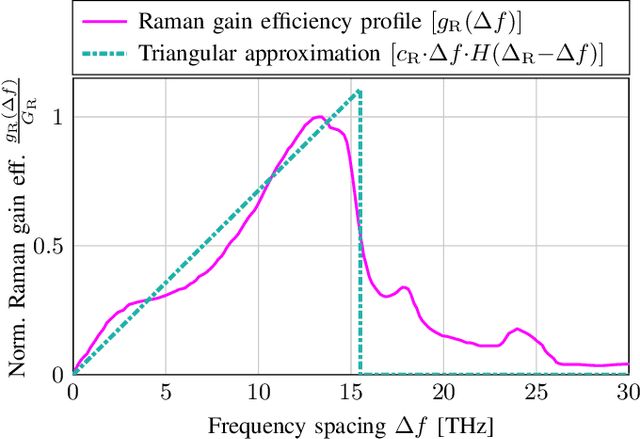
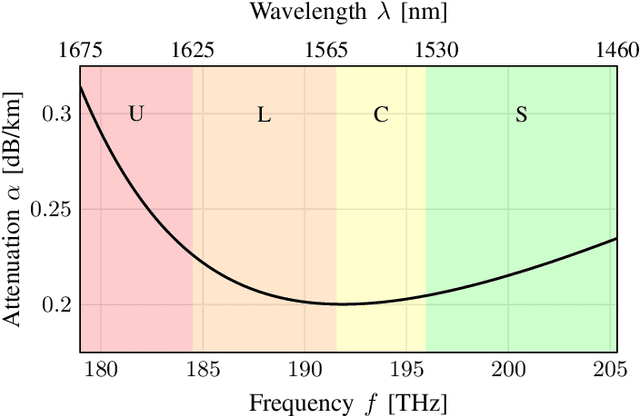
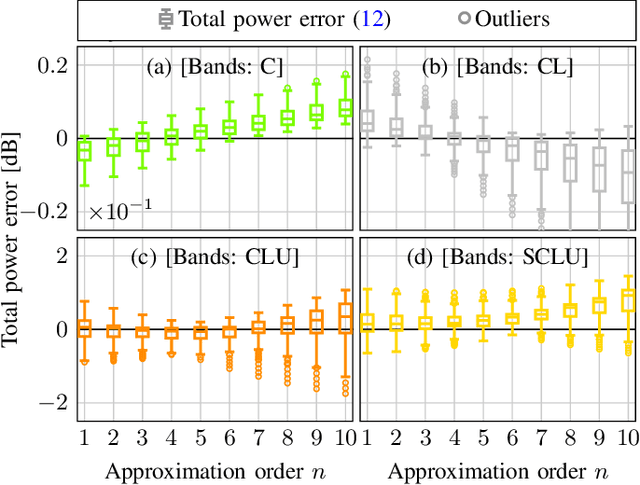
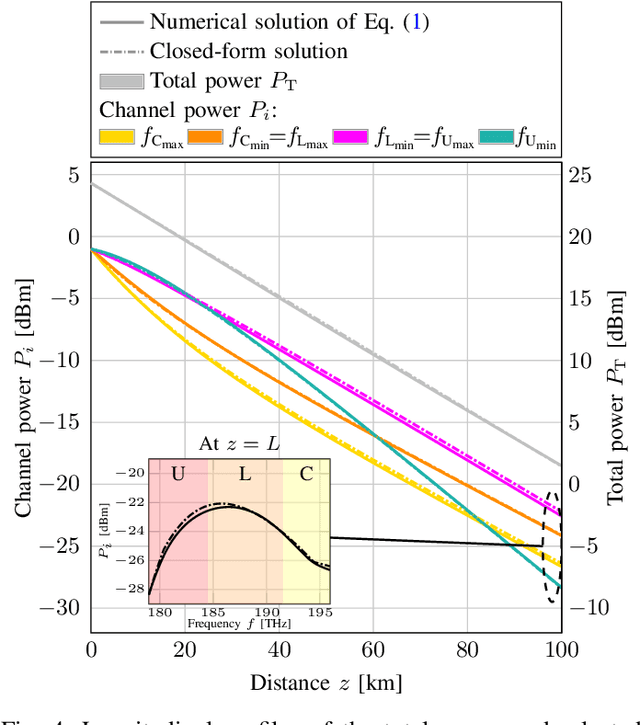
Wideband systems experience significant inter-channel stimulated Raman scattering (ISRS) and channel-dependent losses. Due to the non-uniform attenuation profile, the combined effects of ISRS and fiber loss can only be accurately estimated using numerical methods. In this work, we present an approximate closed-form expression for the channels' power profile accounting for these combined effects. We validate the proposed expression against numerical solutions in the case of CLU transmission, showing high accuracy for both single-span and multi-span fiber-optic links. Additionally, we derive an inverse expression, formulated as a function of the output power, which can be utilized to target a desired optical signal-to-noise ratio (OSNR) profile through pre-emphasis of the launched channel powers.