 Add to Chrome
 Add to Firefox
 Add to Edge
On the SNR Statistics in Coupled-Core Multi-Core Fiber Transmissions with Mode-Dependent Loss
Mar 09, 2026
We investigate the impact of mode-dependent loss (MDL) on the statistics of the signal-to-noise ratio (SNR) in coupled-core multi-core fiber (CC-MCF) systems. Through numerical and theoretical simulations, we present an in-depth analysis of the impact of MDL on received amplified spontaneous emission (ASE) noise and nonlinear interference (NLI), as well as their joint contribution to the SNR. We show that MDL induces different statistics on the two noises and discuss the differences with single-mode polarization-dependent loss. Moreover, we investigate the impact of spatial mode dispersion (SMD) on the MDL-induced impairment, offering insights on their joint effects on ASE and NLI.

A Block Least Mean Square Method for Fiber Longitudinal Power Profile Monitoring
Mar 02, 2026We propose a block least mean square (LMS) algorithm to monitor the longitudinal power profile of a fiber-optic link through receiver-based digital data from a coherent detector. Compared to the benchmark least squares (LS) method, the proposed algorithm does not require large matrix inversions or batch processing, thus allowing the received data to be processed in blocks of minimum size by an overlap-save algorithm, reducing complexity and latency. We propose an efficient implementation of the method with a stochastic gradient update leveraging a key computation in the frequency domain, offering computational savings over state-of-the-art monitoring techniques. We test the proposal in different scenarios by means of numerical simulations.
Closed-form Expression for the Power Profile in Wideband Systems with Inter-channel Stimulated Raman Scattering
Jul 31, 2025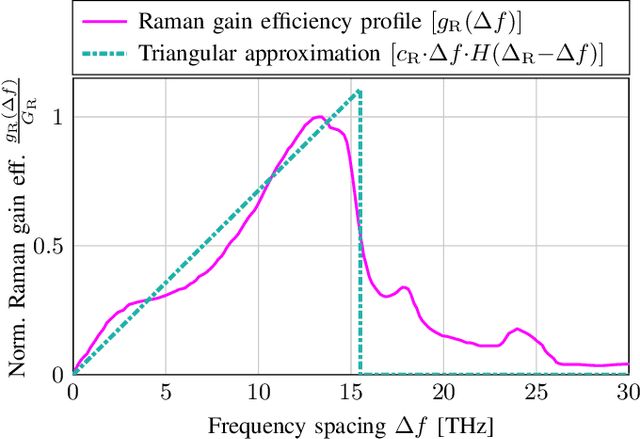
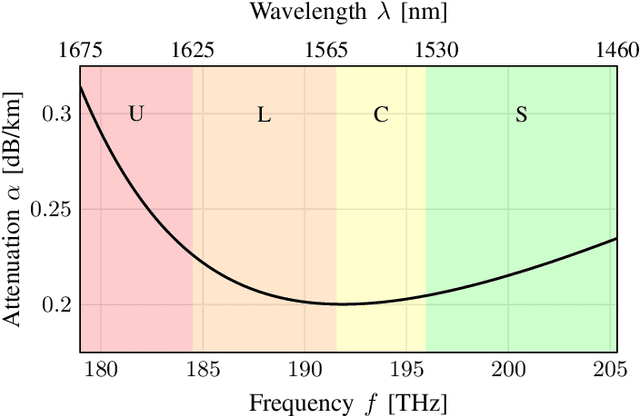
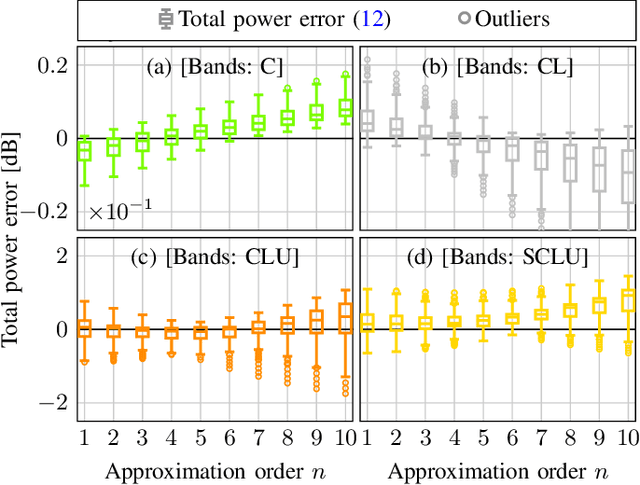
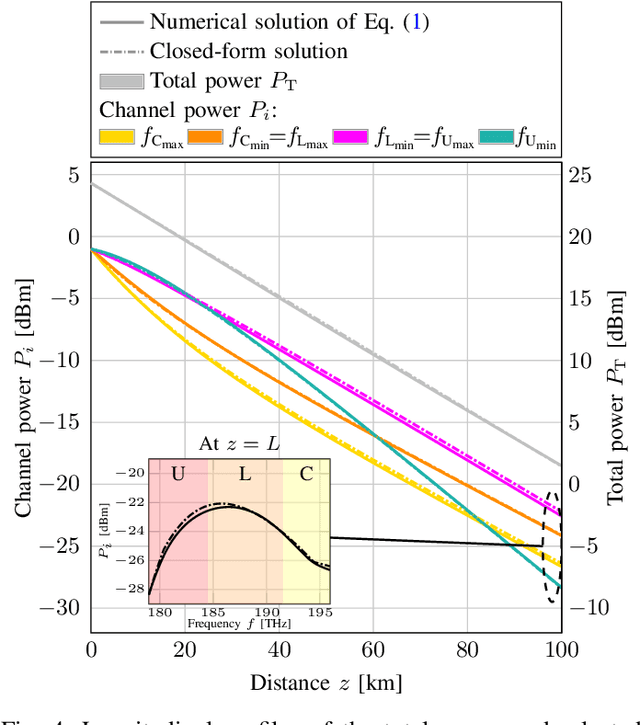
Wideband systems experience significant inter-channel stimulated Raman scattering (ISRS) and channel-dependent losses. Due to the non-uniform attenuation profile, the combined effects of ISRS and fiber loss can only be accurately estimated using numerical methods. In this work, we present an approximate closed-form expression for the channels' power profile accounting for these combined effects. We validate the proposed expression against numerical solutions in the case of CLU transmission, showing high accuracy for both single-span and multi-span fiber-optic links. Additionally, we derive an inverse expression, formulated as a function of the output power, which can be utilized to target a desired optical signal-to-noise ratio (OSNR) profile through pre-emphasis of the launched channel powers.