 Add to Chrome
 Add to Firefox
 Add to Edge
On the impact of retrieved content representations in RAG Pipelines
May 29, 2026
Retrieval-Augmented Generation (RAG) supplements a language model's input with retrieved documents, yet most RAG pipelines inherit retrieval components designed for human readers. How retrieved content should be represented when the consumer is a large language model (LLM) rather than a human is less well understood. Recent work has proposed transformations of retrieved content and identified properties that affect generation, but each examines a single transformation or property in isolation, leaving open which features of a document's representation matter most. We address this with a controlled comparison: holding retrieval fixed, we vary only the representation of retrieved documents, comparing an original baseline against thirteen transformations spanning selection, summarisation, and reformulation, in query-dependent and query-independent variants. Across these fourteen representations we measure question-answering accuracy for four generators, and for each representation we also measure answer retention: whether a known answer-bearing document still supports its answer after transformation. We find that answer retention is the primary determinant of generator accuracy; notably, when retention is high, a representation's wording, structure, length, and query-dependence have limited effect. This suggests that accuracy gains attributed to specific mechanisms in prior work may be partly explained by how well those mechanisms preserve answer-bearing content, an attribution that cannot be settled without controlling for retention.

AgAsk: An Agent to Help Answer Farmer's Questions From Scientific Documents
Dec 21, 2022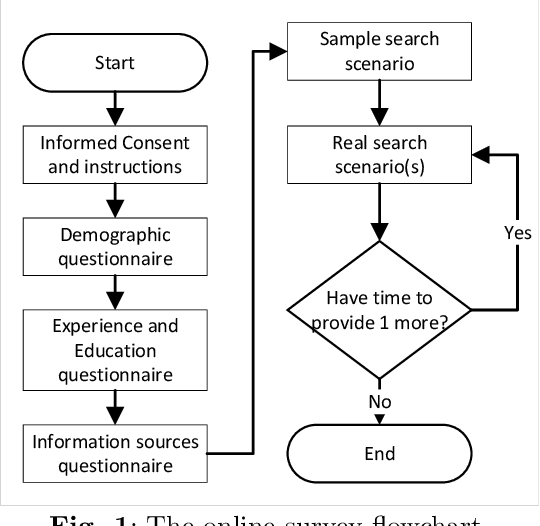
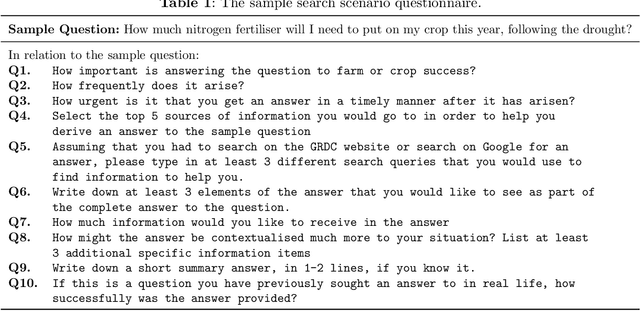
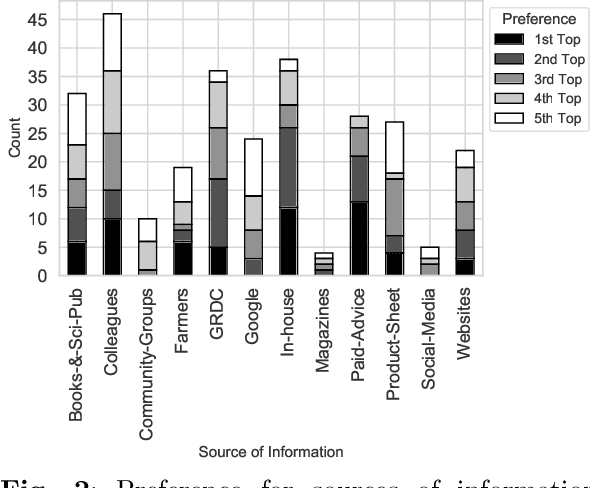
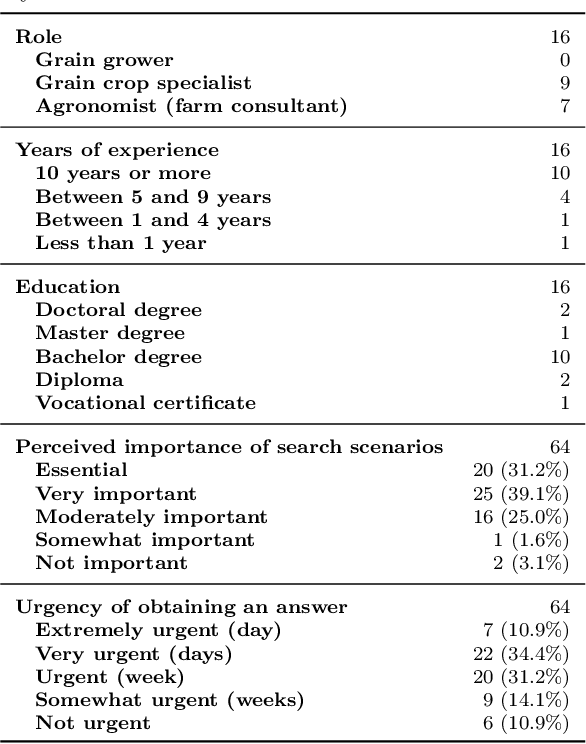
Decisions in agriculture are increasingly data-driven; however, valuable agricultural knowledge is often locked away in free-text reports, manuals and journal articles. Specialised search systems are needed that can mine agricultural information to provide relevant answers to users' questions. This paper presents AgAsk -- an agent able to answer natural language agriculture questions by mining scientific documents. We carefully survey and analyse farmers' information needs. On the basis of these needs we release an information retrieval test collection comprising real questions, a large collection of scientific documents split in passages, and ground truth relevance assessments indicating which passages are relevant to each question. We implement and evaluate a number of information retrieval models to answer farmers questions, including two state-of-the-art neural ranking models. We show that neural rankers are highly effective at matching passages to questions in this context. Finally, we propose a deployment architecture for AgAsk that includes a client based on the Telegram messaging platform and retrieval model deployed on commodity hardware. The test collection we provide is intended to stimulate more research in methods to match natural language to answers in scientific documents. While the retrieval models were evaluated in the agriculture domain, they are generalisable and of interest to others working on similar problems. The test collection is available at: \url{https://github.com/ielab/agvaluate}.