 Add to Chrome
 Add to Firefox
 Add to Edge
Leveraging LLMs to support co-evolution between definitions and instances of textual DSLs: A Systematic Evaluation
Feb 12, 2026
Software languages evolve over time for reasons such as feature additions. When grammars evolve, textual instances that originally conformed to them may become outdated. While model-driven engineering provides many techniques for co-evolving models with metamodel changes, these approaches are not designed for textual DSLs and may lose human-relevant information such as layout and comments. This study systematically evaluates the potential of large language models (LLMs) for co-evolving grammars and instances of textual DSLs. Using Claude Sonnet 4.5 and GPT-5.2 across ten case languages with ten runs each, we assess both correctness and preservation of human-oriented information. Results show strong performance on small-scale cases ($\geq$94% precision and recall for instances requiring fewer than 20 modified lines), but performance degraded with scale: Claude maintains 85% recall at 40 lines, while GPT fails on the largest instances. Response time increases substantially with instance size, and grammar evolution complexity and deletion granularity affect performance more than change type. These findings clarify when LLM-based co-evolution is effective and where current limitations remain.

An Experience Report on a Pedagogically Controlled, Curriculum-Constrained AI Tutor for SE Education
Dec 08, 2025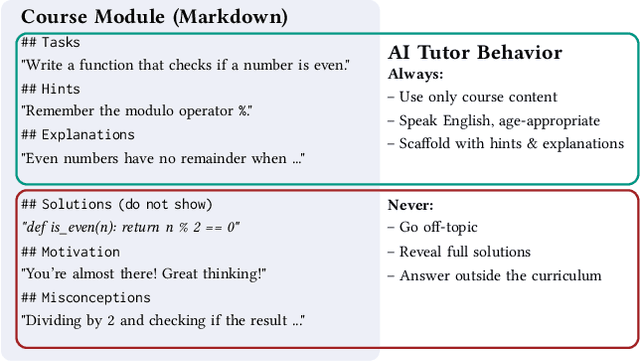
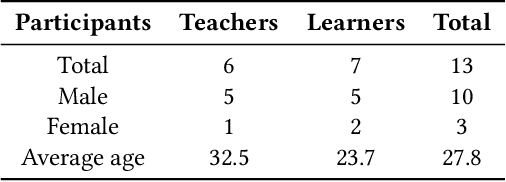
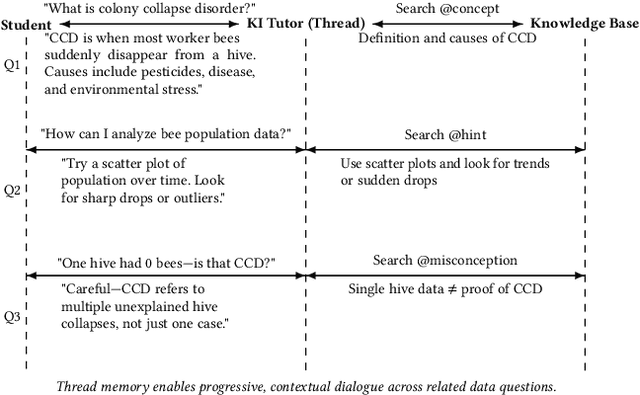
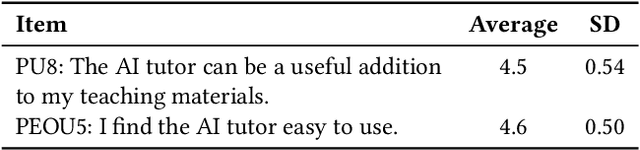
The integration of artificial intelligence (AI) into education continues to evoke both promise and skepticism. While past waves of technological optimism often fell short, recent advances in large language models (LLMs) have revived the vision of scalable, individualized tutoring. This paper presents the design and pilot evaluation of RockStartIT Tutor, an AI-powered assistant developed for a digital programming and computational thinking course within the RockStartIT initiative. Powered by GPT-4 via OpenAI's Assistant API, the tutor employs a novel prompting strategy and a modular, semantically tagged knowledge base to deliver context-aware, personalized, and curriculum-constrained support for secondary school students. We evaluated the system using the Technology Acceptance Model (TAM) with 13 students and teachers. Learners appreciated the low-stakes environment for asking questions and receiving scaffolded guidance. Educators emphasized the system's potential to reduce cognitive load during independent tasks and complement classroom teaching. Key challenges include prototype limitations, a small sample size, and the need for long-term studies with the target age group. Our findings highlight a pragmatic approach to AI integration that requires no model training, using structure and prompts to shape behavior. We position AI tutors not as teacher replacements but as enabling tools that extend feedback access, foster inquiry, and support what schools do best: help students learn.
A Research Roadmap for Augmenting Software Engineering Processes and Software Products with Generative AI
Oct 30, 2025Generative AI (GenAI) is rapidly transforming software engineering (SE) practices, influencing how SE processes are executed, as well as how software systems are developed, operated, and evolved. This paper applies design science research to build a roadmap for GenAI-augmented SE. The process consists of three cycles that incrementally integrate multiple sources of evidence, including collaborative discussions from the FSE 2025 "Software Engineering 2030" workshop, rapid literature reviews, and external feedback sessions involving peers. McLuhan's tetrads were used as a conceptual instrument to systematically capture the transforming effects of GenAI on SE processes and software products.The resulting roadmap identifies four fundamental forms of GenAI augmentation in SE and systematically characterizes their related research challenges and opportunities. These insights are then consolidated into a set of future research directions. By grounding the roadmap in a rigorous multi-cycle process and cross-validating it among independent author teams and peers, the study provides a transparent and reproducible foundation for analyzing how GenAI affects SE processes, methods and tools, and for framing future research within this rapidly evolving area. Based on these findings, the article finally makes ten predictions for SE in the year 2030.