 Add to Chrome
 Add to Firefox
 Add to Edge
StabilityBench: Benchmarking Instability in LLMs
Jul 17, 2026
AI Assistants are increasingly deployed in high-stakes settings, such as healthcare or government services. Yet their real-world behavior remains poorly understood due to strong context dependence. Current evaluation protocols follow a defense-in-depth paradigm with compounding layers of safeguards, ranging from traditional benchmarks to live or adversarial testing. Such benchmarks remain largely static and single-turn, limiting their ability to capture real-world variability in conversational settings. We propose StabilityBench, a principled, general and model-agnostic benchmark operator that transforms single-turn benchmark queries into multi-turn interaction histories. StabilityBench augments existing benchmarks by injecting realistic user simulations, through demographic proxies or sycophantic baits, while preserving original task intent. We apply StabilityBench to four benchmarks spanning mathematical reasoning, health question-answering and safety, and evaluate nine large language models under these conditions. Our results show that model performance is consistently unstable under these injections, with considerable performance degradations on three out of four benchmarks studied. These highlight important limitations of static evaluations and motivate more realistic evaluation settings. To this end, we propose StabilityBench-Mini: a size-preserving variant of StabilityBench that samples across diversification axes, enabling more realistic evaluation without increasing costs.

Uncertainty Resolution in Misinformation Detection
Jan 02, 2024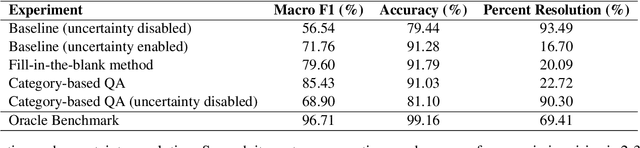
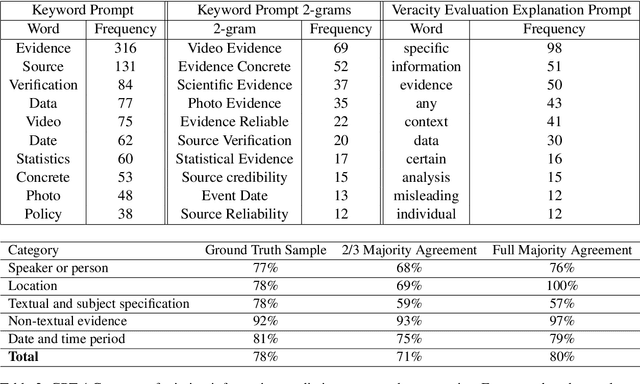
Misinformation poses a variety of risks, such as undermining public trust and distorting factual discourse. Large Language Models (LLMs) like GPT-4 have been shown effective in mitigating misinformation, particularly in handling statements where enough context is provided. However, they struggle to assess ambiguous or context-deficient statements accurately. This work introduces a new method to resolve uncertainty in such statements. We propose a framework to categorize missing information and publish category labels for the LIAR-New dataset, which is adaptable to cross-domain content with missing information. We then leverage this framework to generate effective user queries for missing context. Compared to baselines, our method improves the rate at which generated questions are answerable by the user by 38 percentage points and classification performance by over 10 percentage points macro F1. Thus, this approach may provide a valuable component for future misinformation mitigation pipelines.
Party Prediction for Twitter
Aug 25, 2023


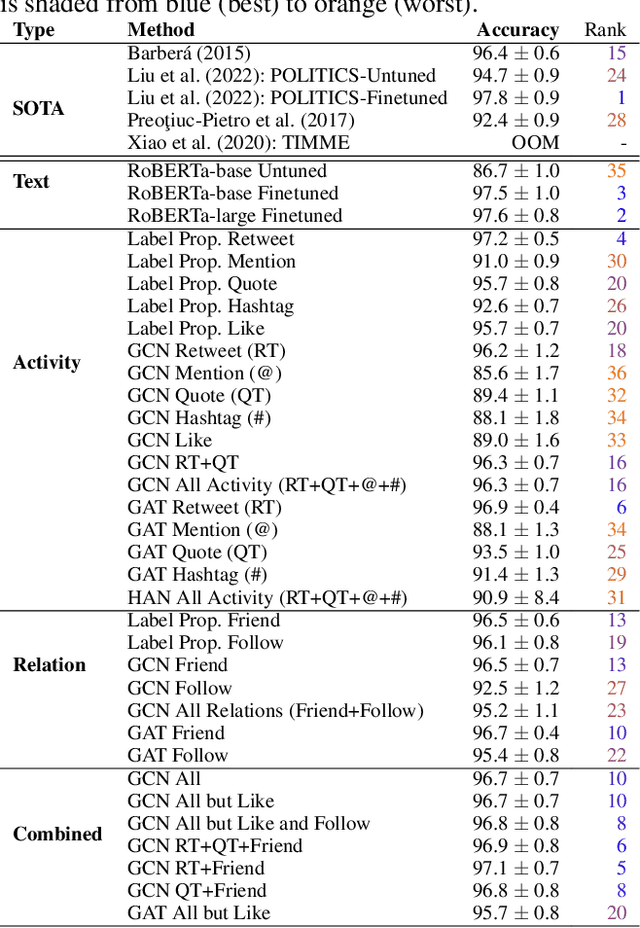
A large number of studies on social media compare the behaviour of users from different political parties. As a basic step, they employ a predictive model for inferring their political affiliation. The accuracy of this model can change the conclusions of a downstream analysis significantly, yet the choice between different models seems to be made arbitrarily. In this paper, we provide a comprehensive survey and an empirical comparison of the current party prediction practices and propose several new approaches which are competitive with or outperform state-of-the-art methods, yet require less computational resources. Party prediction models rely on the content generated by the users (e.g., tweet texts), the relations they have (e.g., who they follow), or their activities and interactions (e.g., which tweets they like). We examine all of these and compare their signal strength for the party prediction task. This paper lets the practitioner select from a wide range of data types that all give strong performance. Finally, we conduct extensive experiments on different aspects of these methods, such as data collection speed and transfer capabilities, which can provide further insights for both applied and methodological research.