 Add to Chrome
 Add to Firefox
 Add to Edge
The Whale That Outswam Evolution: Swarm Intelligence Maximises Memory in Connectome Reservoirs
Jun 05, 2026
Reservoir computing exploits the fixed dynamics of a recurrent network for temporal processing, requiring only a trained linear readout. Biological neural connectomes, shaped by millions of years of evolution, may encode computational structure beyond what random reservoirs provide, yet whether that structure can be further enhanced by principled optimisation remains an open question. We address it by applying four gradient-free, bio-inspired optimisers (Particle Swarm Optimisation, Differential Evolution, Grey Wolf Optimiser, and Whale Optimisation Algorithm) to the edge weights of connectome-based echo-state networks across six species spanning six orders of magnitude in neural complexity: C. elegans (279 neurons), Drosophila (49 nodes), mouse (112), rat (73), macaque (29 regions, continuous FLNe synaptic strengths), and human structural MRI connectivity (83 parcels). Each connectome is evaluated on four canonical reservoir computing benchmarks: Memory Capacity (MC), Lorenz attractor prediction, NARMA-10 system identification, and Mackey-Glass chaotic time-series prediction. All four optimisers consistently outperform unoptimised biological baselines across every task and species when initialised from biological weights. WOA achieves the largest gains on every task: up to a 17x MC improvement (C. elegans: 1.39 to 23.91) and up to 89% NRMSE reduction (Mackey-Glass, human), corresponding to an average 214% improvement across all species and tasks. Crucially, random initialisation on the same topology reliably underperforms biology, establishing biological weight values as an essential inductive bias that topology alone cannot recover. These results position bio-inspired, biologically-initialised optimisation as a principled and broadly effective strategy for connectome reservoir computing across the animal kingdom.

NLPineers@ NLU of Devanagari Script Languages 2025: Hate Speech Detection using Ensembling of BERT-based models
Dec 12, 2024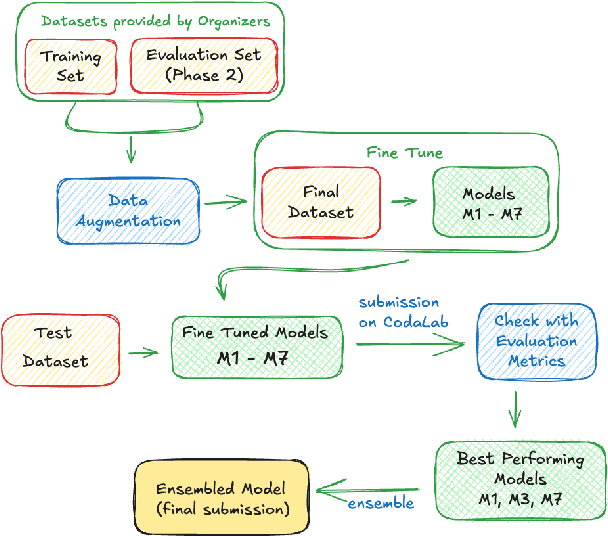

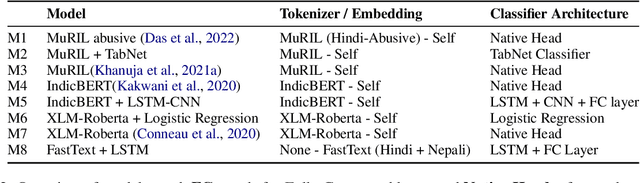
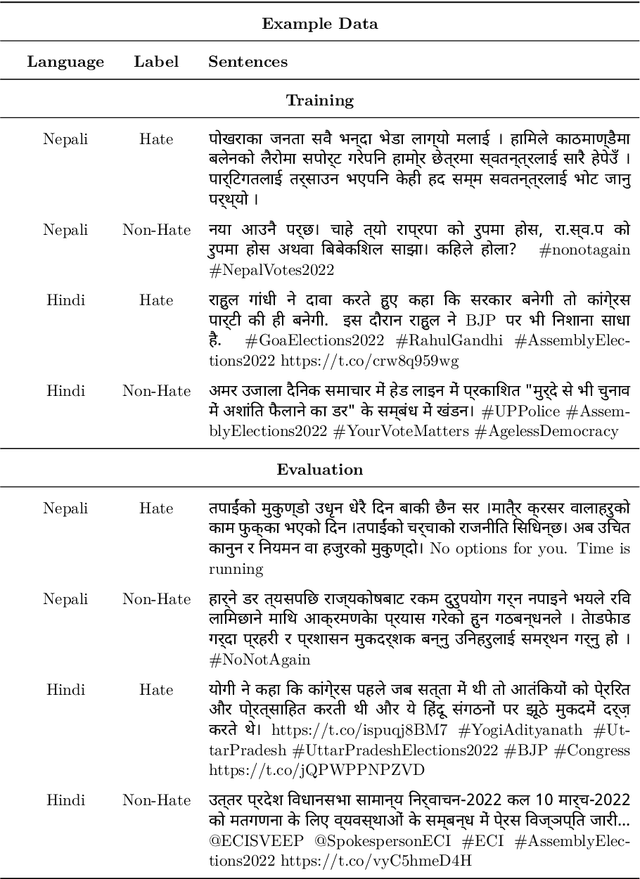
This paper explores hate speech detection in Devanagari-scripted languages, focusing on Hindi and Nepali, for Subtask B of the CHIPSAL@COLING 2025 Shared Task. Using a range of transformer-based models such as XLM-RoBERTa, MURIL, and IndicBERT, we examine their effectiveness in navigating the nuanced boundary between hate speech and free expression. Our best performing model, implemented as ensemble of multilingual BERT models achieve Recall of 0.7762 (Rank 3/31 in terms of recall) and F1 score of 0.6914 (Rank 17/31). To address class imbalance, we used backtranslation for data augmentation, and cosine similarity to preserve label consistency after augmentation. This work emphasizes the need for hate speech detection in Devanagari-scripted languages and presents a foundation for further research.
Real-Time Scream Detection and Position Estimation for Worker Safety in Construction Sites
Nov 05, 2024


The construction industry faces high risks due to frequent accidents, often leaving workers in perilous situations where rapid response is critical. Traditional safety monitoring methods, including wearable sensors and GPS, often fail under obstructive or indoor conditions. This research introduces a novel real-time scream detection and localization system tailored for construction sites, especially in low-resource environments. Integrating Wav2Vec2 and Enhanced ConvNet models for accurate scream detection, coupled with the GCC-PHAT algorithm for robust time delay estimation under reverberant conditions, followed by a gradient descent-based approach to achieve precise position estimation in noisy environments. Our approach combines these concepts to achieve high detection accuracy and rapid localization, thereby minimizing false alarms and optimizing emergency response. Preliminary results demonstrate that the system not only accurately detects distress calls amidst construction noise but also reliably identifies the caller's location. This solution represents a substantial improvement in worker safety, with the potential for widespread application across high-risk occupational environments. The scripts used for training, evaluation of scream detection, position estimation, and integrated framework will be released at: https://github.com/Anmol2059/construction_safety.
Speech Foundation Model Ensembles for the Controlled Singing Voice Deepfake Detection (CtrSVDD) Challenge 2024
Sep 03, 2024


This work details our approach to achieving a leading system with a 1.79% pooled equal error rate (EER) on the evaluation set of the Controlled Singing Voice Deepfake Detection (CtrSVDD). The rapid advancement of generative AI models presents significant challenges for detecting AI-generated deepfake singing voices, attracting increased research attention. The Singing Voice Deepfake Detection (SVDD) Challenge 2024 aims to address this complex task. In this work, we explore the ensemble methods, utilizing speech foundation models to develop robust singing voice anti-spoofing systems. We also introduce a novel Squeeze-and-Excitation Aggregation (SEA) method, which efficiently and effectively integrates representation features from the speech foundation models, surpassing the performance of our other individual systems. Evaluation results confirm the efficacy of our approach in detecting deepfake singing voices. The codes can be accessed at https://github.com/Anmol2059/SVDD2024.