 Add to Chrome
 Add to Firefox
 Add to Edge
Designing Robots to Support Parent-Child Connections: Opportunities Through Robot-Mediated Communication
Apr 27, 2026
The sense of family connectedness may support positive outcomes including individual well-being, resilience, and healthy family functioning. However, as technologies advance, they often replace human-human interactions instead of nurturing them. In this work, we investigate how robot-facilitated communication tools might instead create new opportunities for family connection. We conducted two studies with families with children aged 5-12. We first explored the design space through in-home technology probe sessions with six families. These probes inspired us to explore two key interaction design dimensions: the robot's behavior strategy (passive, reactive, proactive) and the mode of communication (synchronous, asynchronous). We then conducted a laboratory study with 20 families to examine how the two dimensions shaped parent-child interaction and connection. Our findings characterize how parents and children appropriated robot-mediated exchanges, the tensions they experienced around initiative, timing, and privacy, and the opportunities they envisioned for supporting everyday connectedness.

Alignment-Process-Outcome: Rethinking How AIs and Humans Collaborate
Mar 10, 2026In real-world collaboration, alignment, process structure, and outcome quality do not exhibit a simple linear or one-to-one correspondence: similar alignment may accompany either rapid convergence or extensive multi-branch exploration, and lead to different results. Existing accounts often isolate these dimensions or focus on specific participant types, limiting structural accounts of collaboration. We reconceptualize collaboration through two complementary lenses. The task lens models collaboration as trajectory evolution in a structured task space, revealing patterns such as advancement, branching, and backtracking. The intent lens examines how individual intents are expressed within shared contexts and enter situated decisions. Together, these lenses clarify the structural relationships among alignment, decision-making, and trajectory structure. Rather than reducing collaboration to outcome quality or treating alignment as the sole objective, we propose a unified dynamic view of the relationships among alignment, process, and outcome, and use it to re-examine collaboration structure across Human-Human, AI-AI, and Human-AI settings.
Designing Telepresence Robots to Support Place Attachment
Jan 06, 2025


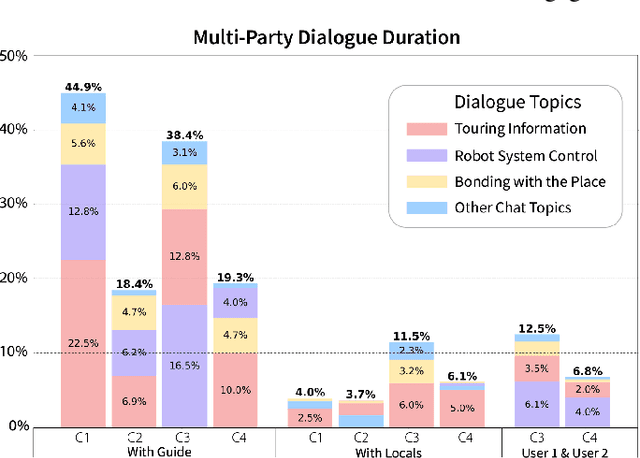
People feel attached to places that are meaningful to them, which psychological research calls "place attachment." Place attachment is associated with self-identity, self-continuity, and psychological well-being. Even small cues, including videos, images, sounds, and scents, can facilitate feelings of connection and belonging to a place. Telepresence robots that allow people to see, hear, and interact with a remote place have the potential to establish and maintain a connection with places and support place attachment. In this paper, we explore the design space of robotic telepresence to promote place attachment, including how users might be guided in a remote place and whether they experience the environment individually or with others. We prototyped a telepresence robot that allows one or more remote users to visit a place and be guided by a local human guide or a conversational agent. Participants were 38 university alumni who visited their alma mater via the telepresence robot. Our findings uncovered four distinct user personas in the remote experience and highlighted the need for social participation to enhance place attachment. We generated design implications for future telepresence robot design to support people's connections with places of personal significance.