 Add to Chrome
 Add to Firefox
 Add to Edge
Actions Speak Louder Than (Pass)words: Passive Authentication of Smartphone Users via Deep Temporal Features
Jan 16, 2019
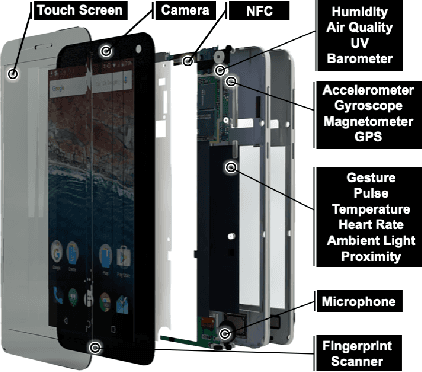
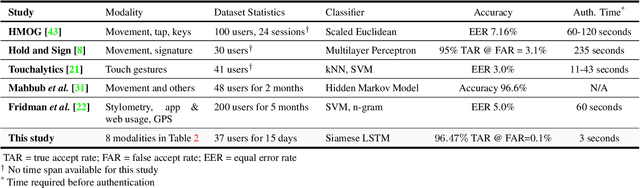
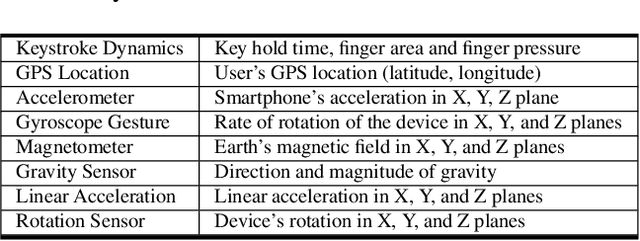
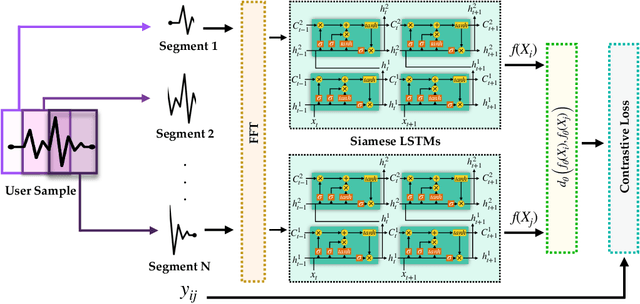
Prevailing user authentication schemes on smartphones rely on explicit user interaction, where a user types in a passcode or presents a biometric cue such as face, fingerprint, or iris. In addition to being cumbersome and obtrusive to the users, such authentication mechanisms pose security and privacy concerns. Passive authentication systems can tackle these challenges by frequently and unobtrusively monitoring the user's interaction with the device. In this paper, we propose a Siamese Long Short-Term Memory network architecture for passive authentication, where users can be verified without requiring any explicit authentication step. We acquired a dataset comprising of measurements from 30 smartphone sensor modalities for 37 users. We evaluate our approach on 8 dominant modalities, namely, keystroke dynamics, GPS location, accelerometer, gyroscope, magnetometer, linear accelerometer, gravity, and rotation sensors. Experimental results find that, within 3 seconds, a genuine user can be correctly verified 97.15% of the time at a false accept rate of 0.1%.

Generalizing Fingerprint Spoof Detector: Learning a One-Class Classifier
Jan 13, 2019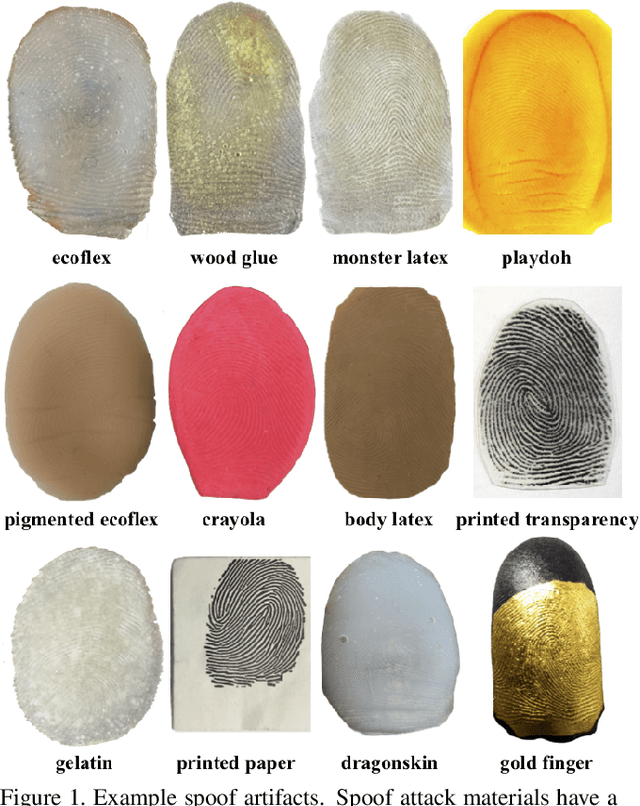

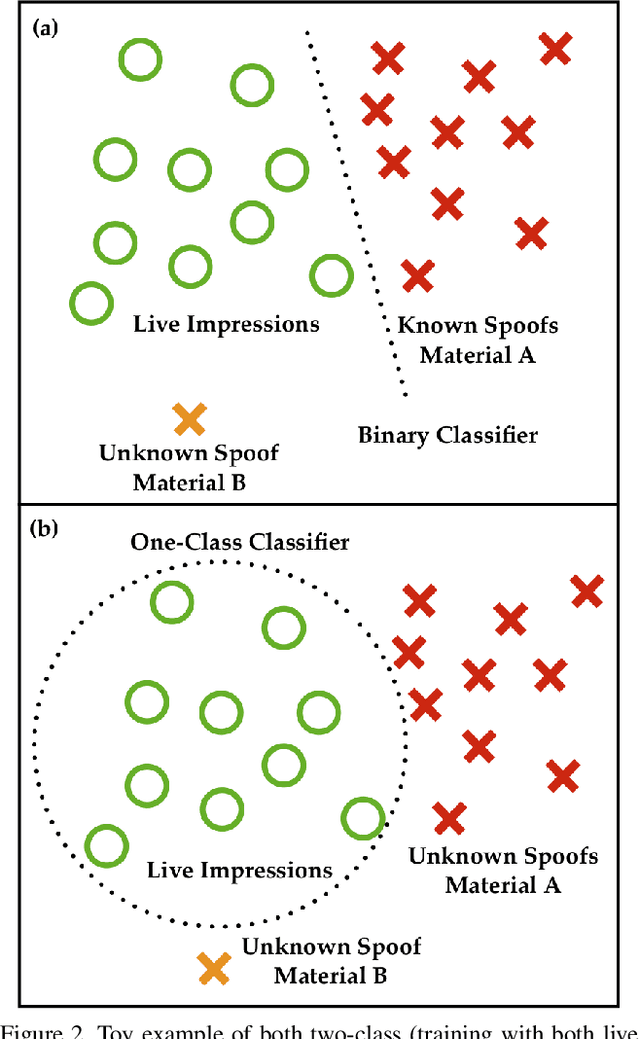
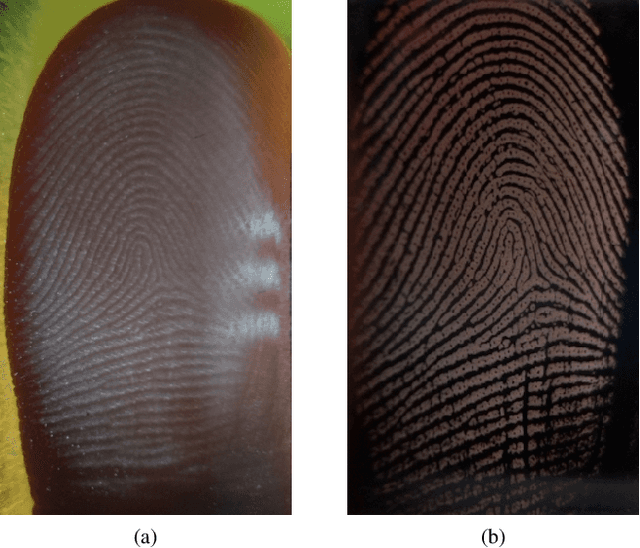
Prevailing fingerprint recognition systems are vulnerable to spoof attacks. To mitigate these attacks, automated spoof detectors are trained to distinguish a set of live or bona fide fingerprints from a set of known spoof fingerprints. However, spoof detectors remain vulnerable when exposed to attacks from spoofs made with materials not seen during training of the detector. To alleviate this shortcoming, we approach spoof detection as a one-class classification problem. The goal is to train a spoof detector on only the live fingerprints such that once the concept of "live" has been learned, spoofs of any material can be rejected. We accomplish this through training multiple generative adversarial networks (GANS) on live fingerprint images acquired with the open source, dual-camera, 1900 ppi RaspiReader fingerprint reader. Our experimental results, conducted on 5.5K spoof images (from 12 materials) and 11.8K live images show that the proposed approach improves the cross-material spoof detection performance over state-of-the-art one-class and binary class spoof detectors TDR = 84.4% vs. TDR = 40.3% (both @ FDR = 0.2%).
Learning Continuous Face Age Progression: A Pyramid of GANs
Jan 10, 2019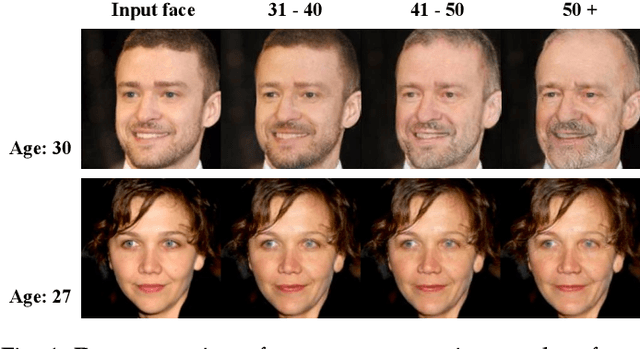
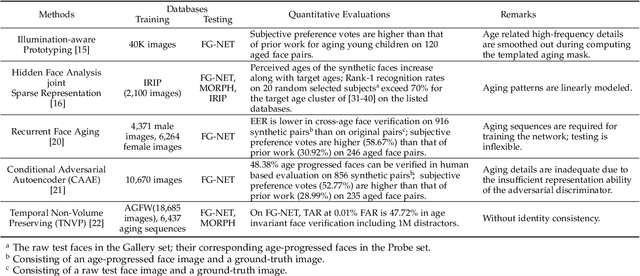
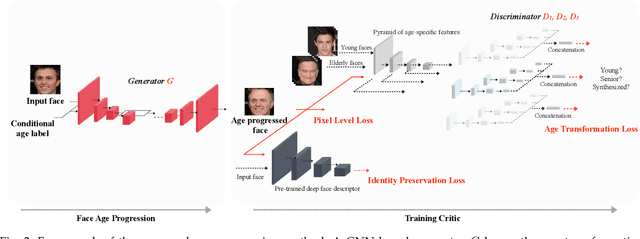
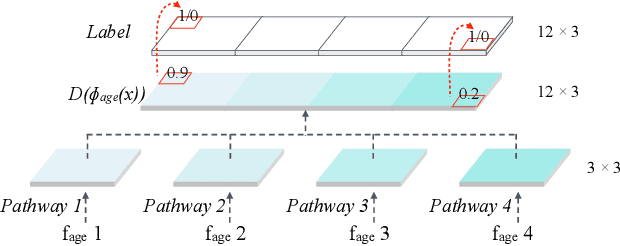
The two underlying requirements of face age progression, i.e. aging accuracy and identity permanence, are not well studied in the literature. This paper presents a novel generative adversarial network based approach to address the issues in a coupled manner. It separately models the constraints for the intrinsic subject-specific characteristics and the age-specific facial changes with respect to the elapsed time, ensuring that the generated faces present desired aging effects while simultaneously keeping personalized properties stable. To ensure photo-realistic facial details, high-level age-specific features conveyed by the synthesized face are estimated by a pyramidal adversarial discriminator at multiple scales, which simulates the aging effects with finer details. Further, an adversarial learning scheme is introduced to simultaneously train a single generator and multiple parallel discriminators, resulting in smooth continuous face aging sequences. The proposed method is applicable even in the presence of variations in pose, expression, makeup, etc., achieving remarkably vivid aging effects. Quantitative evaluations by a COTS face recognition system demonstrate that the target age distributions are accurately recovered, and 99.88% and 99.98% age progressed faces can be correctly verified at 0.001% FAR after age transformations of approximately 28 and 23 years elapsed time on the MORPH and CACD databases, respectively. Both visual and quantitative assessments show that the approach advances the state-of-the-art.
Fingerprint Presentation Attack Detection: Generalization and Efficiency
Dec 30, 2018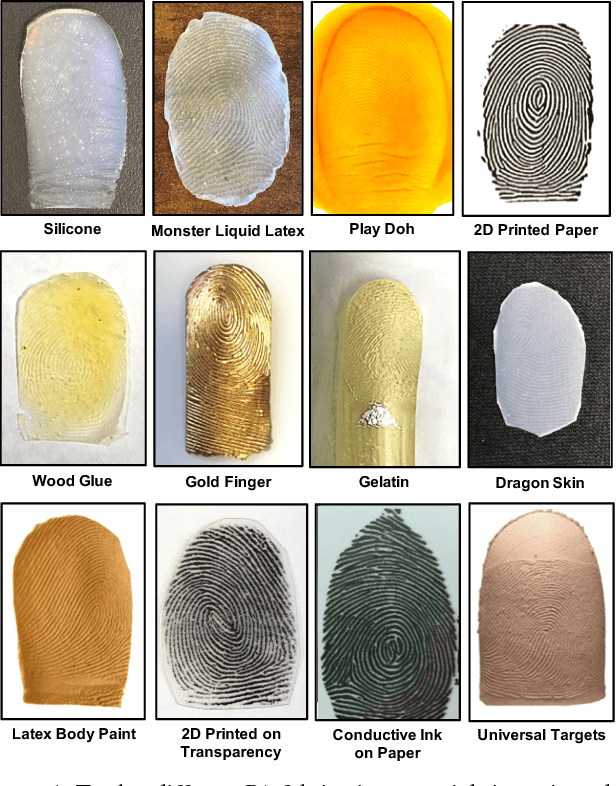
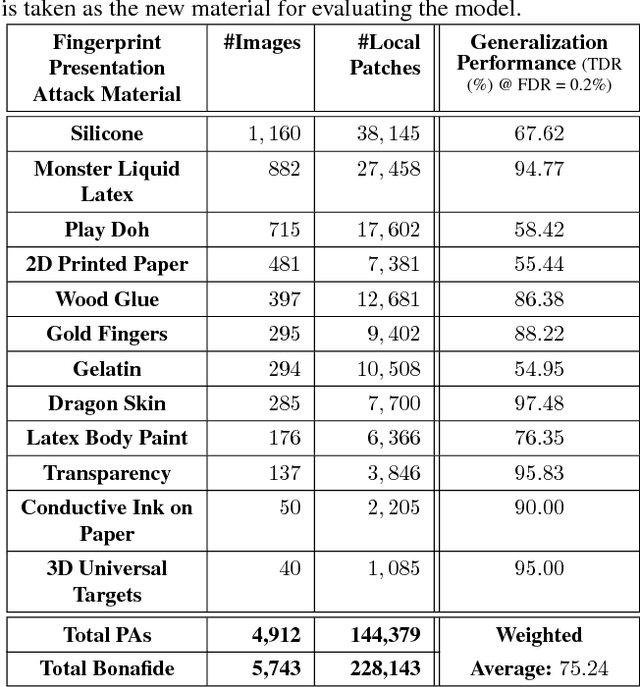
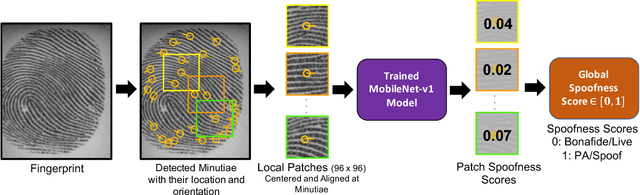
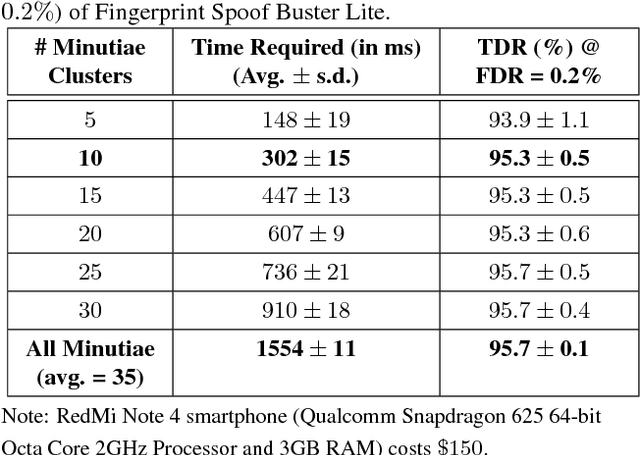
We study the problem of fingerprint presentation attack detection (PAD) under unknown PA materials not seen during PAD training. A dataset of 5,743 bonafide and 4,912 PA images of 12 different materials is used to evaluate a state-of-the-art PAD, namely Fingerprint Spoof Buster. We utilize 3D t-SNE visualization and clustering of material characteristics to identify a representative set of PA materials that cover most of PA feature space. We observe that a set of six PA materials, namely Silicone, 2D Paper, Play Doh, Gelatin, Latex Body Paint and Monster Liquid Latex provide a good representative set that should be included in training to achieve generalization of PAD. We also propose an optimized Android app of Fingerprint Spoof Buster that can run on a commodity smartphone (Xiaomi Redmi Note 4) without a significant drop in PAD performance (from TDR = 95.7% to 95.3% @ FDR = 0.2%) which can make a PA prediction in less than 300ms.
WarpGAN: Automatic Caricature Generation
Nov 28, 2018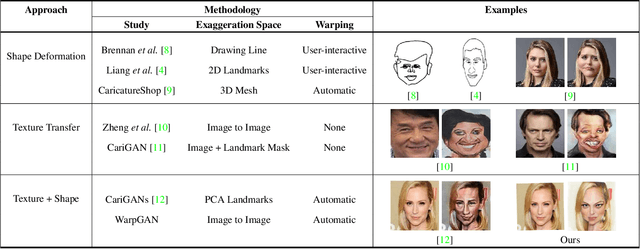
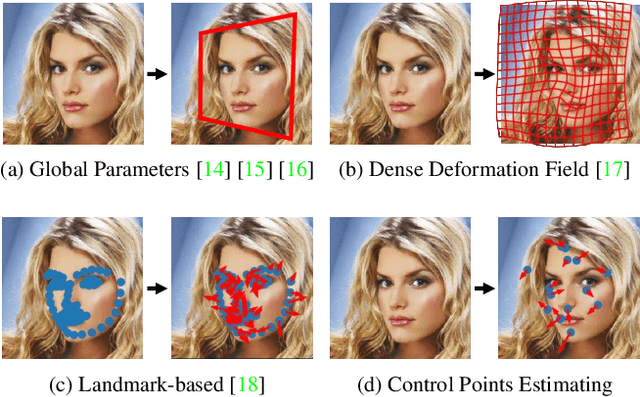
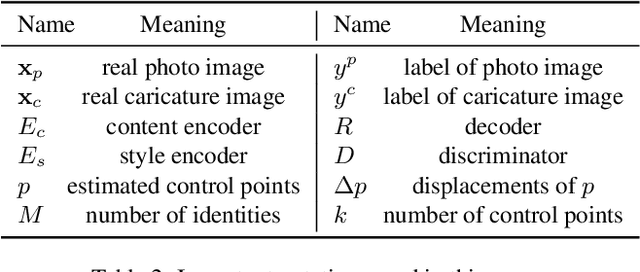
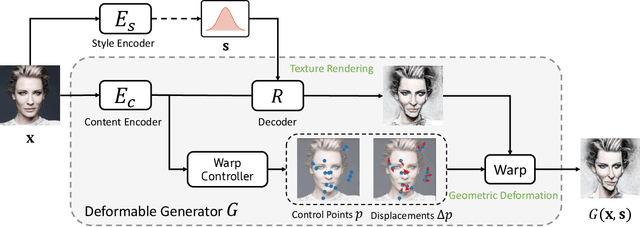
We propose, WarpGAN, a fully automatic network that can generate caricatures given an input face photo. Besides transferring rich texture styles, WarpGAN learns to automatically predict a set of control points that can warp the photo into a caricature, while preserving identity. We introduce an identity-preserving adversarial loss that aids the discriminator to distinguish between different subjects. Moreover, WarpGAN allows customization of the generated caricatures by controlling the exaggeration extent and the visual styles. Experimental results on a public domain dataset, WebCaricature, show that WarpGAN is capable of generating a diverse set of caricatures while preserving the identities. Five caricature experts suggest that caricatures generated by WarpGAN are visually similar to hand-drawn ones and only prominent facial features are exaggerated.
Tattoo Image Search at Scale: Joint Detection and Compact Representation Learning
Nov 01, 2018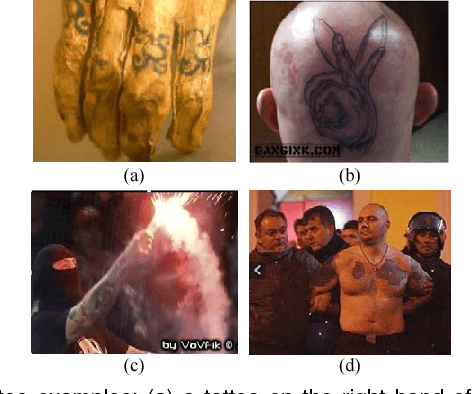
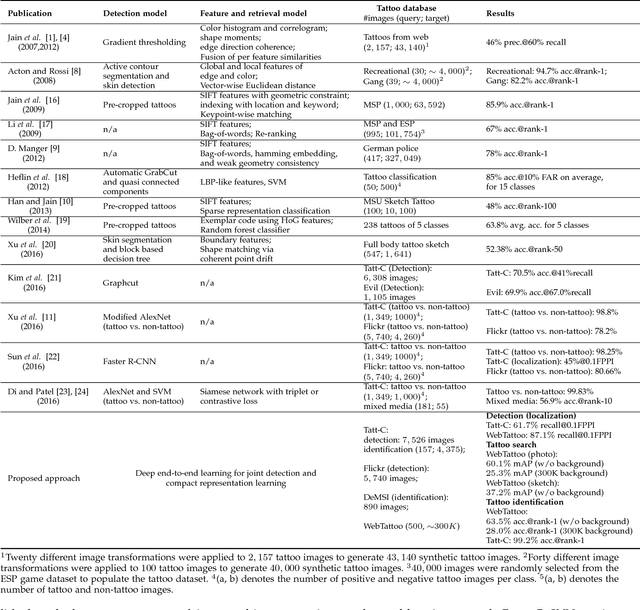
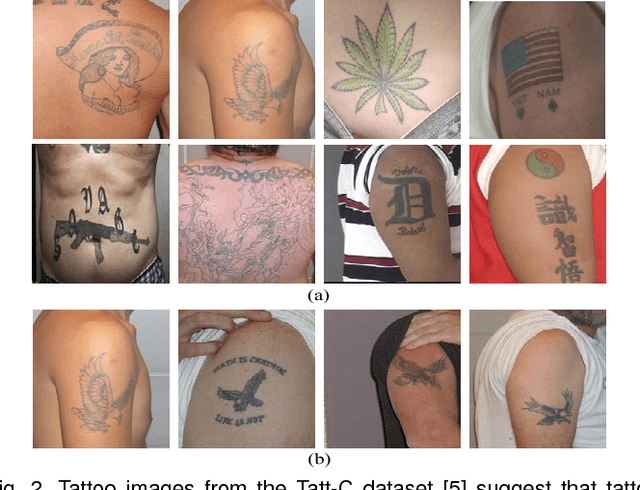
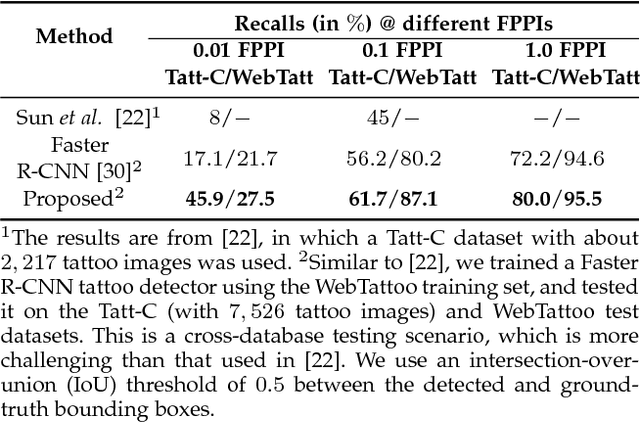
The explosive growth of digital images in video surveillance and social media has led to the significant need for efficient search of persons of interest in law enforcement and forensic applications. Despite tremendous progress in primary biometric traits (e.g., face and fingerprint) based person identification, a single biometric trait alone cannot meet the desired recognition accuracy in forensic scenarios. Tattoos, as one of the important soft biometric traits, have been found to be valuable for assisting in person identification. However, tattoo search in a large collection of unconstrained images remains a difficult problem, and existing tattoo search methods mainly focus on matching cropped tattoos, which is different from real application scenarios. To close the gap, we propose an efficient tattoo search approach that is able to learn tattoo detection and compact representation jointly in a single convolutional neural network (CNN) via multi-task learning. While the features in the backbone network are shared by both tattoo detection and compact representation learning, individual latent layers of each sub-network optimize the shared features toward the detection and feature learning tasks, respectively. We resolve the small batch size issue inside the joint tattoo detection and compact representation learning network via random image stitch and preceding feature buffering. We evaluate the proposed tattoo search system using multiple public-domain tattoo benchmarks, and a gallery set with about 300K distracter tattoo images compiled from these datasets and images from the Internet. In addition, we also introduce a tattoo sketch dataset containing 300 tattoos for sketch-based tattoo search. Experimental results show that the proposed approach has superior performance in tattoo detection and tattoo search at scale compared to several state-of-the-art tattoo retrieval algorithms.
Learning Face Age Progression: A Pyramid Architecture of GANs
Oct 09, 2018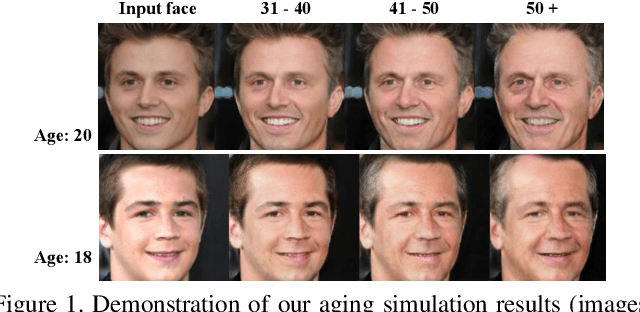
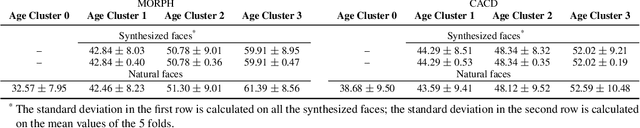
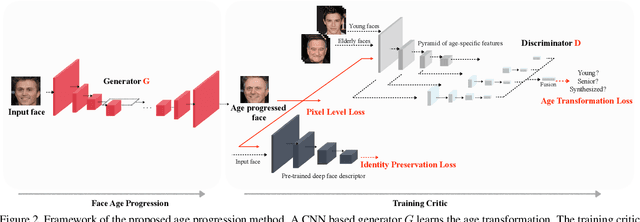
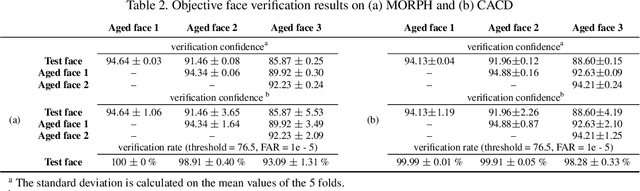
The two underlying requirements of face age progression, i.e. aging accuracy and identity permanence, are not well handled in the literature. In this paper, we present a novel generative adversarial network based approach. It separately models the constraints for the intrinsic subject-specific characteristics and the age-specific facial changes with respect to the elapsed time, ensuring that the generated faces present desired aging effects while simultaneously keeping personalized properties stable. Further, to generate more lifelike facial details, high-level age-specific features conveyed by the synthesized face are estimated by a pyramidal adversarial discriminator at multiple scales, which simulates the aging effects in a finer manner. The proposed method is applicable for diverse face samples in the presence of variations in pose, expression, makeup, etc., and remarkably vivid aging effects are achieved. Both visual fidelity and quantitative evaluations show that the approach advances the state-of-the-art.
Altered Fingerprints: Detection and Localization
Sep 18, 2018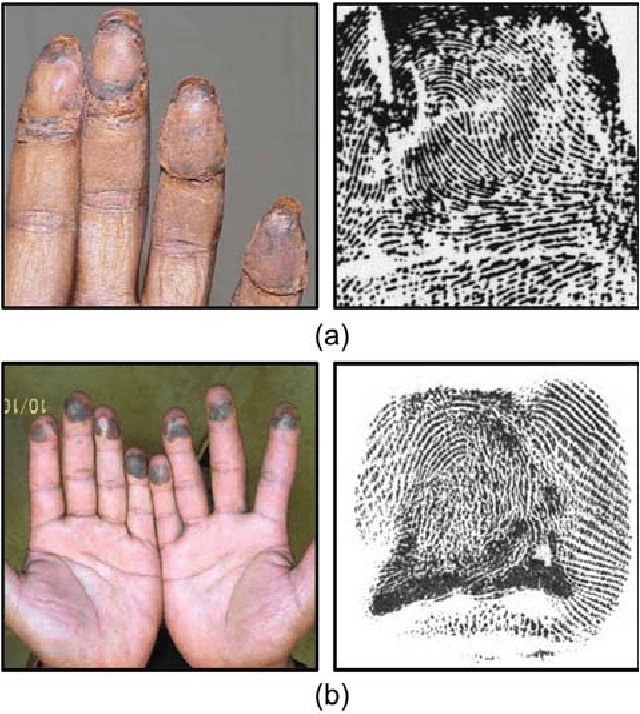
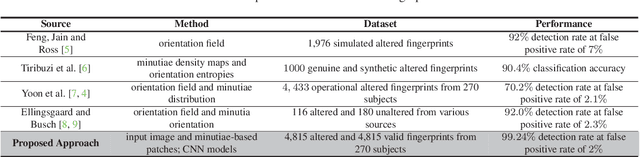
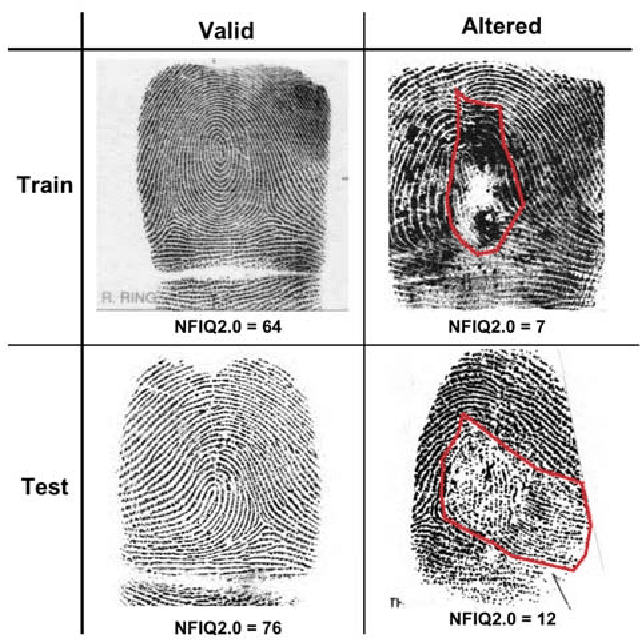
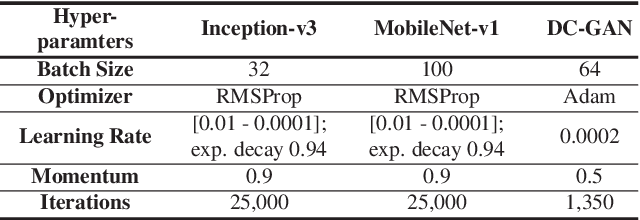
Fingerprint alteration, also referred to as obfuscation presentation attack, is to intentionally tamper or damage the real friction ridge patterns to avoid identification by an AFIS. This paper proposes a method for detection and localization of fingerprint alterations. Our main contributions are: (i) design and train CNN models on fingerprint images and minutiae-centered local patches in the image to detect and localize regions of fingerprint alterations, and (ii) train a Generative Adversarial Network (GAN) to synthesize altered fingerprints whose characteristics are similar to true altered fingerprints. A successfully trained GAN can alleviate the limited availability of altered fingerprint images for research. A database of 4,815 altered fingerprints from 270 subjects, and an equal number of rolled fingerprint images are used to train and test our models. The proposed approach achieves a True Detection Rate (TDR) of 99.24% at a False Detection Rate (FDR) of 2%, outperforming published results. The synthetically generated altered fingerprint dataset will be open-sourced.
DocFace+: ID Document to Selfie Matching
Sep 18, 2018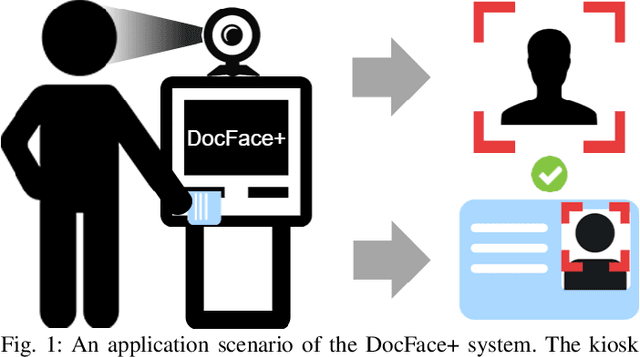
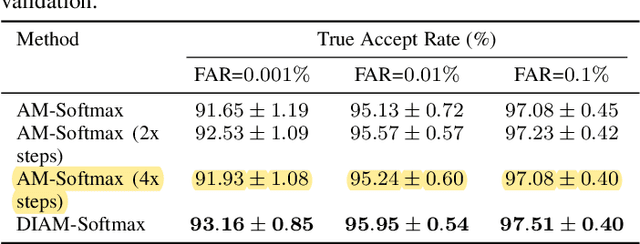
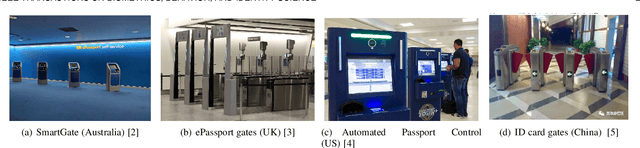
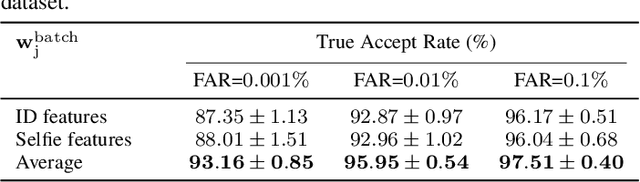
Numerous activities in our daily life require us to verify who we are by showing our ID documents containing face images, such as passports and driver licenses, to human operators. However, this process is slow, labor intensive and unreliable. As such, an automated system for matching ID document photos to live face images (selfies) in real time and with high accuracy is required. In this paper, we propose DocFace+ to meet this objective. We first show that gradient-based optimization methods converge slowly (due to the underfitting of classifier weights) when many classes have very few samples, a characteristic of existing ID-selfie datasets. To overcome this shortcoming, we propose a method, called dynamic weight imprinting (DWI), to update the classifier weights, which allows faster convergence and more generalizable representations. Next, a pair of sibling networks with partially shared parameters are trained to learn a unified face representation with domain-specific parameters. Cross-validation on an ID-selfie dataset shows that while a publicly available general face matcher (SphereFace) only achieves a True Accept Rate (TAR) of 59.29+-1.55% at a False Accept Rate (FAR) of 0.1% on the problem, DocFace+ improves the TAR to 97.51+-0.40%.
Automatic Latent Fingerprint Segmentation
Sep 04, 2018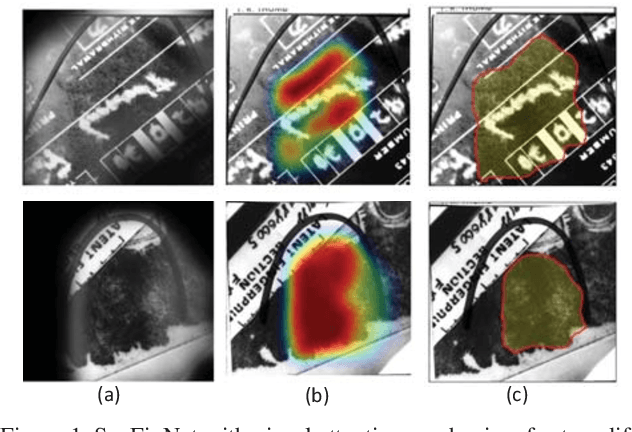
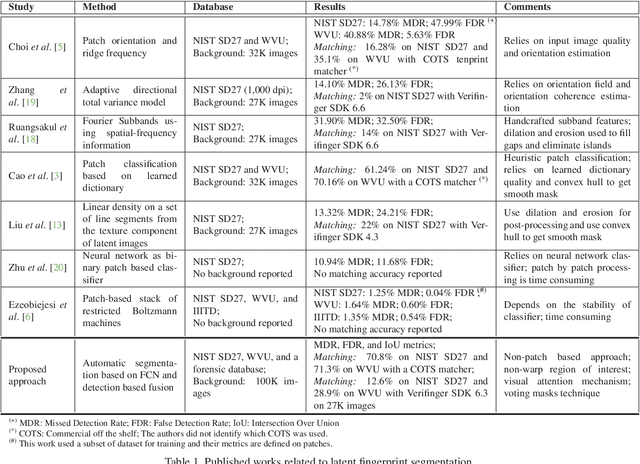
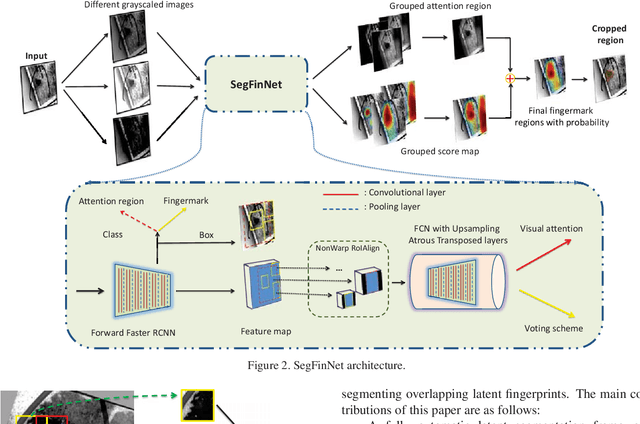
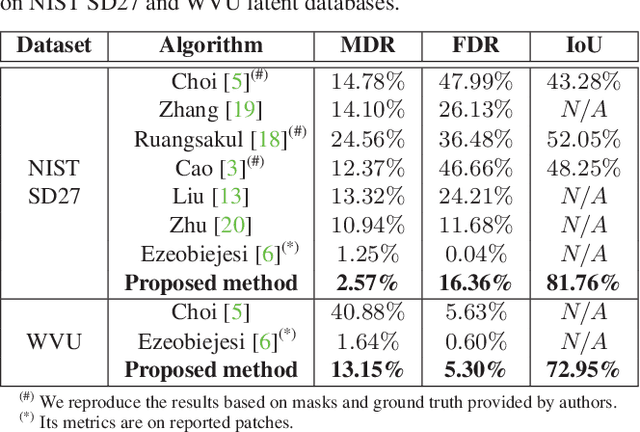
We present a simple but effective method for automatic latent fingerprint segmentation, called SegFinNet. SegFinNet takes a latent image as an input and outputs a binary mask highlighting the friction ridge pattern. Our algorithm combines fully convolutional neural network and detection-based approaches to process the entire input latent image in one shot instead of using latent patches. Experimental results on three different latent databases (i.e. NIST SD27, WVU, and an operational forensic database) show that SegFinNet outperforms both human markup for latents and the state-of-the-art latent segmentation algorithms. We further show that this improved cropping boosts the hit rate of a latent fingerprint matcher.