 Add to Chrome
 Add to Firefox
 Add to Edge
A Unified Evaluation of Learning-Based Similarity Techniques for Malware Detection
Feb 17, 2026
Cryptographic digests (e.g., MD5, SHA-256) are designed to provide exact identity. Any single-bit change in the input produces a completely different hash, which is ideal for integrity verification but limits their usefulness in many real-world tasks like threat hunting, malware analysis and digital forensics, where adversaries routinely introduce minor transformations. Similarity-based techniques address this limitation by enabling approximate matching, allowing related byte sequences to produce measurably similar fingerprints. Modern enterprises manage tens of thousands of endpoints with billions of files, making the effectiveness and scalability of the proposed techniques more important than ever in security applications. Security researchers have proposed a range of approaches, including similarity digests and locality-sensitive hashes (e.g., ssdeep, sdhash, TLSH), as well as more recent machine-learning-based methods that generate embeddings from file features. However, these techniques have largely been evaluated in isolation, using disparate datasets and evaluation criteria. This paper presents a systematic comparison of learning-based classification and similarity methods using large, publicly available datasets. We evaluate each method under a unified experimental framework with industry-accepted metrics. To our knowledge, this is the first reproducible study to benchmark these diverse learning-based similarity techniques side by side for real-world security workloads. Our results show that no single approach performs well across all dimensions; instead, each exhibits distinct trade-offs, indicating that effective malware analysis and threat-hunting platforms must combine complementary classification and similarity techniques rather than rely on a single method.

A Decompilation-Driven Framework for Malware Detection with Large Language Models
Jan 14, 2026The parallel evolution of Large Language Models (LLMs) with advanced code-understanding capabilities and the increasing sophistication of malware presents a new frontier for cybersecurity research. This paper evaluates the efficacy of state-of-the-art LLMs in classifying executable code as either benign or malicious. We introduce an automated pipeline that first decompiles Windows executable into a C code using Ghidra disassembler and then leverages LLMs to perform the classification. Our evaluation reveals that while standard LLMs show promise, they are not yet robust enough to replace traditional anti-virus software. We demonstrate that a fine-tuned model, trained on curated malware and benign datasets, significantly outperforms its vanilla counterpart. However, the performance of even this specialized model degrades notably when encountering newer malware. This finding demonstrates the critical need for continuous fine-tuning with emerging threats to maintain model effectiveness against the changing coding patterns and behaviors of malicious software.
Proactively Detecting Threats: A Novel Approach Using LLMs
Jan 13, 2026Enterprise security faces escalating threats from sophisticated malware, compounded by expanding digital operations. This paper presents the first systematic evaluation of large language models (LLMs) to proactively identify indicators of compromise (IOCs) from unstructured web-based threat intelligence sources, distinguishing it from reactive malware detection approaches. We developed an automated system that pulls IOCs from 15 web-based threat report sources to evaluate six LLM models (Gemini, Qwen, and Llama variants). Our evaluation of 479 webpages containing 2,658 IOCs (711 IPv4 addresses, 502 IPv6 addresses, 1,445 domains) reveals significant performance variations. Gemini 1.5 Pro achieved 0.958 precision and 0.788 specificity for malicious IOC identification, while demonstrating perfect recall (1.0) for actual threats.
Automated Discovery of Real-Time Network Camera Data From Heterogeneous Web Pages
Mar 23, 2021
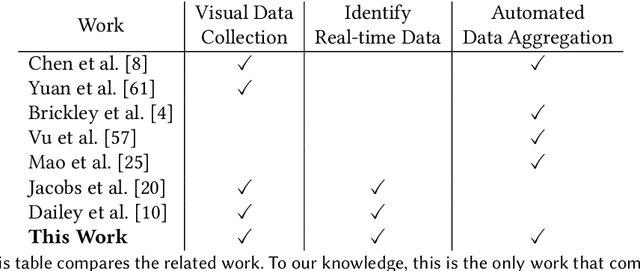
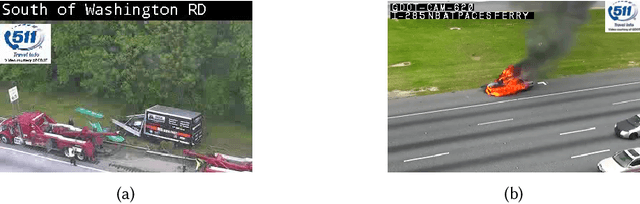
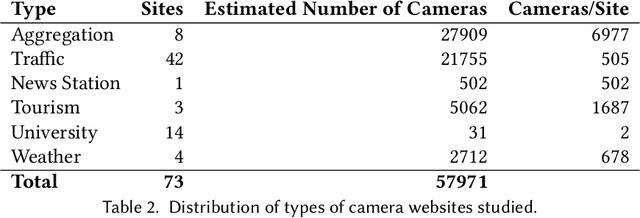
Reduction in the cost of Network Cameras along with a rise in connectivity enables entities all around the world to deploy vast arrays of camera networks. Network cameras offer real-time visual data that can be used for studying traffic patterns, emergency response, security, and other applications. Although many sources of Network Camera data are available, collecting the data remains difficult due to variations in programming interface and website structures. Previous solutions rely on manually parsing the target website, taking many hours to complete. We create a general and automated solution for aggregating Network Camera data spread across thousands of uniquely structured web pages. We analyze heterogeneous web page structures and identify common characteristics among 73 sample Network Camera websites (each website has multiple web pages). These characteristics are then used to build an automated camera discovery module that crawls and aggregates Network Camera data. Our system successfully extracts 57,364 Network Cameras from 237,257 unique web pages.
Cross-referencing Social Media and Public Surveillance Camera Data for Disaster Response
Jan 19, 2019
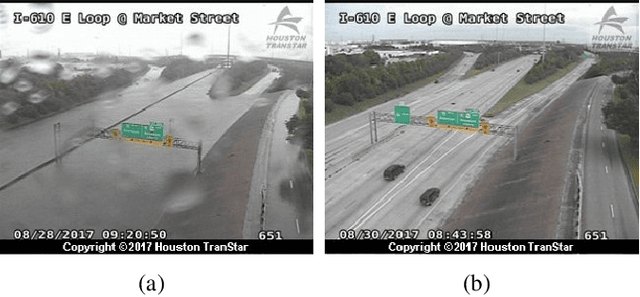
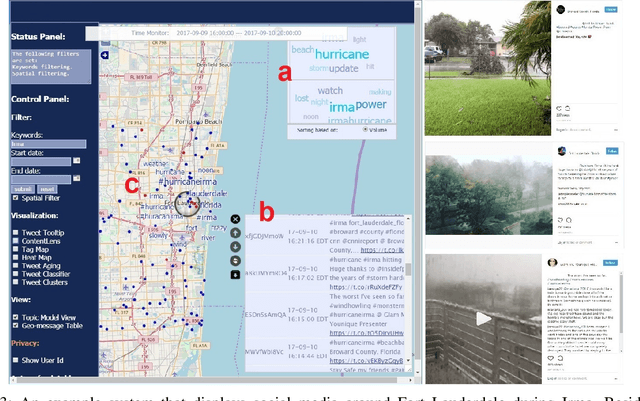
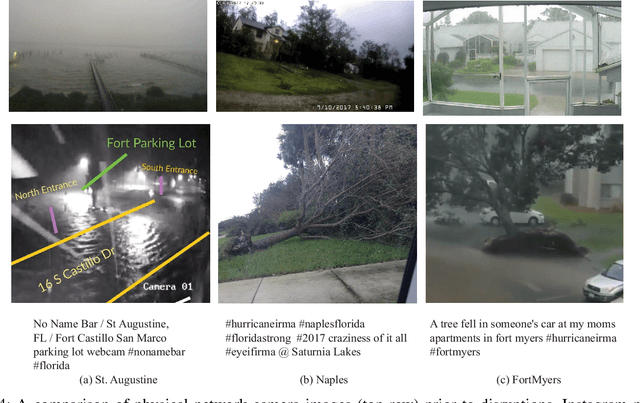
Physical media (like surveillance cameras) and social media (like Instagram and Twitter) may both be useful in attaining on-the-ground information during an emergency or disaster situation. However, the intersection and reliability of both surveillance cameras and social media during a natural disaster are not fully understood. To address this gap, we tested whether social media is of utility when physical surveillance cameras went off-line during Hurricane Irma in 2017. Specifically, we collected and compared geo-tagged Instagram and Twitter posts in the state of Florida during times and in areas where public surveillance cameras went off-line. We report social media content and frequency and content to determine the utility for emergency managers or first responders during a natural disaster.