 Add to Chrome
 Add to Firefox
 Add to Edge
EVMbench: Evaluating AI Agents on Smart Contract Security
Mar 05, 2026
Smart contracts on public blockchains now manage large amounts of value, and vulnerabilities in these systems can lead to substantial losses. As AI agents become more capable at reading, writing, and running code, it is natural to ask how well they can already navigate this landscape, both in ways that improve security and in ways that might increase risk. We introduce EVMbench, an evaluation that measures the ability of agents to detect, patch, and exploit smart contract vulnerabilities. EVMbench draws on 117 curated vulnerabilities from 40 repositories and, in the most realistic setting, uses programmatic grading based on tests and blockchain state under a local Ethereum execution environment. We evaluate a range of frontier agents and find that they are capable of discovering and exploiting vulnerabilities end-to-end against live blockchain instances. We release code, tasks, and tooling to support continued measurement of these capabilities and future work on security.

OpenAI GPT-5 System Card
Dec 19, 2025This is the system card published alongside the OpenAI GPT-5 launch, August 2025. GPT-5 is a unified system with a smart and fast model that answers most questions, a deeper reasoning model for harder problems, and a real-time router that quickly decides which model to use based on conversation type, complexity, tool needs, and explicit intent (for example, if you say 'think hard about this' in the prompt). The router is continuously trained on real signals, including when users switch models, preference rates for responses, and measured correctness, improving over time. Once usage limits are reached, a mini version of each model handles remaining queries. This system card focuses primarily on gpt-5-thinking and gpt-5-main, while evaluations for other models are available in the appendix. The GPT-5 system not only outperforms previous models on benchmarks and answers questions more quickly, but -- more importantly -- is more useful for real-world queries. We've made significant advances in reducing hallucinations, improving instruction following, and minimizing sycophancy, and have leveled up GPT-5's performance in three of ChatGPT's most common uses: writing, coding, and health. All of the GPT-5 models additionally feature safe-completions, our latest approach to safety training to prevent disallowed content. Similarly to ChatGPT agent, we have decided to treat gpt-5-thinking as High capability in the Biological and Chemical domain under our Preparedness Framework, activating the associated safeguards. While we do not have definitive evidence that this model could meaningfully help a novice to create severe biological harm -- our defined threshold for High capability -- we have chosen to take a precautionary approach.
OpenAI o1 System Card
Dec 21, 2024


The o1 model series is trained with large-scale reinforcement learning to reason using chain of thought. These advanced reasoning capabilities provide new avenues for improving the safety and robustness of our models. In particular, our models can reason about our safety policies in context when responding to potentially unsafe prompts, through deliberative alignment. This leads to state-of-the-art performance on certain benchmarks for risks such as generating illicit advice, choosing stereotyped responses, and succumbing to known jailbreaks. Training models to incorporate a chain of thought before answering has the potential to unlock substantial benefits, while also increasing potential risks that stem from heightened intelligence. Our results underscore the need for building robust alignment methods, extensively stress-testing their efficacy, and maintaining meticulous risk management protocols. This report outlines the safety work carried out for the OpenAI o1 and OpenAI o1-mini models, including safety evaluations, external red teaming, and Preparedness Framework evaluations.
Beyond CAGE: Investigating Generalization of Learned Autonomous Network Defense Policies
Nov 30, 2022Advancements in reinforcement learning (RL) have inspired new directions in intelligent automation of network defense. However, many of these advancements have either outpaced their application to network security or have not considered the challenges associated with implementing them in the real-world. To understand these problems, this work evaluates several RL approaches implemented in the second edition of the CAGE Challenge, a public competition to build an autonomous network defender agent in a high-fidelity network simulator. Our approaches all build on the Proximal Policy Optimization (PPO) family of algorithms, and include hierarchical RL, action masking, custom training, and ensemble RL. We find that the ensemble RL technique performs strongest, outperforming our other models and taking second place in the competition. To understand applicability to real environments we evaluate each method's ability to generalize to unseen networks and against an unknown attack strategy. In unseen environments, all of our approaches perform worse, with degradation varied based on the type of environmental change. Against an unknown attacker strategy, we found that our models had reduced overall performance even though the new strategy was less efficient than the ones our models trained on. Together, these results highlight promising research directions for autonomous network defense in the real world.
Towards Causal Models for Adversary Distractions
Apr 21, 2021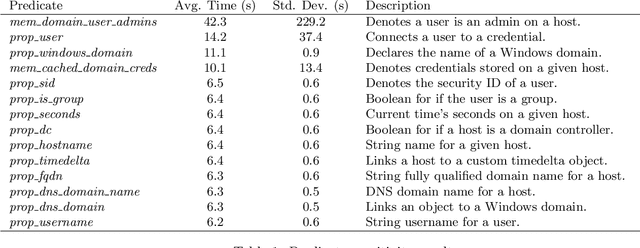
Automated adversary emulation is becoming an indispensable tool of network security operators in testing and evaluating their cyber defenses. At the same time, it has exposed how quickly adversaries can propagate through the network. While research has greatly progressed on quality decoy generation to fool human adversaries, we may need different strategies to slow computer agents. In this paper, we show that decoy generation can slow an automated agent's decision process, but that the degree to which it is inhibited is greatly dependent on the types of objects used. This points to the need to explicitly evaluate decoy generation and placement strategies against fast moving, automated adversaries.