 Add to Chrome
 Add to Firefox
 Add to Edge
Long-Term Embeddings for Balanced Personalization
Apr 09, 2026
Modern transformer-based sequential recommenders excel at capturing short-term intent but often suffer from recency bias, overlooking stable long-term preferences. While extending sequence lengths is an intuitive fix, it is computationally inefficient, and recent interactions tend to dominate the model's attention. We propose Long-Term Embeddings (LTE) as a high-inertia contextual anchor to bridge this gap. We address a critical production challenge: the point-in-time consistency problem caused by infrastructure constraints, as feature stores typically host only a single "live" version of features. This leads to an offline-online mismatch during model deployments and rollbacks, as models are forced to process evolved representations they never saw during training. To resolve this, we introduce an LTE framework that constrains embeddings to a fixed semantic basis of content-based item representations, ensuring cross-version compatibility. Furthermore, we investigate integration strategies for causal language modeling, considering the data leakage issue that occurs when the LTE and the transformer's short-term sequence share a temporal horizon. We evaluate two representations: a heuristic average and an asymmetric autoencoder with a fixed decoder grounded in the semantic basis to enable behavioral fine-tuning while maintaining stability. Online A/B tests on Zalando demonstrate that integrating LTE as a contextual prefix token using a lagged window yields significant uplifts in both user engagement and financial metrics.

Reducing Popularity Influence by Addressing Position Bias
Dec 11, 2024Position bias poses a persistent challenge in recommender systems, with much of the existing research focusing on refining ranking relevance and driving user engagement. However, in practical applications, the mitigation of position bias does not always result in detectable short-term improvements in ranking relevance. This paper provides an alternative, practically useful view of what position bias reduction methods can achieve. It demonstrates that position debiasing can spread visibility and interactions more evenly across the assortment, effectively reducing a skew in the popularity of items induced by the position bias through a feedback loop. We offer an explanation of how position bias affects item popularity. This includes an illustrative model of the item popularity histogram and the effect of the position bias on its skewness. Through offline and online experiments on our large-scale e-commerce platform, we show that position debiasing can significantly improve assortment utilization, without any degradation in user engagement or financial metrics. This makes the ranking fairer and helps attract more partners or content providers, benefiting the customers and the business in the long term.
Building a Scalable, Effective, and Steerable Search and Ranking Platform
Sep 04, 2024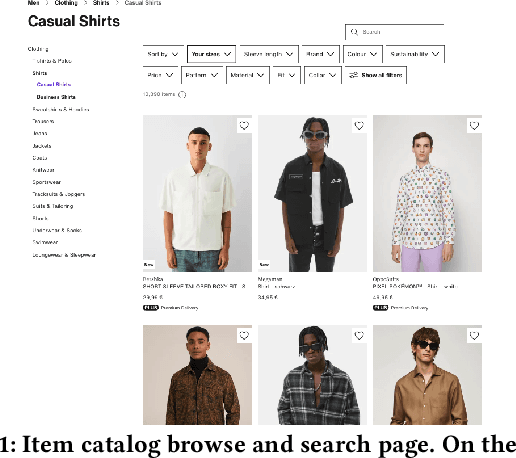
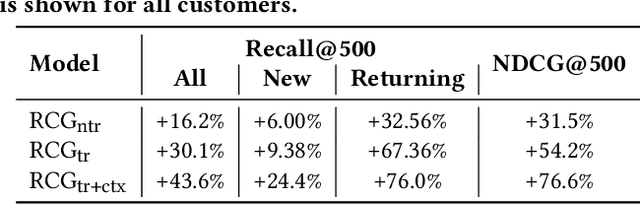
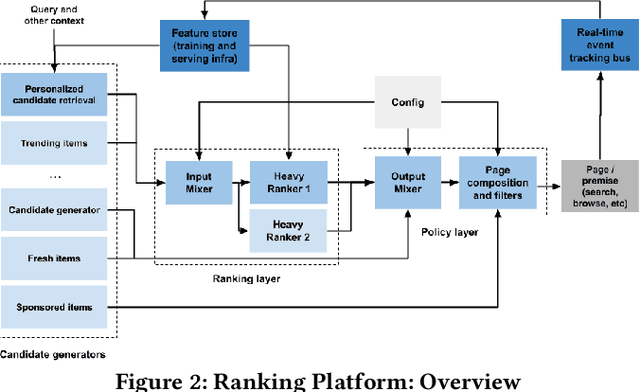
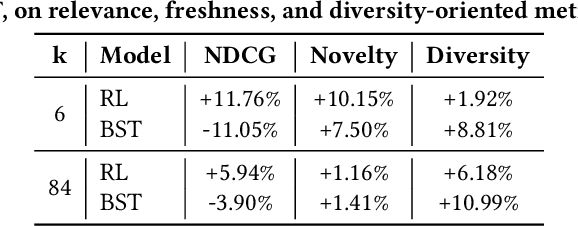
Modern e-commerce platforms offer vast product selections, making it difficult for customers to find items that they like and that are relevant to their current session intent. This is why it is key for e-commerce platforms to have near real-time scalable and adaptable personalized ranking and search systems. While numerous methods exist in the scientific literature for building such systems, many are unsuitable for large-scale industrial use due to complexity and performance limitations. Consequently, industrial ranking systems often resort to computationally efficient yet simplistic retrieval or candidate generation approaches, which overlook near real-time and heterogeneous customer signals, which results in a less personalized and relevant experience. Moreover, related customer experiences are served by completely different systems, which increases complexity, maintenance, and inconsistent experiences. In this paper, we present a personalized, adaptable near real-time ranking platform that is reusable across various use cases, such as browsing and search, and that is able to cater to millions of items and customers under heavy load (thousands of requests per second). We employ transformer-based models through different ranking layers which can learn complex behavior patterns directly from customer action sequences while being able to incorporate temporal (e.g. in-session) and contextual information. We validate our system through a series of comprehensive offline and online real-world experiments at a large online e-commerce platform, and we demonstrate its superiority when compared to existing systems, both in terms of customer experience as well as in net revenue. Finally, we share the lessons learned from building a comprehensive, modern ranking platform for use in a large-scale e-commerce environment.