 Add to Chrome
 Add to Firefox
 Add to Edge
ConceptGuard: Benchmarking Context-Sensitive Unlearning in Large Language Models
Aug 20, 2026
Large Language Models (LLMs) increasingly require selective removal of harmful or sensitive knowledge, called unlearning, yet existing methods and benchmarks fail to evaluate this capability completely. Current approaches rely on disjoint forget and retain sets composed of independent facts, and measure success using simple and direct factual recall. This framing fails to capture a key requirement of unlearning, namely the ability to eliminate harmful behaviors while preserving benign and beneficial knowledge. We argue that effective unlearning must operate at the level of concepts, ensuring complete removal of unsafe applications while maintaining their correct and useful usage, thereby achieving conceptually meaningful and complete unlearning. To better evaluate unlearning techniques from such a practical viewpoint, we introduce the notion of dual-use concepts: concepts that can be used in both harmful and benign contexts. Building on these concepts, we construct a benchmark called ConceptGuard where forget and retain sets are explicitly complementary in concept usage. Our benchmark uniquely enables unlearning to be explored and gauged at the level of concepts, instead of sparse facts, and evaluation is intent-sensitive with the goal of maximizing contextual separation to promote safer behavior. We demonstrate that current unlearning techniques perform poorly under this setting, showing weak contextual separation alongside poor performance in ROUGE and concept-level metrics. Our results reveal strong forgetting-utility trade-offs, limited gains in contextual sensitivity, and poor consistency in concept-level control across methods, and provide ideas for unlearning approaches that better align with real-world safety requirements. Our dataset is publicly available.

Fine-Tuning vs. RAG for Multi-Hop Question Answering with Novel Knowledge
Jan 11, 2026Multi-hop question answering is widely used to evaluate the reasoning capabilities of large language models (LLMs), as it requires integrating multiple pieces of supporting knowledge to arrive at a correct answer. While prior work has explored different mechanisms for providing knowledge to LLMs, such as finetuning and retrieval-augmented generation (RAG), their relative effectiveness for multi-hop question answering remains insufficiently understood, particularly when the required knowledge is temporally novel. In this paper, we systematically compare parametric and non-parametric knowledge injection methods for open-domain multi-hop question answering. We evaluate unsupervised fine-tuning (continual pretraining), supervised fine-tuning, and retrieval-augmented generation across three 7B-parameter open-source LLMs. Experiments are conducted on two benchmarks: QASC, a standard multi-hop science question answering dataset, and a newly constructed dataset of over 10,000 multi-hop questions derived from Wikipedia events in 2024, designed to test knowledge beyond the models' pretraining cutoff. Our results show that unsupervised fine-tuning provides only limited gains over base models, suggesting that continual pretraining alone is insufficient for improving multi-hop reasoning accuracy. In contrast, retrieval-augmented generation yields substantial and consistent improvements, particularly when answering questions that rely on temporally novel information. Supervised fine-tuning achieves the highest overall accuracy across models and datasets. These findings highlight fundamental differences in how knowledge injection mechanisms support multi-hop question answering and underscore the importance of retrieval-based methods when external or compositional knowledge is required.
Data Augmentation Supporting a Conversational Agent Designed for Smoking Cessation Support Groups
Dec 18, 2025Online support groups for smoking cessation are economical and accessible, yet they often face challenges with low user engagement and stigma. The use of an automatic conversational agent would improve engagement by ensuring that all user comments receive a timely response.). We address the challenge of insufficient high-quality data by employing a two-level data augmentation strategy: synthetic data augmentation and real data augmentation. First, we fine-tuned an open source LLM to classify posts from our existing smoking cessation support groups and identify intents with low F1 (precision+recall) scores. Then, for these intents, we generate additional synthetic data using prompt engineering with the GPT model, with an average of 87\% of the generated synthetic posts deemed high quality by human annotators. Overall, the synthetic augmentation process resulted in 43\% of the original posts being selected for augmentation, followed by 140\% synthetic expansion of these posts. Additionally, we scraped more than 10,000 real posts from a related online support context, of which 73\% were validated as good quality by human annotators. Each synthetic or scraped post underwent rigorous validation involving human reviewers to ensure quality and relevance. The validated new data, combined with the original support group posts, formed an augmented dataset used to retrain the intent classifier. Performance evaluation of the retrained model demonstrated a 32\% improvement in F1, confirming the effectiveness of our data augmentation approach. Synthetic and real post augmentation led to similar performance improvements. This study provides a replicable framework for enhancing conversational agent performance in domains where data scarcity is a critical issue.
IMPQ: Interaction-Aware Layerwise Mixed Precision Quantization for LLMs
Sep 18, 2025Large Language Models (LLMs) promise impressive capabilities, yet their multi-billion-parameter scale makes on-device or low-resource deployment prohibitive. Mixed-precision quantization offers a compelling solution, but existing methods struggle when the average precision drops below four bits, as they rely on isolated, layer-specific metrics that overlook critical inter-layer interactions affecting overall performance. In this paper, we propose two innovations to address these limitations. First, we frame the mixed-precision quantization problem as a cooperative game among layers and introduce Shapley-based Progressive Quantization Estimation (SPQE) to efficiently obtain accurate Shapley estimates of layer sensitivities and inter-layer interactions. Second, building upon SPQE, we propose Interaction-aware Mixed-Precision Quantization (IMPQ) which translates these Shapley estimates into a binary quadratic optimization formulation, assigning either 2 or 4-bit precision to layers under strict memory constraints. Comprehensive experiments conducted on Llama-3, Gemma-2, and Qwen-3 models across three independent PTQ backends (Quanto, HQQ, GPTQ) demonstrate IMPQ's scalability and consistently superior performance compared to methods relying solely on isolated metrics. Across average precisions spanning 4 bit down to 2 bit, IMPQ cuts Perplexity by 20 to 80 percent relative to the best baseline, with the margin growing as the bit-width tightens.
Building a Scalable, Effective, and Steerable Search and Ranking Platform
Sep 04, 2024
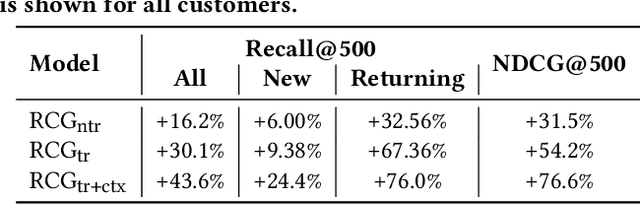
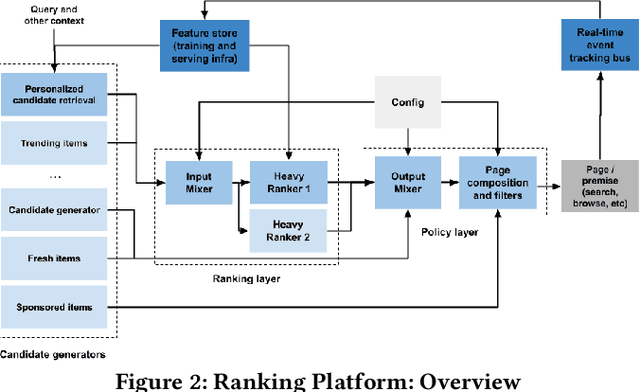
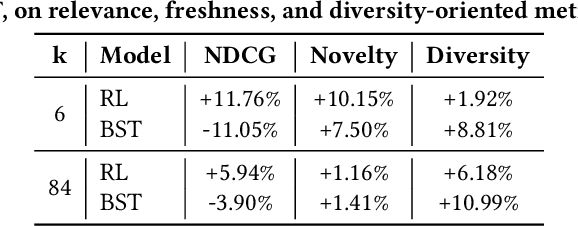
Modern e-commerce platforms offer vast product selections, making it difficult for customers to find items that they like and that are relevant to their current session intent. This is why it is key for e-commerce platforms to have near real-time scalable and adaptable personalized ranking and search systems. While numerous methods exist in the scientific literature for building such systems, many are unsuitable for large-scale industrial use due to complexity and performance limitations. Consequently, industrial ranking systems often resort to computationally efficient yet simplistic retrieval or candidate generation approaches, which overlook near real-time and heterogeneous customer signals, which results in a less personalized and relevant experience. Moreover, related customer experiences are served by completely different systems, which increases complexity, maintenance, and inconsistent experiences. In this paper, we present a personalized, adaptable near real-time ranking platform that is reusable across various use cases, such as browsing and search, and that is able to cater to millions of items and customers under heavy load (thousands of requests per second). We employ transformer-based models through different ranking layers which can learn complex behavior patterns directly from customer action sequences while being able to incorporate temporal (e.g. in-session) and contextual information. We validate our system through a series of comprehensive offline and online real-world experiments at a large online e-commerce platform, and we demonstrate its superiority when compared to existing systems, both in terms of customer experience as well as in net revenue. Finally, we share the lessons learned from building a comprehensive, modern ranking platform for use in a large-scale e-commerce environment.
A General Framework for Pairwise Unbiased Learning to Rank
Jul 18, 2022


Pairwise debiasing is one of the most effective strategies in reducing position bias in learning-to-rank (LTR) models. However, limiting the scope of this strategy, are the underlying assumptions required by many pairwise debiasing approaches. In this paper, we develop an approach based on a minimalistic set of assumptions that can be applied to a much broader range of user browsing patterns and arbitrary presentation layouts. We implement the approach as a simplified version of the Unbiased LambdaMART and demonstrate that it retains the underlying unbiasedness property in a wider variety of settings than the original algorithm. Finally, using simulations with "golden" relevance labels, we will show that the simplified version compares favourably with the original Unbiased LambdaMART when the examination of different positions in a ranked list is not assumed to be independent.