 Add to Chrome
 Add to Firefox
 Add to Edge
How Many Trees in a Random Forest? A Revisited Approach with Plateau Search and Optuna Integration
Jun 02, 2026
Hyperparameter optimization (HPO) for Random Forest faces a specific difficulty in tuning the number of trees: the predictive score typically improves monotonically with ensemble size, so standard methods such as Tree-structured Parzen Estimator (TPE) and Hyperband require a predefined search range and often drive the estimate toward its right boundary. Early-stopping strategies avoid fixing such a range, but can be sensitive to score noise and prone to premature stopping. To address this, we propose an integrated triplet-based plateau-search algorithm that removes the number of trees from the direct TPE search space and still exploits information accumulated across HPO trials. The method adaptively tracks a near-minimal sufficient ensemble size by monitoring relative changes in the out-of-bag (OOB) score across a triplet of forest sizes and shifting this triplet accordingly. This yields an automated and user-interpretable procedure based on a tolerance parameter. We also provide a theoretical analysis: we relate the proposed relative OOB-score criterion to the gap between the current and limiting scores, and derive an asymptotic variance estimate for the corresponding OOB-based absolute relative difference. Experiments show that the selected number of trees can differ substantially from the common heuristic: for most classical benchmark datasets it is smaller, whereas for some high-dimensional bioinformatics datasets, such as Arcene and Dorothea, it is larger. The source code and reproducible experiments are available at https://github.com/lange-am/rf_plateau_hpo.

Self-Supervised Learning in Event Sequences: A Comparative Study and Hybrid Approach of Generative Modeling and Contrastive Learning
Jan 30, 2024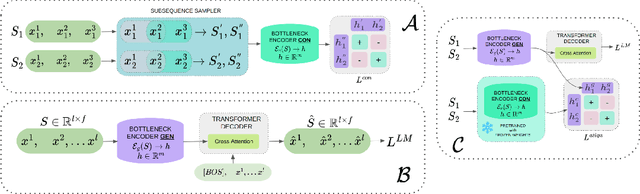

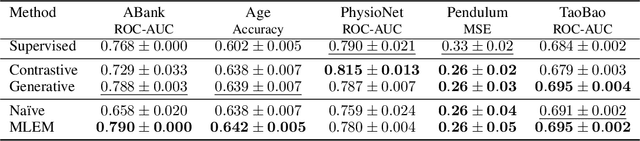

This study investigates self-supervised learning techniques to obtain representations of Event Sequences. It is a key modality in various applications, including but not limited to banking, e-commerce, and healthcare. We perform a comprehensive study of generative and contrastive approaches in self-supervised learning, applying them both independently. We find that there is no single supreme method. Consequently, we explore the potential benefits of combining these approaches. To achieve this goal, we introduce a novel method that aligns generative and contrastive embeddings as distinct modalities, drawing inspiration from contemporary multimodal research. Generative and contrastive approaches are often treated as mutually exclusive, leaving a gap for their combined exploration. Our results demonstrate that this aligned model performs at least on par with, and mostly surpasses, existing methods and is more universal across a variety of tasks. Furthermore, we demonstrate that self-supervised methods consistently outperform the supervised approach on our datasets.