 Add to Chrome
 Add to Firefox
 Add to Edge
Causal Risk Minimization for High-Dimensional Treatments
May 26, 2026
Predicting the effect of interventions with many possible variations, e.g., therapeutic content that affects mental health outcomes or an earnings call transcript that drives movement in share price, is useful across several domains. However, classical causal estimators tend to assume that all possible interventions are observed, which is infeasible when interventions vary widely, for instance, in the space of all text strings. We adapt a well-known approach of recasting causal inference as a learning problem, to address high-dimensional treatment spaces. Specifically, under standard assumptions like no unobserved confounding, we show that causal error decomposes into a series of moment-balancing errors of increasing order, and design objectives that directly improve causal estimation. We also show how to project the effect of a high-dimensional treatment onto lower-dimensional treatment attributes, which allows a single model to answer several causal questions without additional attribute-specific training. We empirically evaluate our estimators in settings with high-dimensional continuous, discrete, and text treatments, the last of which used a semi-synthetic dataset of Amazon Reviews. Our experiments demonstrate the benefit of higher-order balance error optimization and competitive performance of projected causal estimates with attribute-specific estimators.

Conversational Swarm Intelligence, a Pilot Study
Aug 31, 2023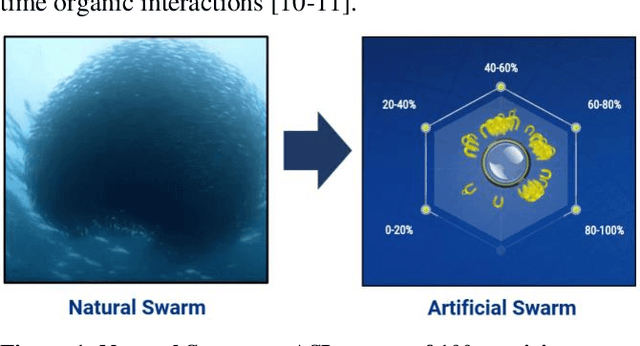
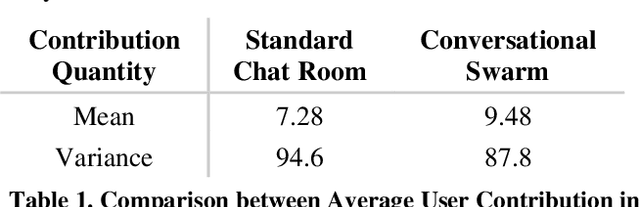
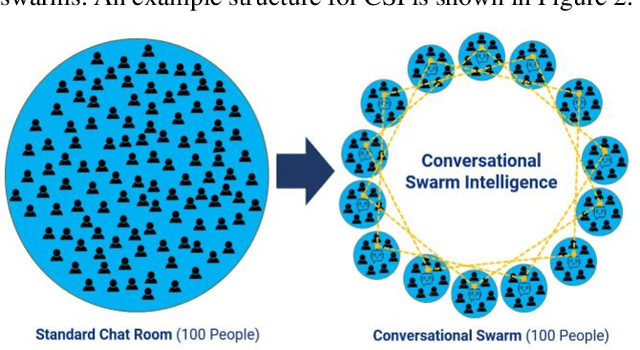
Conversational Swarm Intelligence (CSI) is a new method for enabling large human groups to hold real-time networked conversations using a technique modeled on the dynamics of biological swarms. Through the novel use of conversational agents powered by Large Language Models (LLMs), the CSI structure simultaneously enables local dialog among small deliberative groups and global propagation of conversational content across a larger population. In this way, CSI combines the benefits of small-group deliberative reasoning and large-scale collective intelligence. In this pilot study, participants deliberating in conversational swarms (via text chat) (a) produced 30% more contributions (p<0.05) than participants deliberating in a standard centralized chat room and (b) demonstrated 7.2% less variance in contribution quantity. These results indicate that users contributed more content and participated more evenly when using the CSI structure.