 Add to Chrome
 Add to Firefox
 Add to Edge
Implicit Neural Representations of Individual Behavior
Jun 10, 2026
We study policy representation learning from unlabeled multi-policy behavioral data. Each episode is generated by a fixed policy, but policy labels are unavailable. This setting appears in robotics play, demonstrations, games, racing, and other datasets where heterogeneous behaviors are mixed without annotations. We introduce \emph{Behavioral INR}, a self-supervised generative model that adapts implicit neural representations (INRs) from vision to behavior. Instead of mapping coordinates to RGB values, Behavioral INR represents a policy as a state-action function mapping states to subsequent actions. An episode-level latent modulates this function through FiLM layers, yielding a generative prior over policies and allowing policy identity to be inferred without supervision. Because INRs treat each datapoint as samples from an underlying function, the same model naturally accommodates variable episode lengths and different sampling granularities, as in vision INRs with different image resolutions. We also define policy-level out-of-distribution (OOD) shifts along state-distribution and action-distribution axes, which arise when policies overlap in states or actions but are not captured by standard behavioral OOD settings based only on new agents or environments. We evaluate on synthetic Gaussian random field data, MuJoCo demonstrations with controlled OOD splits, and real-world chess, Formula 1 racing, robotics, and Seek-Avoid datasets. Behavioral INR most consistently improves policy identifiability in the hardest continuous state-action settings, especially when longer episodes, more policies, and OOD splits reduce the usefulness of marginal shortcuts; amortized history encoders remain competitive when policy identity can be recovered from symbolic repetition or low-dimensional action statistics. We release code and checkpoints.

Monte Carlo Pass Search: Using Trajectory Generation for 3D Counterfactual Pass Evaluation in Football
Jun 09, 2026We recast pass evaluation in football (soccer) as a Monte Carlo Tree Search (MCTS)-like evaluation problem whose components mostly exist in the literature under different names: a value model (possession value), a world model (multi-agent trajectories with ball interactions), and a policy over counterfactual actions (sampling pass variants with noise). Building on the first public high-fidelity tracking dataset with 3D ball trajectories from the Bundesliga, we introduce Monte Carlo Pass Search (MCPS), which infers kick parameters for each observed pass, samples execution variants and option variants, rolls each candidate forward with a ball-conditioned world model until the next ball interaction, and scores outcomes with a learned value model to obtain a distribution over gained value. This distribution enables distribution-aware attribution with two complementary execution-surplus scores used for analysis and ranking: mean-based and percentile-based scores. To make the world model sample-efficient under limited public data, we adapt a discrete-token, autoregressive trajectory generator from autonomous driving (SMART) and show it yields strong best-of-20 forecasting accuracy compared to baselines, while supporting fully hypothetical rollouts for downstream evaluation. We have released model checkpoints and code.
Smooth Imitation Learning for Online Sequence Prediction
Jun 03, 2016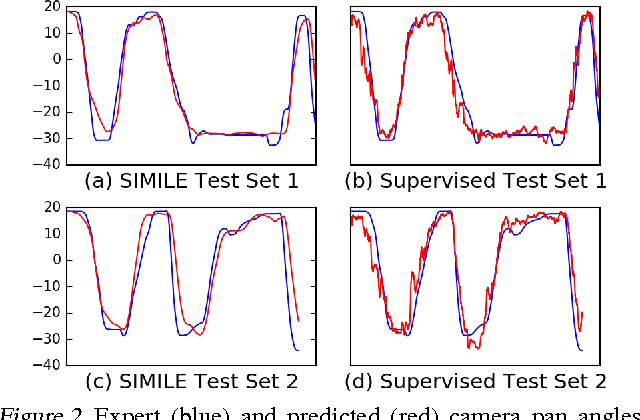
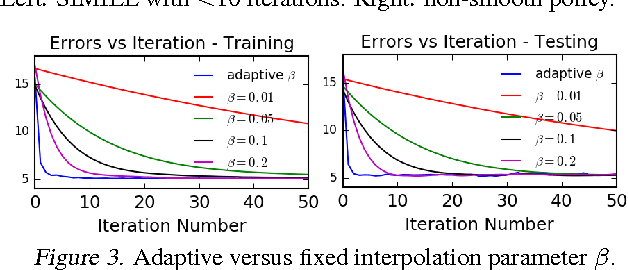
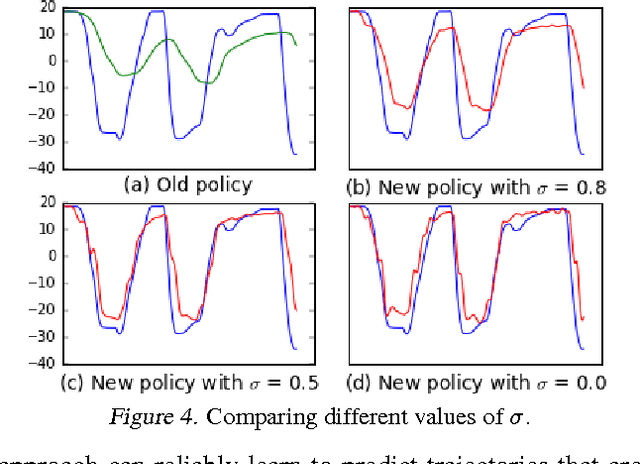
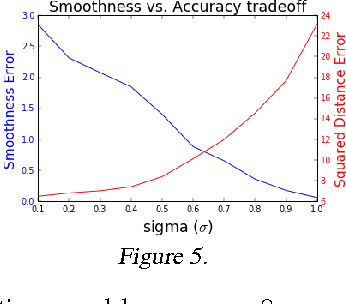
We study the problem of smooth imitation learning for online sequence prediction, where the goal is to train a policy that can smoothly imitate demonstrated behavior in a dynamic and continuous environment in response to online, sequential context input. Since the mapping from context to behavior is often complex, we take a learning reduction approach to reduce smooth imitation learning to a regression problem using complex function classes that are regularized to ensure smoothness. We present a learning meta-algorithm that achieves fast and stable convergence to a good policy. Our approach enjoys several attractive properties, including being fully deterministic, employing an adaptive learning rate that can provably yield larger policy improvements compared to previous approaches, and the ability to ensure stable convergence. Our empirical results demonstrate significant performance gains over previous approaches.