 Add to Chrome
 Add to Firefox
 Add to Edge
Multi-Objective Hierarchical Optimization with Large Language Models
Jan 20, 2026
Despite their widespread adoption in various domains, especially due to their powerful reasoning capabilities, Large Language Models (LLMs) are not the off-the-shelf choice to drive multi-objective optimization yet. Conventional strategies rank high in benchmarks due to their intrinsic capabilities to handle numerical inputs and careful modelling choices that balance exploration and Pareto-front exploitation, as well as handle multiple (conflicting) objectives. In this paper, we close this gap by leveraging LLMs as surrogate models and candidate samplers inside a structured hierarchical search strategy. By adaptively partitioning the input space into disjoint hyperrectangular regions and ranking them with a composite score function, we restrict the generative process of the LLM to specific, high-potential sub-spaces, hence making the problem easier to solve as the LLM doesn't have to reason about the global structure of the problem, but only locally instead. We show that under standard regularity assumptions, our algorithm generates candidate solutions that converge to the true Pareto set in Hausdorff distance. Empirically, it consistently outperforms the global LLM-based multi-objective optimizer and is on par with standard evolutionary and Bayesian optimization algorithm on synthetic and real-world benchmarks.

Improving LLM-based Global Optimization with Search Space Partitioning
May 27, 2025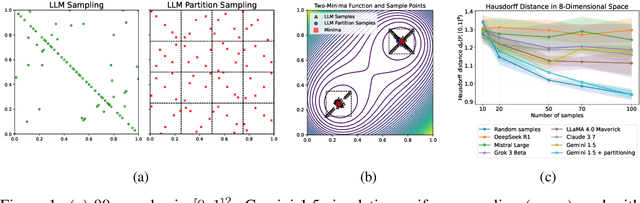

Large Language Models (LLMs) have recently emerged as effective surrogate models and candidate generators within global optimization frameworks for expensive blackbox functions. Despite promising results, LLM-based methods often struggle in high-dimensional search spaces or when lacking domain-specific priors, leading to sparse or uninformative suggestions. To overcome these limitations, we propose HOLLM, a novel global optimization algorithm that enhances LLM-driven sampling by partitioning the search space into promising subregions. Each subregion acts as a ``meta-arm'' selected via a bandit-inspired scoring mechanism that effectively balances exploration and exploitation. Within each selected subregion, an LLM then proposes high-quality candidate points, without any explicit domain knowledge. Empirical evaluation on standard optimization benchmarks shows that HOLLM consistently matches or surpasses leading Bayesian optimization and trust-region methods, while substantially outperforming global LLM-based sampling strategies.