 Add to Chrome
 Add to Firefox
 Add to Edge
Towards a Unified Coding Scheme for 6G
Mar 24, 2026
The growing demand for higher data rates necessitates continuous innovations in wireless communication systems, particularly with the emergence of 6G. Channel coding plays a crucial role in this evolution. In 5G systems, rate-adaptive raptor-like quasi-cyclic irregular low-density parity-check codes are used for the data link, while polar codes with successive cancellation list decoding handle short messages on the synchronization channel. However, to meet the stringent requirements of future 6G systems, a versatile and unified coding scheme should be developed - one that offers competitive error-correcting performance alongside low complexity encoding and decoding schemes that enable energy-efficient hardware implementations. This white paper outlines the vision for such a unified coding scheme. We explore various 6G communication scenarios that pose new challenges to channel coding and provide a first analysis of potential solutions.

Graph Search based Polar Code Design
Nov 30, 2022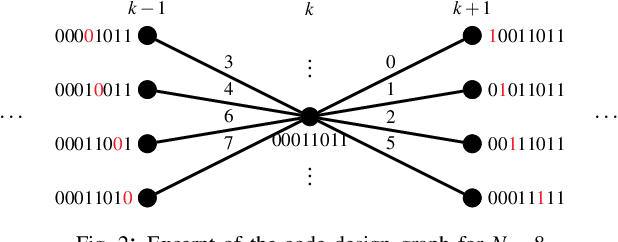
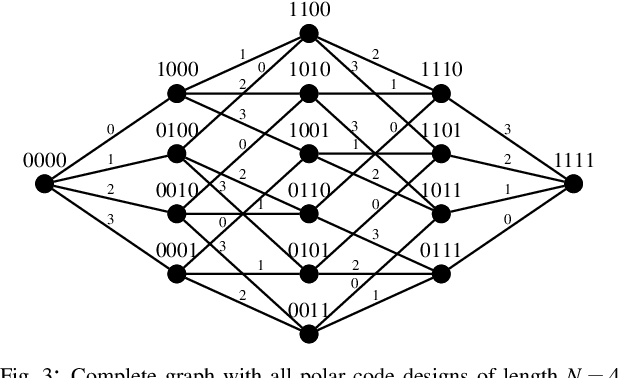
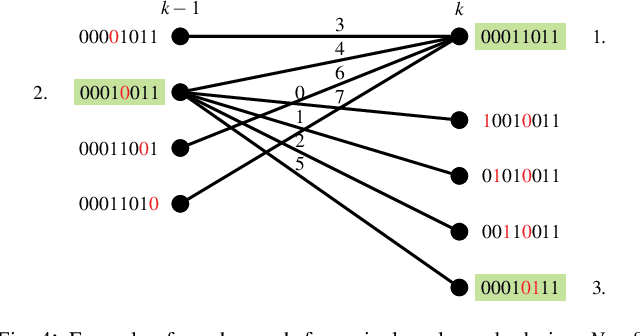
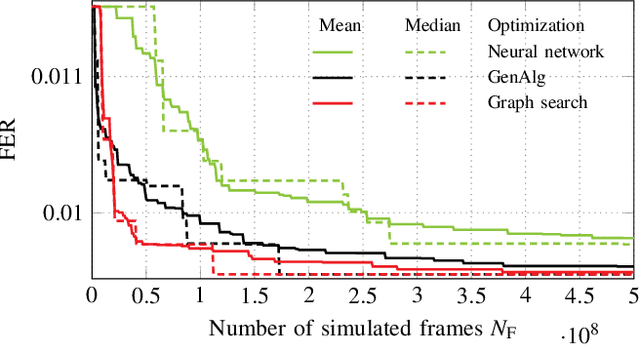
It is well known that to fulfill their full potential, the design of polar codes must be tailored to their intended decoding algorithm. While for successive cancellation (SC) decoding, information theoretically optimal constructions are available, the code design for other decoding algorithms (such as belief propagation (BP) decoding) can only be optimized using extensive Monte Carlo simulations. We propose to view the design process of polar codes as a graph search problem and thereby approaching it more systematically. Based on this formalism, the design-time complexity can be significantly reduced compared to state-of-the-art Genetic Algorithm (GenAlg) and deep learning-based design algorithms. Moreover, sequences of rate-compatible polar codes can be efficiently found. Finally, we analyze both the complexity of the proposed algorithm and the error-rate performance of the constructed codes.