 Add to Chrome
 Add to Firefox
 Add to Edge
Towards a Unified Coding Scheme for 6G
Mar 24, 2026
The growing demand for higher data rates necessitates continuous innovations in wireless communication systems, particularly with the emergence of 6G. Channel coding plays a crucial role in this evolution. In 5G systems, rate-adaptive raptor-like quasi-cyclic irregular low-density parity-check codes are used for the data link, while polar codes with successive cancellation list decoding handle short messages on the synchronization channel. However, to meet the stringent requirements of future 6G systems, a versatile and unified coding scheme should be developed - one that offers competitive error-correcting performance alongside low complexity encoding and decoding schemes that enable energy-efficient hardware implementations. This white paper outlines the vision for such a unified coding scheme. We explore various 6G communication scenarios that pose new challenges to channel coding and provide a first analysis of potential solutions.

Spiking Neural Belief Propagation Decoder for Short Block Length LDPC Codes
Oct 15, 2024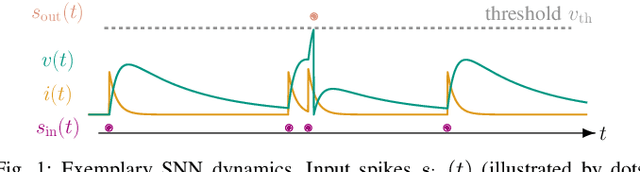
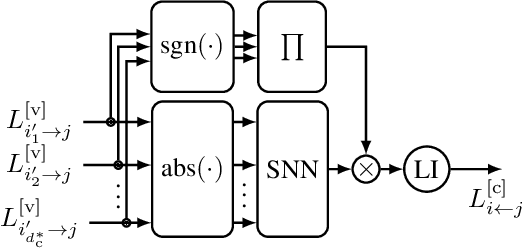


Spiking neural networks (SNNs) are neural networks that enable energy-efficient signal processing due to their event-based nature. This paper proposes a novel decoding algorithm for low-density parity-check (LDPC) codes that integrates SNNs into belief propagation (BP) decoding by approximating the check node update equations using SNNs. For the (273,191) and (1023,781) finite-geometry LDPC code, the proposed decoder outperforms sum-product decoder at high signal-to-noise ratios (SNRs). The decoder achieves a similar bit error rate to normalized sum-product decoding with successive relaxation. Furthermore, the novel decoding operates without requiring knowledge of the SNR, making it robust to SNR mismatch.