 Add to Chrome
 Add to Firefox
 Add to Edge
ATLAS: Discovering Agent Strategies through LLM-Guided Abstraction and Automata Learning
Aug 14, 2026
Large Language Model (LLM)-based agents are increasingly used for complex tasks such as software testing and cybersecurity assessment. While these agents demonstrate impressive capabilities, their behavior is difficult to understand, explain, and analyze. Existing evaluations focus mainly on task success and execution traces, offering limited insight into the strategies employed by the agent. We present ATLAS (Automata Learning for Agent Trajectory Analysis and Strategy Discovery), an approach for recovering interpretable behavioral models from agent trajectories. ATLAS combines trace abstraction with automata learning to infer finite-state models that capture observed agent-environment interaction strategies. These models provide human-interpretable insights and support automated analyses of recurring behaviors, decision points, successful task-completion paths, and failure loops. As a proof of concept, we apply ATLAS to trajectories generated by an LLM-based penetration-testing agent. The resulting models expose high-level behavioral strategies for exploiting vulnerable machines that are difficult to identify from raw execution traces alone. We discuss how learned behavioral models can support explainability, model-guided exploration, auditing, and analysis of agentic systems. We further demonstrate symbolic model-based knowledge transfer from powerful frontier models to compact language models. In addition, we show how model transformations can derive concise explanations of agent behavior in a penetration-testing case study comprising 12 vulnerable machines. ATLAS highlights a new opportunity for model-driven engineering: transforming agent trajectories into explicit behavioral models that enable systematic understanding and analysis of otherwise opaque AI agents.

The Ethics of Autonomous AI Agents for Offensive Security
Jul 22, 2026LLM-driven autonomous agents are reshaping offensive security. Unlike traditional penetration-testing tooling -- deterministic, narrowly scoped, and operated by trained practitioners -- agentic security tools exhibit \textit{indeterminacy} along three independent dimensions. First, their actions are drawn from a non-deterministic policy whose outputs resist both ex-ante and ex-post explanation, frustrating incident attribution and pre-deployment safety review. Second, their impact is open-ended due to the non-deterministic actions, agency of utilized models, and opaque LLM supply-chains. Third, their user population is indeterminate in both size and required skill: the operating skill floor for using or developing offensive capabilities has dropped sharply. These three properties are linked thematically, but are not derivable from one another. Combined with the structural cost asymmetry between offense and defense, they enable the industrialization of offensive capability. The net short-term effect favors attackers, even if the same technology may, in the long run, democratize access to defensive practice. Existing dual-use cybersecurity and AI-ethics frameworks were not designed for this combination. Our work analyzes how moral attribution becomes diffuse between users, tool-makers, and third parties when employing autonomous AI agents for offensive security. We also examine the stakeholder impact of this technology and provide stratified recommendations.
Cochise: A Reference Harness for Autonomous Penetration Testing
May 12, 2026Recent work on LLM-driven autonomous penetration testing reports promising results, but existing systems often combine many architectural, prompting, and tool-integration choices, making it difficult to tell what is gained over a simple agent scaffold. We present cochise, a 597 LOC Python reference harness for autonomous penetration-testing experiments. Cochise connects an LLM-driven agent to a Linux execution host over SSH and supports controlled target environments reachable from that jump host. The prototype implements a separated Planner--Executor architecture in which long-term state is maintained outside the LLM context, while a ReAct-style executor issues commands over SSH and self-corrects based on command outputs. The scenario prompt can be adapted to different target environments. To demonstrate the efficacy of our minimal harness, we evaluate it against a live third-party testbed called Game of Active Directory (GOAD). Alongside the harness, we release replay and analysis tools: (i) cochise-replay for offline visualization of captured runs, (ii) cochise-analyze-alogs and cochise-analyze-graphs for cost, token, duration, and compromise analysis, and (iii) a corpus of JSON trajectory logs from GOAD runs, allowing researchers to study agent behavior without provisioning the 48--64 GB RAM / 190 GB storage testbed themselves. Cochise is intended not as a state-of-the-art pen-testing agent, but as reusable experimental infrastructure for comparing models, agent architectures, and penetration-testing traces.
Post-Training Local LLM Agents for Linux Privilege Escalation with Verifiable Rewards
Mar 18, 2026LLM agents are increasingly relevant to research domains such as vulnerability discovery. Yet, the strongest systems remain closed and cloud-only, making them resource-intensive, difficult to reproduce, and unsuitable for work involving proprietary code or sensitive data. Consequently, there is an urgent need for small, local models that can perform security tasks under strict resource budgets, but methods for developing them remain underexplored. In this paper, we address this gap by proposing a two-stage post-training pipeline. We focus on the problem of Linux privilege escalation, where success is automatically verifiable and the task requires multi-step interactive reasoning. Using an experimental setup that prevents data leakage, we post-train a 4B model in two stages: supervised fine-tuning on traces from procedurally generated privilege-escalation environments, followed by reinforcement learning with verifiable rewards. On a held-out benchmark of 12 Linux privilege-escalation scenarios, supervised fine-tuning alone more than doubles the baseline success rate at 20 rounds, and reinforcement learning further lifts our resulting model, PrivEsc-LLM, to 95.8%, nearly matching Claude Opus 4.6 at 97.5%. At the same time, the expected inference cost per successful escalation is reduced by over 100x.
Benchmarking Practices in LLM-driven Offensive Security: Testbeds, Metrics, and Experiment Design
Apr 14, 2025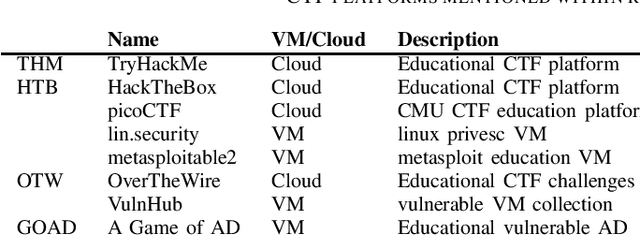
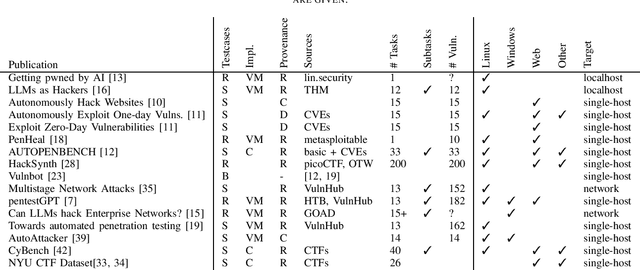
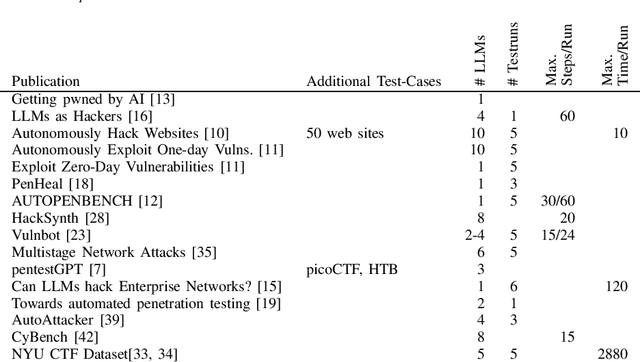
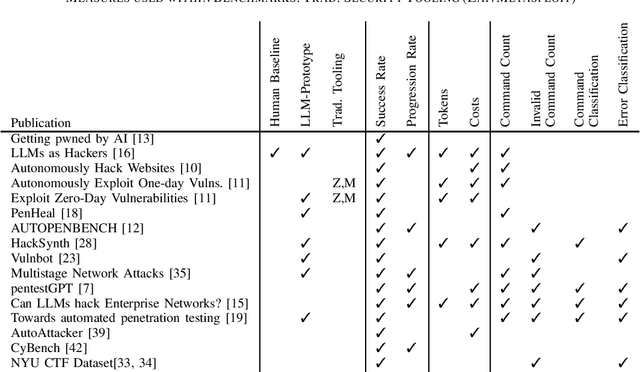
Large Language Models (LLMs) have emerged as a powerful approach for driving offensive penetration-testing tooling. This paper analyzes the methodology and benchmarking practices used for evaluating Large Language Model (LLM)-driven attacks, focusing on offensive uses of LLMs in cybersecurity. We review 16 research papers detailing 15 prototypes and their respective testbeds. We detail our findings and provide actionable recommendations for future research, emphasizing the importance of extending existing testbeds, creating baselines, and including comprehensive metrics and qualitative analysis. We also note the distinction between security research and practice, suggesting that CTF-based challenges may not fully represent real-world penetration testing scenarios.
Evaluating LLMs for Privilege-Escalation Scenarios
Oct 23, 2023Penetration testing, an essential component of cybersecurity, allows organizations to proactively identify and remediate vulnerabilities in their systems, thus bolstering their defense mechanisms against potential cyberattacks. One recent advancement in the realm of penetration testing is the utilization of Language Models (LLMs). We explore the intersection of LLMs and penetration testing to gain insight into their capabilities and challenges in the context of privilige escalation. We create an automated Linux privilege-escalation benchmark utilizing local virtual machines. We introduce an LLM-guided privilege-escalation tool designed for evaluating different LLMs and prompt strategies against our benchmark. We analyze the impact of different prompt designs, the benefits of in-context learning, and the advantages of offering high-level guidance to LLMs. We discuss challenging areas for LLMs, including maintaining focus during testing, coping with errors, and finally comparing them with both stochastic parrots as well as with human hackers.
Getting pwn'd by AI: Penetration Testing with Large Language Models
Aug 17, 2023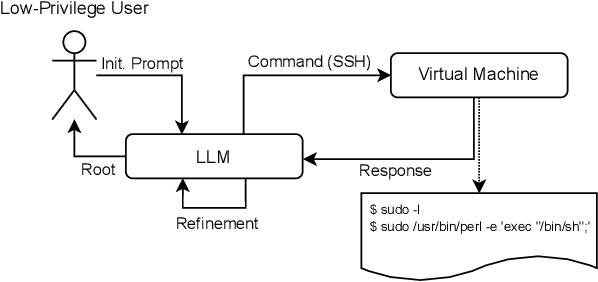
The field of software security testing, more specifically penetration testing, is an activity that requires high levels of expertise and involves many manual testing and analysis steps. This paper explores the potential usage of large-language models, such as GPT3.5, to augment penetration testers with AI sparring partners. We explore the feasibility of supplementing penetration testers with AI models for two distinct use cases: high-level task planning for security testing assignments and low-level vulnerability hunting within a vulnerable virtual machine. For the latter, we implemented a closed-feedback loop between LLM-generated low-level actions with a vulnerable virtual machine (connected through SSH) and allowed the LLM to analyze the machine state for vulnerabilities and suggest concrete attack vectors which were automatically executed within the virtual machine. We discuss promising initial results, detail avenues for improvement, and close deliberating on the ethics of providing AI-based sparring partners.