 Add to Chrome
 Add to Firefox
 Add to Edge
Improving the sharpness in neural network-based parametric post-processing of ensemble forecasts
Jun 07, 2026
Statistical post-processing has proven to be an effective tool in improving ensemble forecast of different weather variables. Case studies show that post-processing can remedy the typically underdispersive and potentially biased behaviour of the ensemble while optimizing a proper scoring rule expressing the forecast skill. The price of these positive effects is generally a deterioration in sharpness; the width of the central prediction intervals and the uncertainty of the predictions are increasing, especially for shorter lead times. This work aims to reduce the extent of the latter phenomenon for neural network-based parametric post-processing methods by extending the network's loss function with a penalty term. We demonstrate the effect of the proposed technique for 2m temperature ensemble forecasts of the European Centre for Medium-Range Weather Forecasts downloaded from the EUPPBench benchmark dataset and verified against synoptic observations. Here, the predictive distribution is Gaussian, and we use the continuous ranked probability score (CRPS) as loss function. The case studies confirm a substantial relative decrease ($8.2\%-12.5\%$) in the width of the nominal central prediction interval compared to the width of the predictive distribution computed without the penalty term, while there is no deterioration in the mean CRPS of probabilistic forecasts and in the RMSE of the predictive mean.

A two-step machine learning approach to statistical post-processing of weather forecasts for power generation
Jul 15, 2022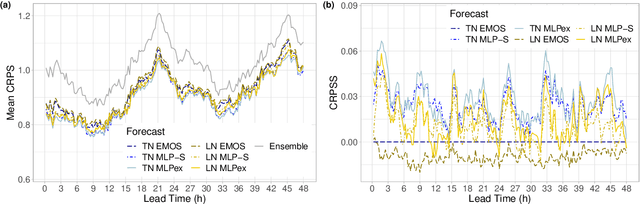

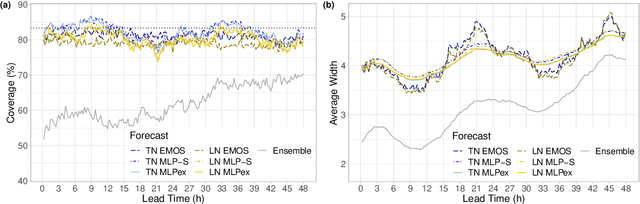

By the end of 2021, the renewable energy share of the global electricity capacity reached 38.3% and the new installations are dominated by wind and solar energy, showing global increases of 12.7% and 18.5%, respectively. However, both wind and photovoltaic energy sources are highly volatile making planning difficult for grid operators, so accurate forecasts of the corresponding weather variables are essential for reliable electricity predictions. The most advanced approach in weather prediction is the ensemble method, which opens the door for probabilistic forecasting; though ensemble forecast are often underdispersive and subject to systematic bias. Hence, they require some form of statistical post-processing, where parametric models provide full predictive distributions of the weather variables at hand. We propose a general two-step machine learning-based approach to calibrating ensemble weather forecasts, where in the first step improved point forecasts are generated, which are then together with various ensemble statistics serve as input features of the neural network estimating the parameters of the predictive distribution. In two case studies based of 100m wind speed and global horizontal irradiance forecasts of the operational ensemble pre diction system of the Hungarian Meteorological Service, the predictive performance of this novel method is compared with the forecast skill of the raw ensemble and the state-of-the-art parametric approaches. Both case studies confirm that at least up to 48h statistical post-processing substantially improves the predictive performance of the raw ensemble for all considered forecast horizons. The investigated variants of the proposed two-step method outperform in skill their competitors and the suggested new approach is well applicable for different weather quantities and for a fair range of predictive distributions.
Calibration of wind speed ensemble forecasts for power generation
Apr 30, 2021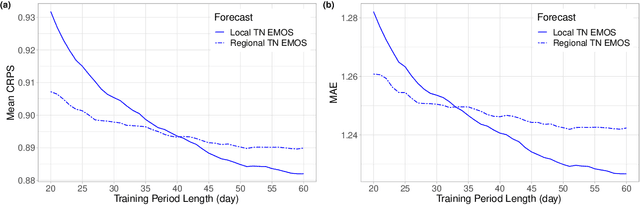
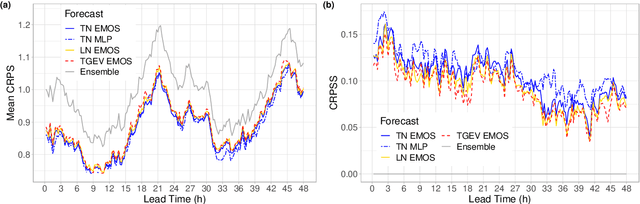
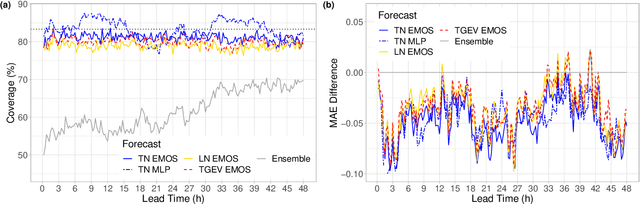
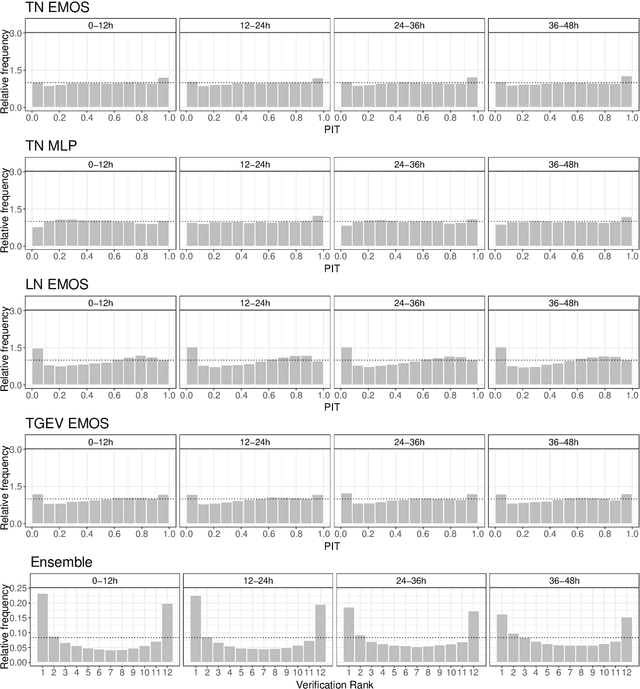
In the last decades wind power became the second largest energy source in the EU covering 16% of its electricity demand. However, due to its volatility, accurate short range wind power predictions are required for successful integration of wind energy into the electrical grid. Accurate predictions of wind power require accurate hub height wind speed forecasts, where the state of the art method is the probabilistic approach based on ensemble forecasts obtained from multiple runs of numerical weather prediction models. Nonetheless, ensemble forecasts are often uncalibrated and might also be biased, thus require some form of post-processing to improve their predictive performance. We propose a novel flexible machine learning approach for calibrating wind speed ensemble forecasts, which results in a truncated normal predictive distribution. In a case study based on 100m wind speed forecasts produced by the operational ensemble prediction system of the Hungarian Meteorological Service, the forecast skill of this method is compared with the predictive performance of three different ensemble model output statistics approaches and the raw ensemble forecasts. We show that compared with the raw ensemble, post-processing always improves the calibration of probabilistic and accuracy of point forecasts and from the four competing methods the novel machine learning based approach results in the best overall performance.
Efficient Learning of Model Weights via Changing Features During Training
Feb 21, 2020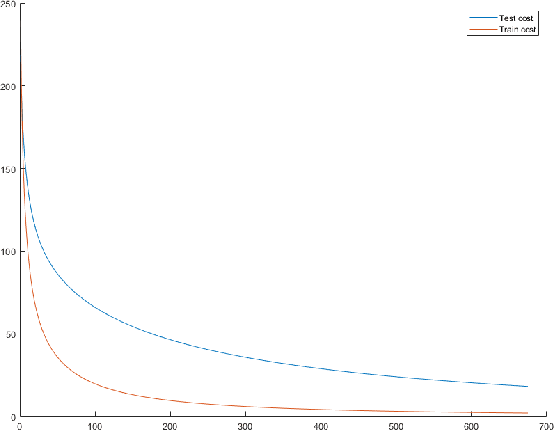
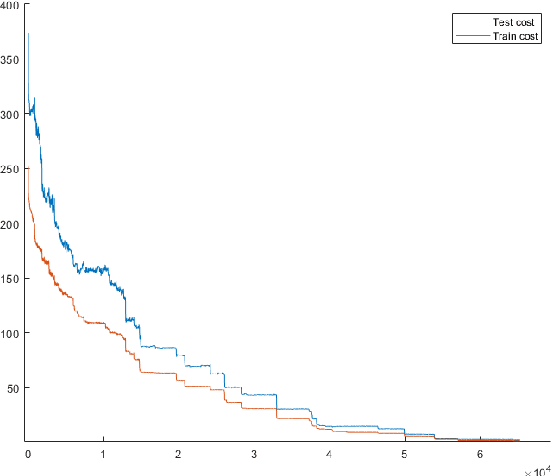
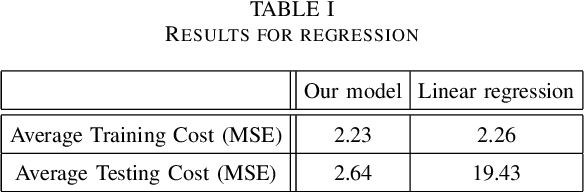
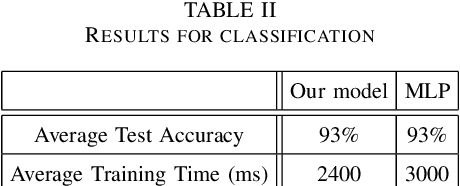
In this paper, we propose a machine learning model, which dynamically changes the features during training. Our main motivation is to update the model in a small content during the training process with replacing less descriptive features to new ones from a large pool. The main benefit is coming from the fact that opposite to the common practice we do not start training a new model from the scratch, but can keep the already learned weights. This procedure allows the scan of a large feature pool which together with keeping the complexity of the model leads to an increase of the model accuracy within the same training time. The efficiency of our approach is demonstrated in several classic machine learning scenarios including linear regression and neural network-based training. As a specific analysis towards signal processing, we have successfully tested our approach on the database MNIST for digit classification considering single pixel and pixel-pairs intensities as possible features.
Machine learning for total cloud cover prediction
Jan 16, 2020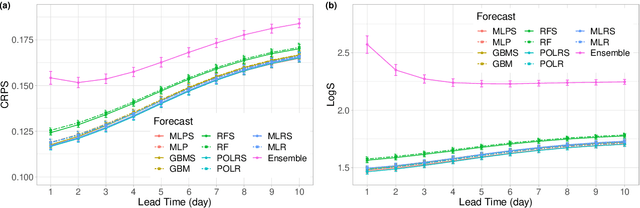
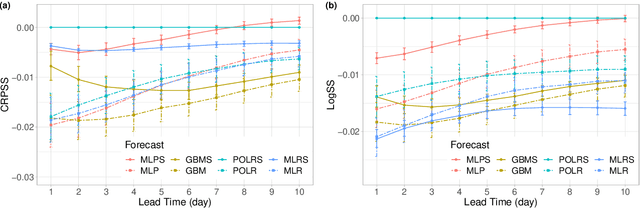
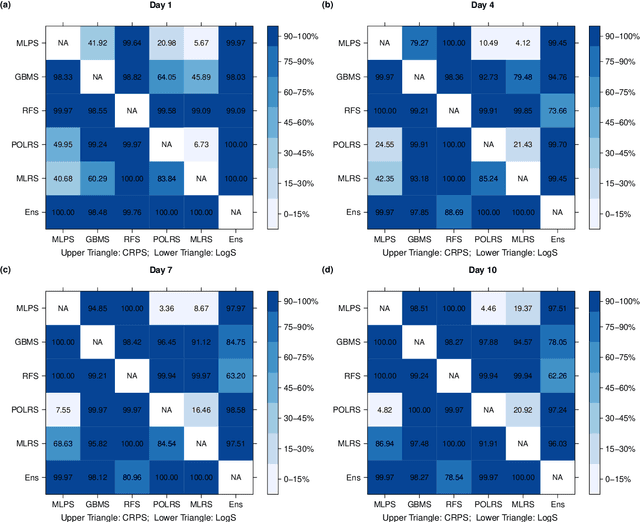
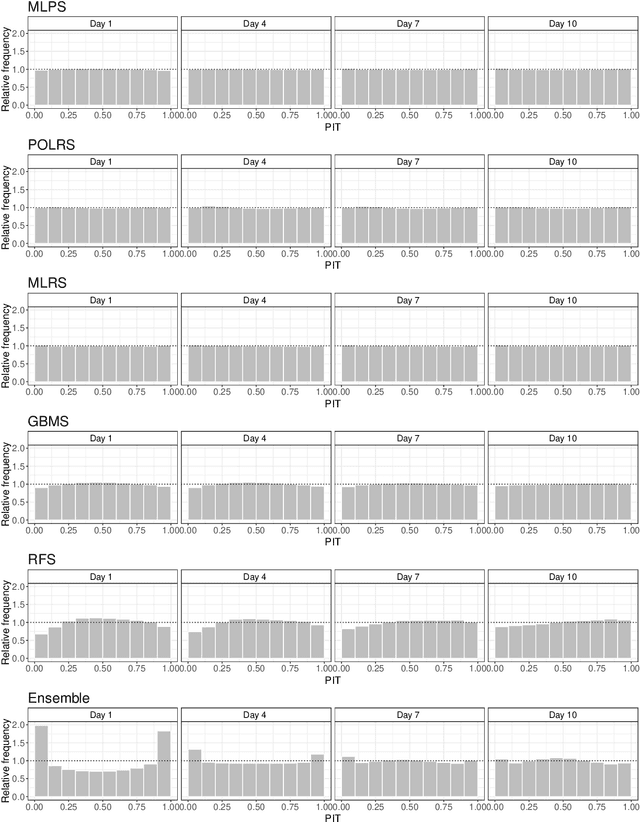
Accurate and reliable forecasting of total cloud cover (TCC) is vital for many areas such as astronomy, energy demand and production, or agriculture. Most meteorological centres issue ensemble forecasts of TCC, however, these forecasts are often uncalibrated and exhibit worse forecast skill than ensemble forecasts of other weather variables. Hence, some form of post-processing is strongly required to improve predictive performance. As TCC observations are usually reported on a discrete scale taking just nine different values called oktas, statistical calibration of TCC ensemble forecasts can be considered a classification problem with outputs given by the probabilities of the oktas. This is a classical area where machine learning methods are applied. We investigate the performance of post-processing using multilayer perceptron (MLP) neural networks, gradient boosting machines (GBM) and random forest (RF) methods. Based on the European Centre for Medium-Range Weather Forecasts global TCC ensemble forecasts for 2002-2014 we compare these approaches with the proportional odds logistic regression (POLR) and multiclass logistic regression (MLR) models, as well as the raw TCC ensemble forecasts. We further assess whether improvements in forecast skill can be obtained by incorporating ensemble forecasts of precipitation as additional predictor. Compared to the raw ensemble, all calibration methods result in a significant improvement in forecast skill. RF models provide the smallest increase in predictive performance, while MLP, POLR and GBM approaches perform best. The use of precipitation forecast data leads to further improvements in forecast skill and except for very short lead times the extended MLP model shows the best overall performance.