 Add to Chrome
 Add to Firefox
 Add to Edge
Gemma 4 Technical Report
Jul 02, 2026
We introduce Gemma 4, a new generation of open-weight, natively multimodal language models in the Gemma model family. Designed to advance compute efficiency and reasoning, the Gemma 4 model suite features dense and Mixture-of-Experts architectures, ranging from 2.3B to 31B parameters. Alongside improved vision and audio encoders for all model sizes, we propose a unified, encoder-free architecture for our 12B model, which ingests raw audio and image patches. Furthermore, we integrate a thinking mode, enabling Gemma models to generate reasoning traces prior to responding. We improve inference speed, memory, and compute efficiency, as well as long-context abilities through critical design choices. Gemma 4 establishes a leap in performance across STEM, multimodal, and long-context benchmarks, and rivals larger, frontier open models in human-rated tasks.

Inexact Unlearning Needs More Careful Evaluations to Avoid a False Sense of Privacy
Mar 02, 2024


The high cost of model training makes it increasingly desirable to develop techniques for unlearning. These techniques seek to remove the influence of a training example without having to retrain the model from scratch. Intuitively, once a model has unlearned, an adversary that interacts with the model should no longer be able to tell whether the unlearned example was included in the model's training set or not. In the privacy literature, this is known as membership inference. In this work, we discuss adaptations of Membership Inference Attacks (MIAs) to the setting of unlearning (leading to their ``U-MIA'' counterparts). We propose a categorization of existing U-MIAs into ``population U-MIAs'', where the same attacker is instantiated for all examples, and ``per-example U-MIAs'', where a dedicated attacker is instantiated for each example. We show that the latter category, wherein the attacker tailors its membership prediction to each example under attack, is significantly stronger. Indeed, our results show that the commonly used U-MIAs in the unlearning literature overestimate the privacy protection afforded by existing unlearning techniques on both vision and language models. Our investigation reveals a large variance in the vulnerability of different examples to per-example U-MIAs. In fact, several unlearning algorithms lead to a reduced vulnerability for some, but not all, examples that we wish to unlearn, at the expense of increasing it for other examples. Notably, we find that the privacy protection for the remaining training examples may worsen as a consequence of unlearning. We also discuss the fundamental difficulty of equally protecting all examples using existing unlearning schemes, due to the different rates at which examples are unlearned. We demonstrate that naive attempts at tailoring unlearning stopping criteria to different examples fail to alleviate these issues.
Layer-Stack Temperature Scaling
Nov 18, 2022
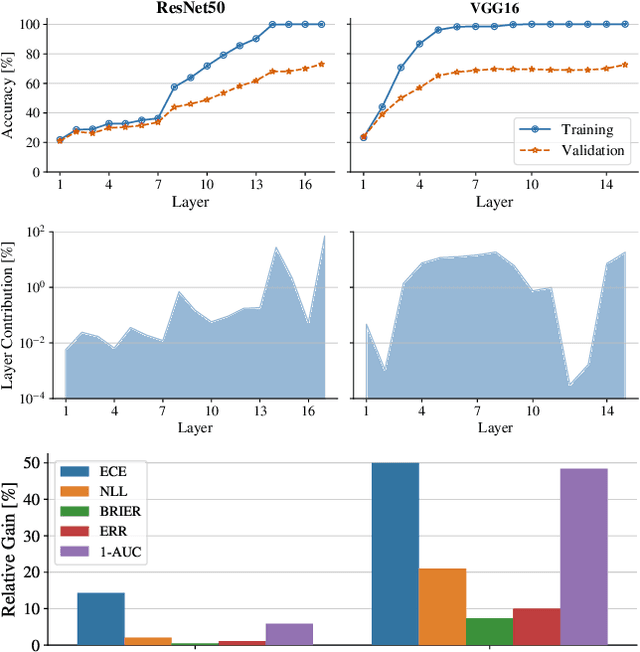

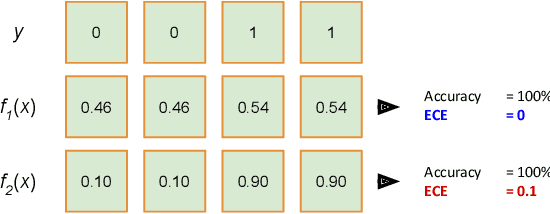
Recent works demonstrate that early layers in a neural network contain useful information for prediction. Inspired by this, we show that extending temperature scaling across all layers improves both calibration and accuracy. We call this procedure "layer-stack temperature scaling" (LATES). Informally, LATES grants each layer a weighted vote during inference. We evaluate it on five popular convolutional neural network architectures both in- and out-of-distribution and observe a consistent improvement over temperature scaling in terms of accuracy, calibration, and AUC. All conclusions are supported by comprehensive statistical analyses. Since LATES neither retrains the architecture nor introduces many more parameters, its advantages can be reaped without requiring additional data beyond what is used in temperature scaling. Finally, we show that combining LATES with Monte Carlo Dropout matches state-of-the-art results on CIFAR10/100.