 Add to Chrome
 Add to Firefox
 Add to Edge
Re-Evaluating Continual Learning with Few-Shot Adaptation
Jun 02, 2026
Continual learning methods aim to maximize the stability and plasticity of machine learning models that are trained on a sequence of tasks. The standard measure of stability (i.e., forgetting) is the 0-shot performance of a model on previously learned tasks, and plasticity, the performance on the most recently learned task. However, 0-shot evaluation does not fully measure a model or method's ability to retain learned information or adapt quickly to new information, as it requires perfect recall across multiple tasks. In this paper, we propose few-shot evaluation as a more comprehensive assessment of the stability and plasticity of a continual learning system. We conduct a fine-grained assessment on task sequences for continual image classification and find that this paradigm produces novel insights into the performance of popular continual learning strategies. Through few-shot evaluation with a novel metric -- per-shot plasticity -- we show that adding `foresight' to continual learning methods via the meta-learning of a short sequence of future tasks induces learning-to-learn behavior over the task sequence.

Level Up: Defining and Exploiting Transitional Problems for Curriculum Learning
Mar 14, 2026Curriculum learning--ordering training examples in a sequence to aid machine learning--takes inspiration from human learning, but has not gained widespread acceptance. Static strategies for scoring item difficulty rely on indirect proxy scores of varying quality and produce curricula that are not specific to the learner at hand. Dynamic approaches base difficulty estimates on gradient information, requiring considerable extra computation during training. We introduce a novel method for measuring the difficulty of individual problem instances directly relative to the ability of a given model, and identify transitional problems that are consistently easier as model ability increases. Applying this method to chess and mathematics, we find that training on a curriculum that "levels up" from easier to harder transitional problems most efficiently improves a model to the next tier of competence. These problems induce a natural progression from easier to harder items, which outperforms other training strategies. By measuring difficulty directly relative to model competence, our method yields interpretable problems, learner-specific curricula, and a principled basis for step-by-step improvement.
LogicLearner: A Tool for the Guided Practice of Propositional Logic Proofs
Mar 25, 2025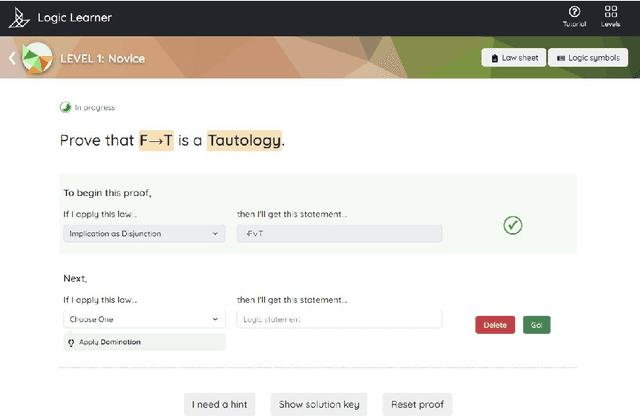

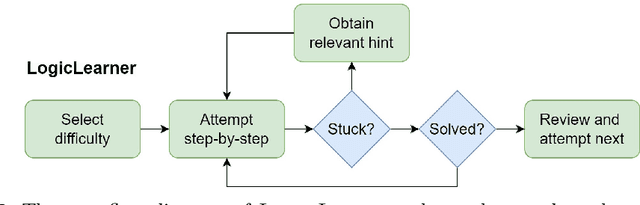
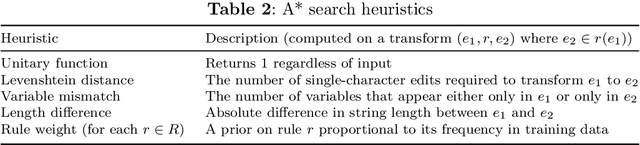
The study of propositional logic -- fundamental to the theory of computing -- is a cornerstone of the undergraduate computer science curriculum. Learning to solve logical proofs requires repeated guided practice, but undergraduate students often lack access to on-demand tutoring in a judgment-free environment. In this work, we highlight the need for guided practice tools in undergraduate mathematics education and outline the desiderata of an effective practice tool. We accordingly develop LogicLearner, a web application for guided logic proof practice. LogicLearner consists of an interface to attempt logic proofs step-by-step and an automated proof solver to generate solutions on the fly, allowing users to request guidance as needed. We pilot LogicLearner as a practice tool in two semesters of an undergraduate discrete mathematics course and receive strongly positive feedback for usability and pedagogical value in student surveys. To the best of our knowledge, LogicLearner is the only learning tool that provides an end-to-end practice environment for logic proofs with immediate, judgment-free feedback.